English translation is being prepared.

Matched fieldsTitle、Summary
Matched fieldsTitle、Summary
Matched fieldsTitle、Summary
Thinking Machines Lab has released its second-generation model Inkling 2 Small, which uses a 594B total parameter, 17B active parameter MoE architecture, supports image input and variable reasoning effort, and scores 31 on the Artificial Analysis Intelligence Index. The model is first offered on Tinker with closed weights, and is planned to be released with full weights under the Apache 2.0 license next week after external safety testing and red-team evaluation are completed. The company says it delivers comprehensive improvements over the previous generation in long-horizon agentic coding, vision, and knowledge work, and its training includes 8.4 trillion token pretraining and joint RL with 1075 steps and over 17 million rollouts.

Thinking Machines Lab has released its second-generation model Inkling 2 Small, which uses a 594B total parameter, 17B active parameter MoE architecture, supports image input and variable reasoning effort, and scores 31 on the Artificial Analysis Intelligence Index. The model is first offered on Tinker with closed weights, and is planned to be released with full weights under the Apache 2.0 license next week after external safety testing and red-team evaluation are completed. The company says it
Matched fieldsSummary、Body
In the ICML 2026 paper "Amortizing Maximum Inner Product Search with Learned Support Functions," the Apple research team proposes training a small neural network offline for a fixed key database, treating MIPS as a support function in convex analysis to learn it, thereby routing queries faster and more accurately at inference time. The methods include SupportNet (using an ICNN to learn the support function, which can be computed per cluster to improve routing) and KeyNet (directly outputting the best-matching key vector, constrained by a consistency loss based on the Euler homogeneous function theorem). Both are trained on samples from the relevant query distribution, trading a one-time amortized cost for more efficient RAG retrieval during inference.

In the ICML 2026 paper "Amortizing Maximum Inner Product Search with Learned Support Functions," the Apple research team proposes training a small neural network offline for a fixed key database, treating MIPS as a support function in convex analysis to learn it, thereby routing queries faster and more accurately at inference time. The methods include SupportNet (using an ICNN to learn the support function, which can be computed per cluster to improve routing) and KeyNet (directly outputting the
Matched fieldsSummary、Body
Nanbeige, the foundation model team under BOSS Zhipin, has released the open-weight reasoning model Nanbeige4.3-33B, which scores 20 on the Artificial Analysis Intelligence Index v5, on par with Qwen3.8 27B (xhigh). The model has 33B dense parameters, an Apache 2.0 license, text-only input and output, and a 524K token context window, and is small enough to run locally on a laptop. It scores 30% on Terminal-Bench 4.0 and 16% on CritPt v2 Hard Subset, both higher than Qwen3.8 27B's 6% and 4%; however, it scores 1162 Elo on AA-Briefcase v1.1, 11% on FrontierCode 2.0, and 7% on HLE-Diamond, lower than the latter's 1391, 15%, and 15%. Its hallucination rate is 18% and its refusal rate is 71%, and it consumes 158K output tokens per Intelligence Index task, about 44% more than Qwen3.8 27B's 110K. There is currently no confirmed public first-party or third-party API.
Nanbeige, the foundation model team under BOSS Zhipin, has released the open-weight reasoning model Nanbeige4.3-33B, which scores 20 on the Artificial Analysis Intelligence Index v5, on par with Qwen3.8 27B (xhigh). The model has 33B dense parameters, an Apache 2.0 license, text-only input and output, and a 524K token context window, and is small enough to run locally on a laptop. It scores 30% on Terminal-Bench 4.0 and 16% on CritPt v2 Hard Subset, both higher than Qwen3.8 27B's 6% and 4%; howe
Matched fieldsSummary、Body
Baidu has open-sourced ERNIE 5.5 Flash Base, a 280B-parameter MoE model with only 14B active parameters, pretrained on 33.5T tokens. The model performs strongly on reasoning, coding, and long-context benchmarks, supports up to 1M context, and post-training is already underway. Baidu's official account reposted the release and said there will be more to come.
Matched fieldsSummary
Hugging Face has released the on-device TTS model Phonon, offering two sizes of approximately 65 MB and 75 MB, covering English, French, German, Spanish, and Portuguese, with more than 100 built-in voices. Among them, Phonon 31m supports only English and is open-sourced under Apache 2.0, allowing use in commercial products; Phonon 40m covers five languages but uses a non-commercial license. The company states that it ranks first in German and Spanish intelligibility on the Open TTS Leaderboard and leads in the CPU streaming first-packet latency benchmark, and that the accompanying inference framework ptts supports more than 10 backends including CPU, GPU, and NPU.
Hugging Face has released the on-device TTS model Phonon, offering two sizes of approximately 65 MB and 75 MB, covering English, French, German, Spanish, and Portuguese, with more than 100 built-in voices. Among them, Phonon 31m supports only English and is open-sourced under Apache 2.0, allowing use in commercial products; Phonon 40m covers five languages but uses a non-commercial license. The company states that it ranks first in German and Spanish intelligibility on the Open TTS Leaderboard a
Matched fieldsSummary、Body
The call for proposals for PyTorch Day China 2026 will close on November 10 at 23:59 (China Standard Time), and the event will be held in Beijing on December 12. The call for proposals covers five tracks: model training and post-training, efficient inference and deployment, PyTorch core and hardware acceleration, Physical AI, and the PyTorch ecosystem and applications, and accepts session talks and lightning talks. CFP notifications are scheduled to be sent on November 17, and the schedule will be announced on November 18.

The call for proposals for PyTorch Day China 2026 will close on November 10 at 23:59 (China Standard Time), and the event will be held in Beijing on December 12. The call for proposals covers five tracks: model training and post-training, efficient inference and deployment, PyTorch core and hardware acceleration, Physical AI, and the PyTorch ecosystem and applications, and accepts session talks and lightning talks. CFP notifications are scheduled to be sent on November 17, and the schedule will
Matched fieldsSummary、Body
NVIDIA has released the AI Factory Operations Agent, which collaborates through multiple domain sub-agents to locate root causes across the compute, network, hardware, and scheduling layers, and provides recommendations through a chat interface for its own DGX SuperPOD operations. The framework is built on the NVIDIA NemoClaw blueprint and OpenShell, is fully locally deployed, uses the local open-source NVIDIA Nemotron model for inference, and runs on DGX H100, DGX B200, and DGX GB300 production clusters. The framework includes sub-agents such as Job Recovery, Hardware, Observability, Research, Kubernetes, and Cluster Management, and integrates MCP tools such as web search, code execution, and Grafana dashboards. Developer examples and open-source code are now available.
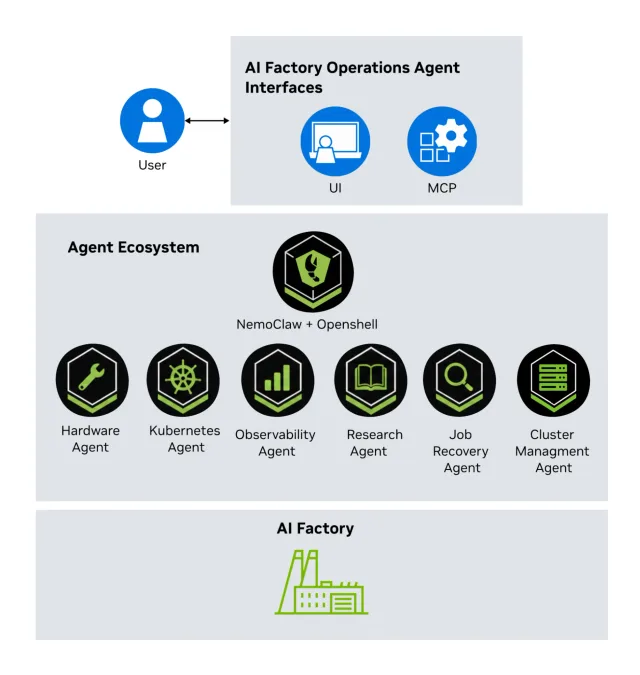
NVIDIA has released the AI Factory Operations Agent, which collaborates through multiple domain sub-agents to locate root causes across the compute, network, hardware, and scheduling layers, and provides recommendations through a chat interface for its own DGX SuperPOD operations. The framework is built on the NVIDIA NemoClaw blueprint and OpenShell, is fully locally deployed, uses the local open-source NVIDIA Nemotron model for inference, and runs on DGX H100, DGX B200, and DGX GB300 production
Matched fieldsSummary、Body
Cognition released the fast coding model SWE-2 Flash, claiming it surpasses all US open-weight models on major benchmarks, including models with 3 times the parameter count. The model is based on thinkymachines' Inkling-Small (276B total parameters, 12B active), paired with an optimized inference stack, and is 5 times cheaper and 3 times faster than SWE-2. Within this month, Pro, Max, and Teams users can use it for free in Devin Desktop and Devin CLI, and the weights will be opened through a secure sharing program with partners and researchers.
Cognition released the fast coding model SWE-2 Flash, claiming it surpasses all US open-weight models on major benchmarks, including models with 3 times the parameter count. The model is based on thinkymachines' Inkling-Small (276B total parameters, 12B active), paired with an optimized inference stack, and is 5 times cheaper and 3 times faster than SWE-2. Within this month, Pro, Max, and Teams users can use it for free in Devin Desktop and Devin CLI, and the weights will be opened through a sec
Matched fieldsSummary
Cognition has released SWE-2 Flash, a fast and efficient coding model, free this month for Pro, Max, and Teams users of Devin Desktop and Devin CLI. The model is based on thinkymachines' Inkling-Small, with 276B total parameters and 12B activated parameters; combined with an optimized inference stack, it costs 5 times less and runs 3 times faster than SWE-2. Cognition says it outperforms all US open-weight models on major benchmarks, and is building a partnership program for securely sharing weights.
Cognition has released SWE-2 Flash, a fast and efficient coding model, free this month for Pro, Max, and Teams users of Devin Desktop and Devin CLI. The model is based on thinkymachines' Inkling-Small, with 276B total parameters and 12B activated parameters; combined with an optimized inference stack, it costs 5 times less and runs 3 times faster than SWE-2. Cognition says it outperforms all US open-weight models on major benchmarks, and is building a partnership program for securely sharing wei
Matched fieldsSummary
The author tested using Grok Bot with Vercel's open-source agent-desktop, which simulates real mouse and keyboard events through CGEvent injection, and can control other local Agents and CapCut to complete AI editing. He compared it with amontlabs' LCU solution: LCU uses the macOS accessibility API and can identify buttons and input fields, but the timeline drag areas of Electron self-drawn UIs like CapCut are almost invisible to the accessibility API; agent-desktop can complete the task with an 800ms slow drag. agent-desktop itself is just a CLI tool and does no reasoning, so when written as a script for replay it consumes zero credits; for the same editing task, the first run took 13 minutes and the second took 37 seconds, while LCU averaged 4 to 5 minutes; the drawback is that it requires occupying a window, and the author recommends pairing it with a Mac mini.
The author tested using Grok Bot with Vercel's open-source agent-desktop, which simulates real mouse and keyboard events through CGEvent injection, and can control other local Agents and CapCut to complete AI editing. He compared it with amontlabs' LCU solution: LCU uses the macOS accessibility API and can identify buttons and input fields, but the timeline drag areas of Electron self-drawn UIs like CapCut are almost invisible to the accessibility API; agent-desktop can complete the task with an
Matched fieldsSummary、Body
Hao AI Lab integrated Pika's open-source MiniMax H3 Flex into FastVideo. On a single GB200, generating a 5-second clip with audio takes 59.7 seconds with the official code, 26.6 seconds with FastVideo BF16, 16.8 seconds with NVFP4 QAD, and 15.2 seconds with FP4 attention. The official code only supports a single GPU, while FastVideo adds multi-GPU support, generating a 15-second clip 7 times faster on 4 GPUs. NVFP4 QAD, by distilling into BF16 Flex, comes 14-17% closer to BF16 than ordinary quantization; FP4 attention reduces a 768p 15-second clip from 101.8 seconds to 85.3 seconds. The project also supports running on DGX Spark, taking 59.5 seconds for a 5-second 480p first-and-last-frame clip, and supports the 2K model of Open-H3-Regenerate-2K, with open weights, inference code, and a complete training recipe.
Hao AI Lab integrated Pika's open-source MiniMax H3 Flex into FastVideo. On a single GB200, generating a 5-second clip with audio takes 59.7 seconds with the official code, 26.6 seconds with FastVideo BF16, 16.8 seconds with NVFP4 QAD, and 15.2 seconds with FP4 attention. The official code only supports a single GPU, while FastVideo adds multi-GPU support, generating a 15-second clip 7 times faster on 4 GPUs. NVFP4 QAD, by distilling into BF16 Flex, comes 14-17% closer to BF16 than ordinary quan
Matched fieldsSummary
Hao AI Lab has integrated Pika Labs' open-source MiniMax H3 Flex into FastVideo. The official open-source inference code takes 59.7 seconds to generate a 5-second 480p video with audio on a single GB200, while FastVideo BF16 takes 26.6 seconds, NVFP4 QAD takes 16.8 seconds, and FP4 attention takes 15.2 seconds. The team claims it is up to 7 times faster than the official code, and has added multi-GPU support, generating a 15-second clip 7 times faster on 4 GPUs. NVFP4 QAD distills the BF16 Flex model, coming 14-17% closer to BF16 than ordinary quantization; FP4 attention reduces a 768p 15-second clip from 101.8 seconds to 85.3 seconds. This clip takes 59.5 seconds on a single DGX Spark. FastVideo also supports the 2K model of Open-H3-Regenerate-2K, and the weights, inference code, and complete training recipe have all been released.
Hao AI Lab has integrated Pika Labs' open-source MiniMax H3 Flex into FastVideo. The official open-source inference code takes 59.7 seconds to generate a 5-second 480p video with audio on a single GB200, while FastVideo BF16 takes 26.6 seconds, NVFP4 QAD takes 16.8 seconds, and FP4 attention takes 15.2 seconds. The team claims it is up to 7 times faster than the official code, and has added multi-GPU support, generating a 15-second clip 7 times faster on 4 GPUs. NVFP4 QAD distills the BF16 Flex
Matched fieldsSummary
Hao AI Lab announced that FastVideo now supports the Open-H3-Regenerate-2K model from HaoZhe65347 and NVIDIA AI, and provided a link to the 2K model. The series previously covered FastVideo's inference optimization of MiniMax H3 Flex, open-sourced by Pika Labs: on a single GB200, generating a 5-second 480p video with audio takes 5.8 seconds, up to 7 times faster than the official open-source inference code, with newly added multi-GPU support.
Matched fieldsSummary
Hao AI Lab announced that Pika Labs' open-source MiniMax H3 Flex has been integrated into FastVideo. The team claims its inference speed is up to 7 times faster than the official open-source inference code, generating a 5-second 480p video with audio in 5.8 seconds on a single NVIDIA GB200. Under the same prompt and random seed, the official code takes 59.7 seconds for a 5-second clip with audio, while FastVideo BF16 takes 26.6 seconds, NVFP4 QAD takes 16.8 seconds, and FP4 attention takes 15.2 seconds; the official code only supports a single GPU, whereas FastVideo adds multi-GPU support, making a 15-second clip 7 times faster on 4 GPUs. NVFP4 QAD uses BF16 Flex as its distillation target, coming 14-17% closer to BF16 than ordinary quantization; FP4 attention reduces a 768p 15-second clip from 101.8 seconds to 85.3 seconds. A 5-second 480p first-and-last-frame clip takes 59.5 seconds on a single DGX Spark, and it supports the Open-H3-Regenerate-2K model from Hao AI Lab and NVIDIA. The weights, inference code, and complete training recipe have all been released.
Hao AI Lab announced that Pika Labs' open-source MiniMax H3 Flex has been integrated into FastVideo. The team claims its inference speed is up to 7 times faster than the official open-source inference code, generating a 5-second 480p video with audio in 5.8 seconds on a single NVIDIA GB200. Under the same prompt and random seed, the official code takes 59.7 seconds for a 5-second clip with audio, while FastVideo BF16 takes 26.6 seconds, NVFP4 QAD takes 16.8 seconds, and FP4 attention takes 15.2
Matched fieldsSummary、Body
Cohere has launched third-party open models in Model Vault and Model Vault Encrypted, allowing enterprises to run both Cohere's own models and open models such as DeepSeek V4.1 Flash, GLM 5.3 Flash, Gemma 4, GPT-OSS, and Phi on a fully managed encrypted inference platform. Model Vault applies zero data retention to prompts and outputs by default, while the Encrypted version uses confidential computing so that neither Cohere nor cloud providers can see the data. Model Vault is now available in the United States, the European Union, and Canada; the Encrypted version is currently limited to the United States, with support for the European Union and Canada coming soon.

Cohere has launched third-party open models in Model Vault and Model Vault Encrypted, allowing enterprises to run both Cohere's own models and open models such as DeepSeek V4.1 Flash, GLM 5.3 Flash, Gemma 4, GPT-OSS, and Phi on a fully managed encrypted inference platform. Model Vault applies zero data retention to prompts and outputs by default, while the Encrypted version uses confidential computing so that neither Cohere nor cloud providers can see the data. Model Vault is now available in th
Matched fieldsSummary、Body
AWS partner Cartesia provides voice models on AWS based on State Space Models (SSMs) with first-byte latency under 100ms: Sonic text-to-speech produces its first audio in about 90ms, supports more than 44 languages and voice cloning from 10-second audio samples, and Ink speech-to-text supports native turn detection and streaming transcription. SSMs achieve native streaming inference through fixed-size hidden states and token-by-token processing, avoiding the latency that comes from Transformers processing an entire sequence.

AWS partner Cartesia provides voice models on AWS based on State Space Models (SSMs) with first-byte latency under 100ms: Sonic text-to-speech produces its first audio in about 90ms, supports more than 44 languages and voice cloning from 10-second audio samples, and Ink speech-to-text supports native turn detection and streaming transcription. SSMs achieve native streaming inference through fixed-size hidden states and token-by-token processing, avoiding the latency that comes from Transformers
Matched fieldsSummary、Body
Google DeepMind has released a set of Cheminformatics Skills for Google Antigravity. Built on RDKit and connected to ChEMBL and PubChem, the language model handles task orchestration and scientific reasoning, while deterministic chemistry tools perform molecular computations. Using lung cancer drugs as an example, the agent searched thousands of compounds in about one hour, completed matched molecular pair analysis, trained a potency prediction model, and also proposed novel rigidified macrocyclic molecular designs with synthetic routes. The team also noted that sparse data, inter-laboratory assay noise, and narrow dynamic ranges limit prediction accuracy; computational designs are only verifiable hypotheses and still require experimental synthesis for validation. The skills are now live on Antigravity and can be used by installing the Science plugin, and free access to the highest usage tier for six months is being offered to 10,000 scientists.

Google DeepMind has released a set of Cheminformatics Skills for Google Antigravity. Built on RDKit and connected to ChEMBL and PubChem, the language model handles task orchestration and scientific reasoning, while deterministic chemistry tools perform molecular computations. Using lung cancer drugs as an example, the agent searched thousands of compounds in about one hour, completed matched molecular pair analysis, trained a potency prediction model, and also proposed novel rigidified macrocycl
Matched fieldsSummary、Body
PyTorchKR and XCENA jointly hosted KVCache Meetup Korea on September 30, 2026, where speakers from XCENA, SK hynix, FuriosaAI, and LMCache shared their work on LLM inference and KV Cache optimization. SK hynix, using 2 H100 GPUs, Llama 3.1 8B, and vLLM in real tests, found that the prefill phase has high GPU compute utilization while the decode phase has high HBM bandwidth utilization; FuriosaAI reported that with a 12,370-token prompt, retrieving from host cache to generate the first token took about 92 ms, compared with about 900 ms for recomputation.

PyTorchKR and XCENA jointly hosted KVCache Meetup Korea on September 30, 2026, where speakers from XCENA, SK hynix, FuriosaAI, and LMCache shared their work on LLM inference and KV Cache optimization. SK hynix, using 2 H100 GPUs, Llama 3.1 8B, and vLLM in real tests, found that the prefill phase has high GPU compute utilization while the decode phase has high HBM bandwidth utilization; FuriosaAI reported that with a 12,370-token prompt, retrieving from host cache to generate the first token took
Matched fieldsSummary、Body