English translation is being prepared.
Matched fieldsTitle、Summary、Body
Matched fieldsTitle、Summary、Body
Matched fieldsTitle、Summary、Body
Matched fieldsTitle、Summary、Body

Matched fieldsTitle、Summary、Body
Matched fieldsTitle、Summary、Body
Matched fieldsTitle、Summary、Body
Matched fieldsTitle、Summary、Body
Matched fieldsTitle、Summary、Body

Matched fieldsTitle、Summary、Body
Matched fieldsTitle、Summary、Body

Matched fieldsTitle、Summary、Body
Matched fieldsTitle、Body
Matched fieldsTitle、Summary、Body
Matched fieldsTitle、Summary、Body
Anthropic has launched the message threads beta on its Messages API. The API caches conversations server-side, so subsequent requests only need to send the new message and the previous message ID, allowing Claude to start responding faster. The company says the feature is already integrated in Claude Code, with median time to first token for 500K to 1M token requests reduced by about 35%, and median request size for long conversations dropping from about 800 KB to 1.8 KB. To use it, add the thread parameter and beta header to requests. The feature is available on Claude Platform, Claude Platform on AWS, Claude in Microsoft Foundry, and Claude on Google Cloud, and is billed at standard token prices.
laude to start responding faster. The company says the feature is already integrated in Claude Code, with median time to first token for 500K to 1M token requests reduced by about 35%, and median request size for long conversations dropping from about 800 KB to 1.8 KB. To use it, add the thread parameter and beta header to requests. The feature is available on Claude Platform, Claude Platform on AWS, Claude in Microsoft Foundry, and Claude on Google Cloud, and is billed at standard token prices.
Matched fieldsSummary
After Claude Code integrated message threads, on requests of 500K to 1M tokens, the median first-token latency dropped by about 35%; in long conversations, the median size of a single request fell from about 800 KB to 1.8 KB. Message threads have entered public beta in the Messages API. The server caches the conversation between turns, so callers only need to send the new message and the ID of the previous message, and must add the thread parameter and beta header. It is available on Claude Platform, Claude Platform on AWS, Claude in Microsoft Foundry, and Claude on Google Cloud, and is billed at standard token prices.
t 35%; in long conversations, the median size of a single request fell from about 800 KB to 1.8 KB. Message threads have entered public beta in the Messages API. The server caches the conversation between turns, so callers only need to send the new message and the ID of the previous message, and must add the thread parameter and beta header. It is available on Claude Platform, Claude Platform on AWS, Claude in Microsoft Foundry, and Claude on Google Cloud, and is billed at standard token prices.
Matched fieldsSummary
Anthropic has opened the public beta of message threads on the Messages API. The API caches conversations on the server side, so developers only need to send the new message and the previous message ID, without resending the full conversation. The feature has been integrated into Claude Code; on requests of 500K to 1M tokens, median time to first token dropped by about 35%, and in long conversations the median request size fell from about 800 KB to 1.8 KB. To use it, add the thread parameter and beta header to requests. The feature is available on Claude Platform, Claude Platform on AWS, Claude in Microsoft Foundry, and Claude on Google Cloud, and is billed at standard token prices.
message ID, without resending the full conversation. The feature has been integrated into Claude Code; on requests of 500K to 1M tokens, median time to first token dropped by about 35%, and in long conversations the median request size fell from about 800 KB to 1.8 KB. To use it, add the thread parameter and beta header to requests. The feature is available on Claude Platform, Claude Platform on AWS, Claude in Microsoft Foundry, and Claude on Google Cloud, and is billed at standard token prices.
Matched fieldsSummary、Body
Circle K built an agentic automated triage system with Amazon Bedrock, reducing average DevOps incident triage time to under 15 minutes—a 67–75% reduction according to internal team metrics. In the system, Grafana alerts trigger AWS Lambda via Amazon SNS and Amazon SQS to invoke Amazon Bedrock Flows, which orchestrates multiple specialized agents in parallel to query logs and infrastructure, and pushes structured summaries to Slack; it has since migrated to Amazon Bedrock AgentCore.

Matched fieldsSummary、Body
AWS demonstrated a multi-agent engineering assistant based on Amazon Bedrock AgentCore, Amazon Nova Multimodal Embeddings, and the open-source Strands Agents SDK, designed to reduce manual cross-checking in parts substitution evaluations. In the system, a planner routes tasks to three expert agents—Catalog, Evaluation, and Knowledge—which are respectively responsible for multimodal retrieval, scoring according to Python tolerance rules, and verifying lifecycle information using real-time web data, with a supervisor ultimately aggregating the results. The system only assembles evidence and drafts review documents; it does not itself recommend or approve substitutions, and every evaluation writes an audit record aligned with AS9100 8.4 and 8.5.6.
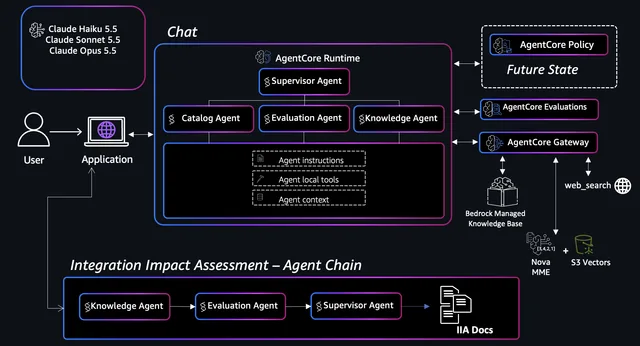
AWS demonstrated a multi-agent engineering assistant based on Amazon Bedrock AgentCore, Amazon Nova Multimodal Embeddings, and the open-source Strands Agents SDK, designed to reduce manual cross-checking in parts substitution evaluations. In the system, a planner routes tasks to three expert agents—Catalog, Evaluation, and Knowledge—which are respectively responsible for multimodal retrieval, scoring according to Python tolerance rules, and verifying lifecycle information using real-time web dat
Matched fieldsSummary、Body
An AWS official blog post explains how to fine-tune a shopping agent on Amazon SageMaker AI using sequence-level knowledge distillation (SeqKD): using GLM-5.3 on Amazon Bedrock as the teacher model to generate trajectories, using the ShoppingBench scorer to retain only trajectories that solve the task, and then performing serverless SFT on the Qwen3.5-4B student model. On 324 held-out test questions, the distilled 4B student's average absolute success rate increased from 0.297 to 0.541, essentially on par with the teacher model and mid-sized frontier models; when the teacher's reasoning process was removed and only tool calls were learned, the average success rate dropped to 0.415.

An AWS official blog post explains how to fine-tune a shopping agent on Amazon SageMaker AI using sequence-level knowledge distillation (SeqKD): using GLM-5.3 on Amazon Bedrock as the teacher model to generate trajectories, using the ShoppingBench scorer to retain only trajectories that solve the task, and then performing serverless SFT on the Qwen3.5-4B student model. On 324 held-out test questions, the distilled 4B student's average absolute success rate increased from 0.297 to 0.541, essentia
Matched fieldsSummary、Body