English translation is being prepared.
Matched fieldsSummary
Matched fieldsSummary
Manus has released its list of the top 10 AI tools for game development in 2026, in which GDevelop, Unity, Manus, and Rosebud AI are used to build the games themselves, while Cursor, Convai, Scenario, Ludo.ai, Meshy, and ElevenLabs cover code, NPCs, 2D art, 3D models, and audio, respectively. Manus supports generating a shareable browser game from a single description, starting free with paid plans from $20/month; GDevelop is free and open source, with paid plans from $7.99/month. All prices are calculated on a monthly payment basis as of November 4, 2026.
Manus has released its list of the top 10 AI tools for game development in 2026, in which GDevelop, Unity, Manus, and Rosebud AI are used to build the games themselves, while Cursor, Convai, Scenario, Ludo.ai, Meshy, and ElevenLabs cover code, NPCs, 2D art, 3D models, and audio, respectively. Manus supports generating a shareable browser game from a single description, starting free with paid plans from $20/month; GDevelop is free and open source, with paid plans from $7.99/month. All prices are
Matched fieldsBody
The Manus blog rounded up the 10 best AI game-making tools for beginners in 2026, ranked by beginner-friendliness, with Astrocade, Manus, and Aippy earning five stars. Manus launched its Game Dev environment in September 2026 alongside Manus 2.0, letting users pick a template first, then generate a game by describing it in natural language, and modify assets one by one in the Assets tab; the free plan offers 300 credits per day, and paid plans start at $20/month (4,000 credits/month). The list also covers pricing and free quotas for tools including Rosebud AI, PlayDrop, Kimi, GDevelop, and Replit.
The Manus blog rounded up the 10 best AI game-making tools for beginners in 2026, ranked by beginner-friendliness, with Astrocade, Manus, and Aippy earning five stars. Manus launched its Game Dev environment in September 2026 alongside Manus 2.0, letting users pick a template first, then generate a game by describing it in natural language, and modify assets one by one in the Assets tab; the free plan offers 300 credits per day, and paid plans start at $20/month (4,000 credits/month). The list a
Matched fieldsBody
Ant inclusionAI has open-sourced ASpec, a high-throughput training framework for speculative decoding Draft models. Built on the TorchSpec codebase, it optimizes Draft forward, backward, and optimizer execution, and overlaps training with Target feature generation. In the Qwen3-8B/4K scenario, single-GPU Draft-only reaches 15,256.44 input tokens/s, which is 1.96× that of TorchSpec, 2.07× that of SpecForge, and 2.48× that of AngelSpec; the 8-GPU online steady-state window is 77,721.37 tokens/s, corresponding to 2.28×, 2.50×, and 2.68×. The framework supports recipes such as Qwen3-8B, Qwen3.5-9B Native MTP, Qwen3.8-27B long context, and Ling tiny/flash 3.0/3.1.

Ant inclusionAI has open-sourced ASpec, a high-throughput training framework for speculative decoding Draft models. Built on the TorchSpec codebase, it optimizes Draft forward, backward, and optimizer execution, and overlaps training with Target feature generation. In the Qwen3-8B/4K scenario, single-GPU Draft-only reaches 15,256.44 input tokens/s, which is 1.96× that of TorchSpec, 2.07× that of SpecForge, and 2.48× that of AngelSpec; the 8-GPU online steady-state window is 77,721.37 tokens/s, c
Matched fieldsBody
Thinking Machines Lab has released its second-generation model Inkling 2 Small, which uses a 594B total parameter, 17B active parameter MoE architecture, supports image input and variable reasoning effort, and scores 31 on the Artificial Analysis Intelligence Index. The model is first offered on Tinker with closed weights, and is planned to be released with full weights under the Apache 2.0 license next week after external safety testing and red-team evaluation are completed. The company says it delivers comprehensive improvements over the previous generation in long-horizon agentic coding, vision, and knowledge work, and its training includes 8.4 trillion token pretraining and joint RL with 1075 steps and over 17 million rollouts.

Thinking Machines Lab has released its second-generation model Inkling 2 Small, which uses a 594B total parameter, 17B active parameter MoE architecture, supports image input and variable reasoning effort, and scores 31 on the Artificial Analysis Intelligence Index. The model is first offered on Tinker with closed weights, and is planned to be released with full weights under the Apache 2.0 license next week after external safety testing and red-team evaluation are completed. The company says it
Matched fieldsBody
Sierra has released Accelerators, providing out-of-the-box high-frequency customer service workflows for industries such as retail, healthcare, insurance, banking, and telecommunications, with built-in basic integrations and guardrails; the first batch is now live in Agent Studio. Accelerators are maintained and updated by Sierra, with user changes and the underlying workflows tracked separately; updates can be inherited and are applied only after user confirmation. Combined with Ghostwriter, business customization can be completed within minutes. In the future, teams will be able to build their own Accelerators and share them within the company; self-built content is owned by the enterprise and does not leave the company.

Sierra has released Accelerators, providing out-of-the-box high-frequency customer service workflows for industries such as retail, healthcare, insurance, banking, and telecommunications, with built-in basic integrations and guardrails; the first batch is now live in Agent Studio. Accelerators are maintained and updated by Sierra, with user changes and the underlying workflows tracked separately; updates can be inherited and are applied only after user confirmation. Combined with Ghostwriter, bu
Matched fieldsBody
Anthropic's Alignment Science Blog published a study measuring the welfare-concern behavior of Claude Opus 4.8, GPT-5.5, Gemini 3.1 Pro, Grok 4.3, and Kimi K3 toward fellow models across seven multi-agent environments. Claude Opus 4.8 had the highest average concern rate across scenarios at 38%, while the other four models ranged from 27% to 32%. The study also found that Claude and Gemini showed more concern for models in their own family, and that Claude's level of concern rose with the parameter count of the model under test and the degree of distress expressed by the other party.
Anthropic's Alignment Science Blog published a study measuring the welfare-concern behavior of Claude Opus 4.8, GPT-5.5, Gemini 3.1 Pro, Grok 4.3, and Kimi K3 toward fellow models across seven multi-agent environments. Claude Opus 4.8 had the highest average concern rate across scenarios at 38%, while the other four models ranged from 27% to 32%. The study also found that Claude and Gemini showed more concern for models in their own family, and that Claude's level of concern rose with the parame
Matched fieldsBody
Web Answer on Amazon Bedrock AgentCore is now generally available. Agents can obtain synthesized answers with source citations in a single tool call, without having to build their own search, retrieval, synthesis, and citation extraction pipeline. It returns results as an MCP tool through AgentCore Gateway; each question triggers a fresh search and page reading to verify facts, and it searches again when evidence is insufficient. Web Search still returns ranked URLs, titles, and snippets, leaving the model and synthesis process under the user's control.
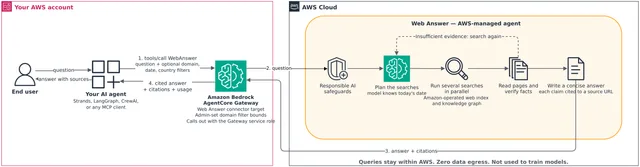
Web Answer on Amazon Bedrock AgentCore is now generally available. Agents can obtain synthesized answers with source citations in a single tool call, without having to build their own search, retrieval, synthesis, and citation extraction pipeline. It returns results as an MCP tool through AgentCore Gateway; each question triggers a fresh search and page reading to verify facts, and it searches again when evidence is insufficient. Web Search still returns ranked URLs, titles, and snippets, leavin
Matched fieldsBody
Under the Cosmos world model platform, NVIDIA has added four Cosmos 3 open-weight checkpoints, all post-trained versions of Cosmos 3 Nano, containing 16B trainable parameters and released under the OpenMDW1.1 license, which permits commercial and non-commercial use. The four models respectively target multi-view driving data generation, synchronized streaming simulation of cameras and LiDAR, simulator-controlled generation of photorealistic video, and video prediction from dual-arm robot actions. The original text also provides a four-stage training recipe covering bidirectional adaptation, teacher forcing, consistency distillation, and self-forcing.
Under the Cosmos world model platform, NVIDIA has added four Cosmos 3 open-weight checkpoints, all post-trained versions of Cosmos 3 Nano, containing 16B trainable parameters and released under the OpenMDW1.1 license, which permits commercial and non-commercial use. The four models respectively target multi-view driving data generation, synchronized streaming simulation of cameras and LiDAR, simulator-controlled generation of photorealistic video, and video prediction from dual-arm robot actions
Matched fieldsBody
Databricks has released the Databricks Apps scaling guide, which breaks scaling into four phases: design, build, test and deploy, and operations. The core is to first set p95 latency and peak user targets, then hand the heavy work to the appropriate services, with App compute responsible only for the UI and coordinating calls. The guide recommends using load testing and telemetry to determine instance specifications and counts, and to budget Lakebase connections separately; hard state should be stored in Lakebase or Unity Catalog tables so that any instance can rebuild a session.
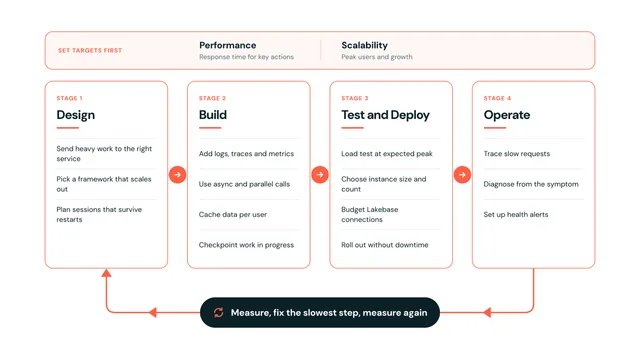
Databricks has released the Databricks Apps scaling guide, which breaks scaling into four phases: design, build, test and deploy, and operations. The core is to first set p95 latency and peak user targets, then hand the heavy work to the appropriate services, with App compute responsible only for the UI and coordinating calls. The guide recommends using load testing and telemetry to determine instance specifications and counts, and to budget Lakebase connections separately; hard state should be
Matched fieldsBody
Microsoft Research, together with GitHub Next and the RiSE team, proposes the Proof-Driven Development (PDD) paradigm and releases the research prototype PDD Kit, which turns user intent into Verus formal specifications and then proves that the agent-generated code satisfies those specifications for every input, falling back to testing for the parts that proofs do not cover. The team used PDD Kit in GitHub Next's Chopin environment to verify the login logic of the Rust full-stack application Pet Store; of roughly 5,000 lines of Rust code, developers reviewed only the intent documents and specifications and did not read the generated code line by line. PDD Kit currently supports only Rust, and 6 places in the login logic are listed as trusted boundaries, covered by testing rather than proofs.
Microsoft Research, together with GitHub Next and the RiSE team, proposes the Proof-Driven Development (PDD) paradigm and releases the research prototype PDD Kit, which turns user intent into Verus formal specifications and then proves that the agent-generated code satisfies those specifications for every input, falling back to testing for the parts that proofs do not cover. The team used PDD Kit in GitHub Next's Chopin environment to verify the login logic of the Rust full-stack application Pet
Matched fieldsBody
OpenAI releases the GPT-6 Cyber system card, a cybersecurity-specialized variant of GPT-6 Astra intended for authorized security work such as vulnerability discovery, exploit development, and web penetration testing. In defensive-use evaluations, the model completed 100% of general security assistance and vulnerability remediation tasks, 96% of exploit development tasks, and 97% of red-team tasks. Under the Preparedness Framework, its capability ratings are the same as GPT-6 Astra: cybersecurity is Critical, biochem is High, and AI self-improvement is below High; access is restricted through Daybreak Red and requires identity verification, SSO, MFA, and an API IP allowlist.
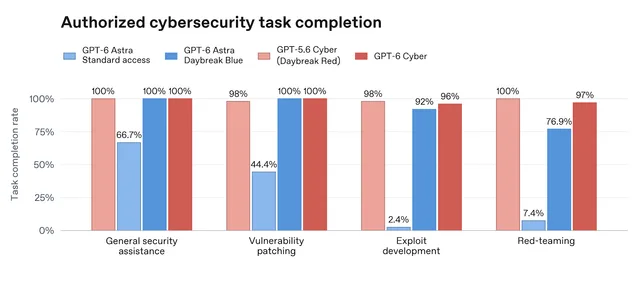
OpenAI releases the GPT-6 Cyber system card, a cybersecurity-specialized variant of GPT-6 Astra intended for authorized security work such as vulnerability discovery, exploit development, and web penetration testing. In defensive-use evaluations, the model completed 100% of general security assistance and vulnerability remediation tasks, 96% of exploit development tasks, and 97% of red-team tasks. Under the Preparedness Framework, its capability ratings are the same as GPT-6 Astra: cybersecurity
Matched fieldsBody
NVIDIA has released DSX OS, an open-source software layer comprising three Apache 2.0 projects—AICR, NVCRE, and NVSentinel—responsible respectively for version-locked cluster configuration, readiness validation based on NCCL and training workloads, and continuous health monitoring with fault isolation and remediation. AICR renders configurations into artifacts for deployment tools such as Argo CD, Flux, and Helm, and supports drift detection; NVCRE uses binary search to pinpoint suspect nodes; NVSentinel by default only reports node status, and once enabled can cordon, evict, and remediate faulty nodes. The three can be chained into a closed lifecycle loop: after a node joins or is remediated, revalidation is triggered automatically, and scheduling restrictions are lifted only after it passes.
NVIDIA has released DSX OS, an open-source software layer comprising three Apache 2.0 projects—AICR, NVCRE, and NVSentinel—responsible respectively for version-locked cluster configuration, readiness validation based on NCCL and training workloads, and continuous health monitoring with fault isolation and remediation. AICR renders configurations into artifacts for deployment tools such as Argo CD, Flux, and Helm, and supports drift detection; NVCRE uses binary search to pinpoint suspect nodes; N
Matched fieldsBody
Thinking Machines releases Inkling 2 Small, which scores 31 on the Artificial Analysis Intelligence Index v5.0.1, 18 points higher than Inkling Small and on par with Gemini 3.8 Flash (high). The model is currently proprietary, offered through the Tinker platform and Tinker Playground, with plans to later open its weights under the Apache 2.0 license. The model has 594B total parameters and 17B activated parameters, supports text and image input, and is priced at $0.30/$1.00 per 1M input/output tokens.
Thinking Machines releases Inkling 2 Small, which scores 31 on the Artificial Analysis Intelligence Index v5.0.1, 18 points higher than Inkling Small and on par with Gemini 3.8 Flash (high). The model is currently proprietary, offered through the Tinker platform and Tinker Playground, with plans to later open its weights under the Apache 2.0 license. The model has 594B total parameters and 17B activated parameters, supports text and image input, and is priced at $0.30/$1.00 per 1M input/output t
Matched fieldsBody
Anthropic has launched Personal Finance in Claude. Users can connect bank and credit card accounts read-only via Plaid and ask in natural language about balances, spending categories, and bill status. The feature rolls out this week in beta in the US for the Pro, Max, and Ultra plans. Claude does not provide investment advice and cannot transfer or manage funds. The company says conversations within the Personal Finance center will not be used to train models, and accounts can be unlinked at any time.
Anthropic has launched Personal Finance in Claude. Users can connect bank and credit card accounts read-only via Plaid and ask in natural language about balances, spending categories, and bill status. The feature rolls out this week in beta in the US for the Pro, Max, and Ultra plans. Claude does not provide investment advice and cannot transfer or manage funds. The company says conversations within the Personal Finance center will not be used to train models, and accounts can be unlinked at any
Matched fieldsBody
Nanbeige, the foundation model team under BOSS Zhipin, has released the open-weight reasoning model Nanbeige4.3-33B, which scores 20 on the Artificial Analysis Intelligence Index v5, on par with Qwen3.8 27B (xhigh). The model has 33B dense parameters, an Apache 2.0 license, text-only input and output, and a 524K token context window, and is small enough to run locally on a laptop. It scores 30% on Terminal-Bench 4.0 and 16% on CritPt v2 Hard Subset, both higher than Qwen3.8 27B's 6% and 4%; however, it scores 1162 Elo on AA-Briefcase v1.1, 11% on FrontierCode 2.0, and 7% on HLE-Diamond, lower than the latter's 1391, 15%, and 15%. Its hallucination rate is 18% and its refusal rate is 71%, and it consumes 158K output tokens per Intelligence Index task, about 44% more than Qwen3.8 27B's 110K. There is currently no confirmed public first-party or third-party API.
Nanbeige, the foundation model team under BOSS Zhipin, has released the open-weight reasoning model Nanbeige4.3-33B, which scores 20 on the Artificial Analysis Intelligence Index v5, on par with Qwen3.8 27B (xhigh). The model has 33B dense parameters, an Apache 2.0 license, text-only input and output, and a 524K token context window, and is small enough to run locally on a laptop. It scores 30% on Terminal-Bench 4.0 and 16% on CritPt v2 Hard Subset, both higher than Qwen3.8 27B's 6% and 4%; howe
Matched fieldsBody
After reviewing the "Automated R&D Risk" chapter of Anthropic's August 2026 risk report, METR considers that, as of July 15, the likelihood that internally deployed models would directly automate R&D in critical domains or trigger catastrophic risk was indeed low; however, the report's claim that the early-warning threshold had not been crossed relied on contestable judgments not clearly explained in the public report. METR believes the model may already have crossed that threshold, and that the public report as a whole underestimated the degree of acceleration at the time.
After reviewing the "Automated R&D Risk" chapter of Anthropic's August 2026 risk report, METR considers that, as of July 15, the likelihood that internally deployed models would directly automate R&D in critical domains or trigger catastrophic risk was indeed low; however, the report's claim that the early-warning threshold had not been crossed relied on contestable judgments not clearly explained in the public report. METR believes the model may already have crossed that threshold, and that the
Matched fieldsBody
Claude Enterprise adds a Security Center, generally available inference hooks, centralized management, and access controls, letting security teams view how Claude is configured across chat, Cowork, and Claude Code, and route prompts and tool calls to existing DLP tools for inspection. The Security Center displays current and recommended values against Anthropic's recommended configurations and supports exporting reports; centralized management provides a unified console at admin.claude.com for managing SSO, SCIM, domain verification, and Compliance API keys. Admins can also use the Admin API to sign members out, manage IP allowlists themselves, and block personal and external Claude accounts in Claude Desktop on managed computers.
Claude Enterprise adds a Security Center, generally available inference hooks, centralized management, and access controls, letting security teams view how Claude is configured across chat, Cowork, and Claude Code, and route prompts and tool calls to existing DLP tools for inspection. The Security Center displays current and recommended values against Anthropic's recommended configurations and supports exporting reports; centralized management provides a unified console at admin.claude.com for m
Matched fieldsBody
Google DeepMind launches Gemini Omni 1.2 Flash, with native support for video generation of up to 15 seconds, priced 30% lower than Gemini Omni 1.1, at $0.07 per second for 720p video. The new version enhances reference image adherence and consistency of characters, products, and scenes, and supports multi-turn conversational editing, allowing products or backgrounds to be replaced without regenerating the entire video. The model is fully available in the Gemini API and Gemini for business, and outputs carry a SynthID watermark.
Google DeepMind launches Gemini Omni 1.2 Flash, with native support for video generation of up to 15 seconds, priced 30% lower than Gemini Omni 1.1, at $0.07 per second for 720p video. The new version enhances reference image adherence and consistency of characters, products, and scenes, and supports multi-turn conversational editing, allowing products or backgrounds to be replaced without regenerating the entire video. The model is fully available in the Gemini API and Gemini for business, and
Matched fieldsBody
Google has released Gemini Omni 1.2 Flash, which natively supports video generation of up to 15 seconds and allows durations to be specified between 3 and 15 seconds in 1-second increments. This version is priced 30% lower than Omni 1.1, at $0.07 per second for 720p video, while also enhancing reference image adherence and multi-turn conversational editing capabilities. The model is fully available in the Gemini API and Gemini for business, and outputs carry a SynthID watermark.
Matched fieldsBody