←Search results

By relevance · Total 1540 results Clear search

Sunday

  1. Databricks Blog

    Databricks uses Lakebase branching to create an independent database per PR: a CI/CD practice

    Databricks describes Snorkel AI's CI/CD solution that uses Lakebase branching to create an independent read-write database for each open PR, reducing branch readiness time from over 30 minutes to under 60 seconds. Branches use copy-on-write; on a production dataset of about 2.5 TB, 100 concurrent PR branches store only 5 to 10 GB of data each for their own changes, and TTL automatically cleans them up after the PR ends. Production data is continuously synchronized to the main branch via AWS DMS; developers log in with Okta SSO, and the CI pipeline authenticates with a service principal and short-lived OAuth tokens.
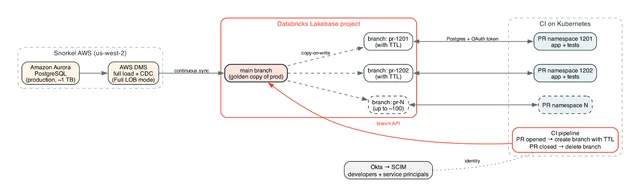
    image1.png

    for each open PR, reducing branch readiness time from over 30 minutes to under 60 seconds. Branches use copy-on-write; on a production dataset of about 2.5 TB, 100 concurrent PR branches store only 5 to 10 GB of data each for their own changes, and TTL automatically cleans them up after the PR ends. Production data is continuously synchronized to the main branch via AWS DMS; developers log in with Okta SSO, and the CI pipeline authenticates with a service principal and short-lived OAuth tokens.

    Matched fieldsSummary、Body

Saturday

  1. AWS Machine Learning

    End-to-End Amazon Bedrock Cost Management: A Practical Handbook for FinOps and Platform Teams

    AWS presents a five-step closed loop for managing Amazon Bedrock costs: attribute by IAM principal, record request observability, control spending with budget alerts and hard blocks, optimize platform defaults such as model routing and caching, and review on a regular cadence. Amazon Bedrock now supports automatically attributing inference costs to the IAM principal that initiated the call, with the caller ARN written to the line_item_iam_principal column in CUR 2.0, covering IAM users, roles, federated identities, and API keys. In shared gateway scenarios, role session names and session tags can be set per user, credentials are cached for up to 1 hour, and attribution by user and tenant is restored.

    Five-stage Amazon Bedrock cost operating model loop: attribute, observe, enforce, optimize, operate

    AWS presents a five-step closed loop for managing Amazon Bedrock costs: attribute by IAM principal, record request observability, control spending with budget alerts and hard blocks, optimize platform defaults such as model routing and caching, and review on a regular cadence. Amazon Bedrock now supports automatically attributing inference costs to the IAM principal that initiated the call, with the caller ARN written to the line item iam principal column in CUR 2.0, covering IAM users, roles, f

    Matched fieldsSummary、Body

Friday

  1. 36Kr · AI

    Who Is Really Eating the AI Dividend: Looking at Profit Distribution Through Tech Giants' Financial Reports

    The article reviews the latest financial reports of tech giants such as Meta, Amazon, and Google, noting that AWS revenue grew 39% year-over-year, but the group's free cash flow over the past 12 months turned negative at -$42.4 billion, and Alphabet's stock price fell 12.64% in a single day. Anthropic's prospectus shows revenue of $16.286 billion in the first half of 2026, a year-over-year increase of 1300%; compute and infrastructure costs during the same period reached $8.945 billion, and it signed minimum purchase commitments totaling $269.4 billion with Google, Amazon, and Microsoft. In a McKinsey survey, 80% of respondents said AI improved work efficiency, but only 37% believed AI made a positive contribution to corporate EBIT.

    The article reviews the latest financial reports of tech giants such as Meta, Amazon, and Google, noting that AWS revenue grew 39% year-over-year, but the group's free cash flow over the past 12 months turned negative at -$42.4 billion, and Alphabet's stock price fell 12.64% in a single day. Anthropic's prospectus shows revenue of $16.286 billion in the first half of 2026, a year-over-year increase of 1300%; compute and infrastructure costs during the same period reached $8.945 billion, and it s

    Matched fieldsSummary、Body

  2. TMTPost · AGI

    Microsoft, Google, and Amazon Earnings Side by Side: The AI Infrastructure Race Reaches a Watershed

    The latest earnings reports from the three cloud providers Microsoft, Google, and Amazon show cloud businesses accelerating across the board: AWS third-quarter revenue was $45.98 billion, up 39.3% year over year; Azure posted $33.165 billion for the quarter, up 48%; Google Cloud revenue was $30.71 billion, more than doubling year over year; and their backlogs reached $578 billion, $677 billion, and $561 billion, respectively. Over the same period, all three posted negative free cash flow: Amazon had a net outflow of $42.36 billion over the past 12 months, Alphabet was negative $9.07 billion, and Meta had a net outflow of $2.12 billion, while only Microsoft remained positive at $18.6 billion. Market reactions diverged; Alphabet fell 12.64% in a single day on slowing advertising growth and its swing to negative cash flow, and the article argues that the competitive bottleneck is shifting from chips to power, land, and grid-connection approvals.

    The latest earnings reports from the three cloud providers Microsoft, Google, and Amazon show cloud businesses accelerating across the board: AWS third-quarter revenue was $45.98 billion, up 39.3% year over year; Azure posted $33.165 billion for the quarter, up 48%; Google Cloud revenue was $30.71 billion, more than doubling year over year; and their backlogs reached $578 billion, $677 billion, and $561 billion, respectively. Over the same period, all three posted negative free cash flow: Amazon

    Matched fieldsSummary、Body

  3. heise online

    Amazon's Q3 revenue grew 12%, AI infrastructure spending pushes free cash flow down to negative $4.24 billion

    Amazon's third-quarter revenue grew 12% year-over-year to $201.9 billion, of which AWS revenue reached $46 billion, up 39% year-over-year, and operating profit grew 56% to $17.8 billion. To meet AI computing demand, capital expenditure over the past 12 months was $94.8 billion more than the same period last year, free cash flow fell to negative $42.4 billion, and the stock price fell about 8% after hours. Amazon expects fourth-quarter revenue between $240 billion and $247 billion, and CEO Andy Jassy said AWS growth of more than 40% will not appear until 2027 to 2028.

    Amazon's third-quarter revenue grew 12% year-over-year to $201.9 billion, of which AWS revenue reached $46 billion, up 39% year-over-year, and operating profit grew 56% to $17.8 billion. To meet AI computing demand, capital expenditure over the past 12 months was $94.8 billion more than the same period last year, free cash flow fell to negative $42.4 billion, and the stock price fell about 8% after hours. Amazon expects fourth-quarter revenue between $240 billion and $247 billion, and CEO Andy J

    Matched fieldsSummary、Body

  4. The New Stack

    Sam Altman once considered abandoning token-based pricing, but dropped the idea due to customer opposition

    OpenAI CEO Sam Altman revealed that the company had considered abandoning token-based billing for its next-generation models in favor of a model where developers submit a prompt and receive a single price directly, similar to AWS's billing model, but dropped the idea because customer feedback was extremely negative. Customers said they need to know what they are paying for, and would even rather accept inflated token counts and pay higher fees than give up itemized billing they can verify. Altman acknowledged that tokens are "a kind of fake unit" and not a good way to measure usage, but OpenAI still uses token-based pricing for now.

    y had considered abandoning token-based billing for its next-generation models in favor of a model where developers submit a prompt and receive a single price directly, similar to AWS's billing model, but dropped the idea because customer feedback was extremely negative. Customers said they need to know what they are paying for, and would even rather accept inflated token counts and pay higher fees than give up itemized billing they can verify. Altman acknowledged that tokens are "a kind of fake

    Matched fieldsSummary、Body

  5. Sina Tech

    Amazon's AI spending turns free cash flow negative at $42.4 billion, shares fall after hours

    Amazon disclosed that free cash flow for the trailing twelve months ended September 30, 2026 was negative $42.4 billion, compared with positive $14.8 billion in the same period of 2025; the company said this was mainly due to a $94.8 billion increase in purchases of property and equipment related to AI investments. Amazon expects cash capital expenditure of $220 billion for 2026, and AWS Chief Financial Officer John Felton said the order backlog as of the second quarter was close to $500 billion. In the earnings report, the advertising business's year-over-year growth rate fell to 12%, compared with 26% in the previous quarter.

    positive $14.8 billion in the same period of 2025; the company said this was mainly due to a $94.8 billion increase in purchases of property and equipment related to AI investments. Amazon expects cash capital expenditure of $220 billion for 2026, and AWS Chief Financial Officer John Felton said the order backlog as of the second quarter was close to $500 billion. In the earnings report, the advertising business's year-over-year growth rate fell to 12%, compared with 26% in the previous quarter.

    Matched fieldsSummary

  6. Wallstreetcn

    Amazon's stock fell about 7% after its Q3 earnings report, showing AI investment pressure alongside Alphabet

    Amazon's total Q3 revenue grew 12% year-over-year to $201.9 billion, below analyst expectations, and its stock fell about 7% after hours following the earnings release. AWS revenue grew 39% year-over-year to $46 billion, accelerating for the sixth consecutive quarter, but online retail growth slowed to 2% and advertising growth slowed to 11%; meanwhile, equipment and property expenditures exceeded $77 billion, and free cash flow over the past 12 months was negative $42.4 billion. This trend echoes Alphabet's single-day plunge of 13% after its search advertising revenue fell short of expectations, as market concerns grow that AI investment is suppressing cash flow and the pace of monetization.

    Amazon's total Q3 revenue grew 12% year-over-year to $201.9 billion, below analyst expectations, and its stock fell about 7% after hours following the earnings release. AWS revenue grew 39% year-over-year to $46 billion, accelerating for the sixth consecutive quarter, but online retail growth slowed to 2% and advertising growth slowed to 11%; meanwhile, equipment and property expenditures exceeded $77 billion, and free cash flow over the past 12 months was negative $42.4 billion. This trend echo

    Matched fieldsSummary、Body

  7. AWS Machine Learning

    How MoEngage Used AgentCore Gateway to Turn Over 400 APIs into Agent Tools

    Using Amazon Bedrock AgentCore Gateway, MoEngage converted approximately 400 internal REST APIs distributed across private VPCs in 7 AWS Regions into permission-controlled agent tools, saving about 6 months of platform engineering effort and reducing new API onboarding from several days to a few hours. The solution requires no MCP server code from product teams, no per-integration network configuration, and involves no public endpoints anywhere in the path. MoEngage also established a principle: engineering teams only maintain OpenAPI specs, while the AI platform team is solely responsible for the MCP layer.

    AgentCore Gateway architecture: agent services reach the gateway through a private VPC interface endpoint, which evaluates Cedar policies and routes calls over Amazon VPC Lattice to internal APIs

    Using Amazon Bedrock AgentCore Gateway, MoEngage converted approximately 400 internal REST APIs distributed across private VPCs in 7 AWS Regions into permission-controlled agent tools, saving about 6 months of platform engineering effort and reducing new API onboarding from several days to a few hours. The solution requires no MCP server code from product teams, no per-integration network configuration, and involves no public endpoints anywhere in the path. MoEngage also established a principle:

    Matched fieldsSummary、Body

  8. AWS Machine Learning

    Building a Repeatable PHP-to-Java Migration Engine with Kiro

    AWS describes building a repeatable PHP-to-Java migration engine with Kiro: the migration methodology and discovery scanner are encapsulated as skill files, using an eight-phase process and a parity harness to verify that the Java port behaves consistently with the original PHP application. The same set of skill files can be used for interactive, application-by-application migration in Kiro, or handed to AWS Transform to run as parallel tasks at portfolio scale. Running requires PHP 8.0 or later, and the generated Spring Boot project requires Java 21 and Maven.

    Workspace architecture: one shared brain, many projects. Diagram of the workspace layout. At the top is the Kiro workspace root, PHP-Java-Migration. Below it, a shared, global layer under .kiro/ holds the skills (the methodology) and the steering file (the governing workflow), and applies to every project. Beneath that, three per-project folders each hold their own spec sub-folder, and the diagram notes that improving the shared layer once benefits every project.

    AWS describes building a repeatable PHP-to-Java migration engine with Kiro: the migration methodology and discovery scanner are encapsulated as skill files, using an eight-phase process and a parity harness to verify that the Java port behaves consistently with the original PHP application. The same set of skill files can be used for interactive, application-by-application migration in Kiro, or handed to AWS Transform to run as parallel tasks at portfolio scale. Running requires PHP 8.0 or later

    Matched fieldsSummary、Body

  9. AWS Machine Learning

    Epsilon Builds Intent-Driven UI Testing with Amazon Nova Act

    Epsilon's Agentic Platform team used Amazon Nova Act together with Amazon Bedrock AgentCore Browser to turn intent-driven UI testing into a multi-tenant platform service layered on top of its existing Playwright regression suite. Test steps are written in natural language, executed by Nova Act over a CDP WebSocket, with per-step screenshots and pass-rate statistics, and results stored in Amazon S3. The solution provides managed temporary browser sessions, AWS IAM-based authentication, and cross-account AssumeRole isolation, and the article also presents an 18-step test workflow.

    Epsilon UI Testing Service architecture with user, authentication, API, execution runner, and Amazon S3 storage layers

    ntCore Browser to turn intent-driven UI testing into a multi-tenant platform service layered on top of its existing Playwright regression suite. Test steps are written in natural language, executed by Nova Act over a CDP WebSocket, with per-step screenshots and pass-rate statistics, and results stored in Amazon S3. The solution provides managed temporary browser sessions, AWS IAM-based authentication, and cross-account AssumeRole isolation, and the article also presents an 18-step test workflow.

    Matched fieldsSummary、Body

Wednesday

  1. The New Stack

    The AI agent was decommissioned long ago—so why is its access key still alive?

    OWASP ranks the failure to decommission non-human identities as the top risk in its 2025 Top 10, and AWS IAM user access keys do not expire automatically—forgotten keys remain valid until someone manually disables or deletes them. The article presents a three-step governance plan: use CloudQuery queries to find keys that have been unused for more than 90 days and are still active, use OPA policies to block the creation of long-term credentials during the Terraform/OpenTofu plan phase, and set a finite lifecycle for each key.

    OWASP ranks the failure to decommission non-human identities as the top risk in its 2025 Top 10, and AWS IAM user access keys do not expire automatically—forgotten keys remain valid until someone manually disables or deletes them. The article presents a three-step governance plan: use CloudQuery queries to find keys that have been unused for more than 90 days and are still active, use OPA policies to block the creation of long-term credentials during the Terraform/OpenTofu plan phase, and set a

    Matched fieldsSummary、Body

  2. heise onlineSelected

    Anthropic Prepares for IPO: Prospectus Discloses Compute Commitments and Security Risks

    Anthropic is preparing for an IPO, with a valuation estimated at up to $2 trillion, and the prospectus published this Monday disclosed details on security, customer dependence, and corporate governance. In the first nine months of 2026, about 5% to 7% of revenue came from customers found to have violated usage policies; the top five customers contributed about 25% of revenue, and in the first half of 2026, 48% of revenue was obtained through platforms such as AWS, Google Cloud, and Microsoft Azure. Existing and planned AI infrastructure agreements total about $657 billion, of which about $417 billion is non-cancelable, and spending could rise to $806 billion after including hardware capacity still under negotiation. After listing, the seven founders will collectively control 50.1% of ordinary shareholder voting rights. The specific listing date has not yet been determined; according to The Wall Street Journal, the target is the week of November 16.

    ound to have violated usage policies; the top five customers contributed about 25% of revenue, and in the first half of 2026, 48% of revenue was obtained through platforms such as AWS, Google Cloud, and Microsoft Azure. Existing and planned AI infrastructure agreements total about $657 billion, of which about $417 billion is non-cancelable, and spending could rise to $806 billion after including hardware capacity still under negotiation. After listing, the seven founders will collectively contro

    Matched fieldsSummary

Thursday

  1. AWS Machine Learning

    Implementing agentic QA automation with Amazon Nova Act to accelerate software delivery (Part 3)

    The AWS blog introduces two new capabilities added to QA Studio based on Amazon Nova Act: applications organize test cases and test suites into application containers with owners, record CloudWatch metrics by application and environment, and provide a 0–100 health score (starting from the pass rate and deducting points for flaky tests), supporting two trend windows of 7 days/hourly and 30 days/daily. Team-based user management defines five cumulative roles: Admin, Team Lead, Editor, Executor, and Viewer; each application belongs to only one team, and permissions are managed by application rather than by individual test.

    QA Studio application detail page showing pass rate, executions, and failures above the use cases and test suites tabs

    The AWS blog introduces two new capabilities added to QA Studio based on Amazon Nova Act: applications organize test cases and test suites into application containers with owners, record CloudWatch metrics by application and environment, and provide a 0–100 health score (starting from the pass rate and deducting points for flaky tests), supporting two trend windows of 7 days/hourly and 30 days/daily. Team-based user management defines five cumulative roles: Admin, Team Lead, Editor, Executor, an

    Matched fieldsSummary、Body

  2. AWS Machine Learning

    Distributed Training on EKS with Ray Train DLC and EFA

    AWS has released the Ray Train DLC image ray:train-ml-cuda-v1.1, which comes pre-integrated with Ray 2.58.0, PyTorch 2.13.0, CUDA 13.0.2, NCCL 2.29.7, and EFA along with the AWS OFI NCCL plugin, enabling distributed training on EKS without the need to build images yourself. The example uses PyTorch FSDP to fine-tune Qwen2.5-1.5B on 8 NVIDIA L4 GPUs across two g6.12xlarge instances, with cross-node communication going directly over EFA. The image is publicly hosted on Amazon ECR Public, so nodes can pull it without credentials.

    EKS cluster with a CPU system node running KubeRay and the Ray head, and two EFA-enabled g6.12xlarge GPU worker nodes in one Availability Zone

    AWS has released the Ray Train DLC image ray:train-ml-cuda-v1.1, which comes pre-integrated with Ray 2.58.0, PyTorch 2.13.0, CUDA 13.0.2, NCCL 2.29.7, and EFA along with the AWS OFI NCCL plugin, enabling distributed training on EKS without the need to build images yourself. The example uses PyTorch FSDP to fine-tune Qwen2.5-1.5B on 8 NVIDIA L4 GPUs across two g6.12xlarge instances, with cross-node communication going directly over EFA. The image is publicly hosted on Amazon ECR Public, so nodes

    Matched fieldsSummary、Body

  3. AWS Machine Learning

    Building an Enterprise-Grade Agentic AI Platform on Amazon Bedrock AgentCore

    AWS has released an enterprise-grade Agentic AI platform blueprint based on Amazon Bedrock and AgentCore, adopting a federated operating model in which a central Platform team provides governed shared services while each Workstream team retains ownership of its own agents, tools, and data. The platform enforces model admission, regional restrictions, rate and token quotas, and budget controls through an independent inference gateway and an MCP tool gateway, and uses an evaluation pipeline to perform gate checks before agents go live.

    Operating model linking the governance foundation, Platform control plane, and team-owned Workstream cells

    AWS has released an enterprise-grade Agentic AI platform blueprint based on Amazon Bedrock and AgentCore, adopting a federated operating model in which a central Platform team provides governed shared services while each Workstream team retains ownership of its own agents, tools, and data. The platform enforces model admission, regional restrictions, rate and token quotas, and budget controls through an independent inference gateway and an MCP tool gateway, and uses an evaluation pipeline to per

    Matched fieldsSummary、Body

Monday

  1. Sakana AI:Blog

    How Sakana AI Is Taking Japan's Homegrown AI Products Global: An Interview with the VP of GTM

    In 2026, Sakana AI launched products including Sakana Chat, Sakana Marlin, Sakana Fugu, and Sakana Translate. Its GTM team was formally established in September 2026, led by Vice President Hidekazu Kakishima. The team adopts a "product-led GTM" model and hires Forward Deployed Engineers (FDEs) to feed customer on-site experience back into product improvements. Kakishima previously served as head of the strategic accounts team at AWS Japan, a founding member of SORACOM, and in a related role at Skydio.

    6, Sakana AI launched products including Sakana Chat, Sakana Marlin, Sakana Fugu, and Sakana Translate. Its GTM team was formally established in September 2026, led by Vice President Hidekazu Kakishima. The team adopts a "product-led GTM" model and hires Forward Deployed Engineers (FDEs) to feed customer on-site experience back into product improvements. Kakishima previously served as head of the strategic accounts team at AWS Japan, a founding member of SORACOM, and in a related role at Skydio.

    Matched fieldsSummary、Body

Tuesday

  1. AWS Machine Learning

    Building Agentic Retrieval on a Managed Amazon Bedrock Knowledge Base with CDK

    AWS released a solution that uses AWS CDK to deploy enterprise-grade agentic retrieval on a managed Amazon Bedrock Knowledge Base: the reasoning agent invokes two knowledge bases as MCP tools through AgentCore Gateway, and AgenticRetrieveStream performs multi-turn planning, internal reranking, and returns answers with citations. The managed knowledge base (Type: MANAGED) takes over ingestion, storage, indexing, and retrieval, eliminating the need to build your own OpenSearch Serverless collection and index. The solution also provisions two CloudWatch dashboards covering seven layers of telemetry, and provides both on-demand and continuous evaluation, deployable with a single command.

    Agent routing a question across two managed knowledge bases through the Gateway, with every step landing in Amazon CloudWatch

    AWS released a solution that uses AWS CDK to deploy enterprise-grade agentic retrieval on a managed Amazon Bedrock Knowledge Base: the reasoning agent invokes two knowledge bases as MCP tools through AgentCore Gateway, and AgenticRetrieveStream performs multi-turn planning, internal reranking, and returns answers with citations. The managed knowledge base (Type: MANAGED) takes over ingestion, storage, indexing, and retrieval, eliminating the need to build your own OpenSearch Serverless collectio

    Matched fieldsSummary、Body

  2. AWS Machine Learning

    Implementing fleet-level computer vision lifecycle management at the edge with SageMaker SDK v3

    AWS has released a fleet-level edge computer vision model lifecycle solution based on the SageMaker Python SDK v3, using SageMaker Neo to replace the deprecated SageMaker Edge Manager for edge optimization. The solution uses a dual-branch SageMaker Pipeline to train an anomaly detector and a ResNet18 defect classifier for each camera; after passing quality gates, they are compiled and registered to the Model Registry, with Step Functions controlling the fleet training cadence. Running the full pipeline once on synthetic data costs about $0.07 in compute.

    Solution architecture: SQS FIFO queue triggers AWS Lambda, which starts a Step Functions state machine with an Amazon DynamoDB semaphore for concurrency control. The state machine launches a 13-step SageMaker Pipeline with parallel entry steps (Preprocess, Fetch Latest Anomaly, Fetch Latest Classifier), dual training branches with ONNX evaluation, quality gates, Neo compilation, and Model Registry registration. Compiled artifacts land in S3. Completions and failures converge on an SNS topic.

    AWS has released a fleet-level edge computer vision model lifecycle solution based on the SageMaker Python SDK v3, using SageMaker Neo to replace the deprecated SageMaker Edge Manager for edge optimization. The solution uses a dual-branch SageMaker Pipeline to train an anomaly detector and a ResNet18 defect classifier for each camera; after passing quality gates, they are compiled and registered to the Model Registry, with Step Functions controlling the fleet training cadence. Running the full p

    Matched fieldsSummary、Body

Saturday

  1. cnBeta

    Large numbers of Amazon NVIDIA GB300 servers temporarily idle due to insufficient power supply

    Amazon AWS at one point expected to receive NVIDIA GB300 server racks worth about $5 billion, but after some equipment was delivered, it was temporarily stored in warehouses or transit facilities because data centers lacked sufficient power capacity; the industry calls such equipment dark GPUs. AWS also plans to continue purchasing at a rate of about $3 billion per month, and has shifted to accepting racks early and paying early to lock in scarce hardware. Amazon plans to invest about $220 billion in capital expenditure this year for AI and cloud computing infrastructure, and free cash flow has turned negative for the first time in recent years.

    Amazon AWS at one point expected to receive NVIDIA GB300 server racks worth about $5 billion, but after some equipment was delivered, it was temporarily stored in warehouses or transit facilities because data centers lacked sufficient power capacity; the industry calls such equipment dark GPUs. AWS also plans to continue purchasing at a rate of about $3 billion per month, and has shifted to accepting racks early and paying early to lock in scarce hardware. Amazon plans to invest about $220 billi

    Matched fieldsSummary、Body