←Search results

By relevance · Total 2902 results Clear search

Friday

  1. Databricks BlogSelected

    Databricks and the Linux Foundation Evolve Delta Sharing into OpenSharing

    Databricks and the Linux Foundation announced that Delta Sharing is evolving into OpenSharing, an open protocol governed by the Linux Foundation that can share not only tables but also Agent Skills, AI models, and unstructured data. The protocol specification is hosted on GitHub under the Apache 2.0 license, adds a Share → Schema → Asset hierarchy and Apache Iceberg REST Catalog client support, and existing Delta Sharing configurations require no migration—simply enabling it on a Unity Catalog metastore is sufficient. Databricks has also launched SecureConnect (generally available), Global Distribution (private preview), Genie Agent Sharing (Beta), and Lakebase table and change data feed sharing (public preview).

    image2.jpg

    Databricks and the Linux Foundation announced that Delta Sharing is evolving into OpenSharing, an open protocol governed by the Linux Foundation that can share not only tables but also Agent Skills, AI models, and unstructured data. The protocol specification is hosted on GitHub under the Apache 2.0 license, adds a Share → Schema → Asset hierarchy and Apache Iceberg REST Catalog client support, and existing Delta Sharing configurations require no migration—simply enabling it on a Unity Catalog m

    Matched fieldsBody

  2. Reflection Blog

    Reflection releases Beam open-source model safety training and evaluation report

    Reflection has released the safety technical report for Beam, describing how it balances refusing harmful requests with answering normal ones through pre-training data filtering, a safety-aligned teacher model, and multi-teacher online policy distillation (MOPD). In its self-built Iris Safety Evaluations, Beam's refusal rate for harmful requests is 89%, and its compliance rate for safe, harmless requests is 82%, placing it on the Pareto frontier of safety and helpfulness. The report also shows that after the safety-aligned teacher increased from 100B to 501B parameters, over-refusal decreased relatively by 48.7%, while the pass rate for harmful requests decreased by 3.1%.

    Reflection.ai dotted artwork

    Reflection has released the safety technical report for Beam, describing how it balances refusing harmful requests with answering normal ones through pre-training data filtering, a safety-aligned teacher model, and multi-teacher online policy distillation (MOPD). In its self-built Iris Safety Evaluations, Beam's refusal rate for harmful requests is 89%, and its compliance rate for safe, harmless requests is 82%, placing it on the Pareto frontier of safety and helpfulness. The report also shows t

    Matched fieldsBody

  3. NVIDIA Developer · Generative AI

    How NVIDIA Co-Design Maximizes the Value of Every Byte in the AI Factory: Five Ways

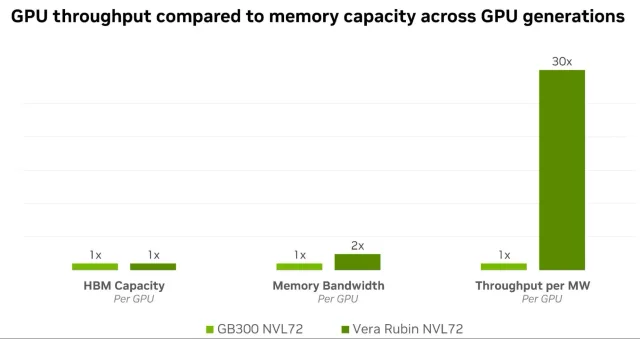
    Through five co-designs—NVFP4, Wide-EP, Dynamo, Vera CPU, and CMX—NVIDIA enables Vera Rubin NVL72 to achieve up to 30x the per-megawatt throughput of GB300 NVL72 on SemiAnalysis AgentX while keeping 288 GB of HBM per GPU unchanged. NVFP4 reduces model footprint by about 3.5x versus FP16 and 1.8x versus FP8, and NVFP4 KV cache cuts it by up to another 50% versus FP8. TensorRT-LLM's Wide-EP spreads experts across 8 or more GPUs, while Dynamo manages KV cache as a cluster-level resource across GPUs, CPUs, and storage.

    Bar chart comparing GB300 NVL72 and Vera Rubin NVL72. Relative to GB300’s1x baseline, HBM capacity per GPU is 1x, memory bandwidth per GPU is 2x, and throughput per megawatt is 30x.

    Through five co-designs—NVFP4, Wide-EP, Dynamo, Vera CPU, and CMX—NVIDIA enables Vera Rubin NVL72 to achieve up to 30x the per-megawatt throughput of GB300 NVL72 on SemiAnalysis AgentX while keeping 288 GB of HBM per GPU unchanged. NVFP4 reduces model footprint by about 3.5x versus FP16 and 1.8x versus FP8, and NVFP4 KV cache cuts it by up to another 50% versus FP8. TensorRT-LLM's Wide-EP spreads experts across 8 or more GPUs, while Dynamo manages KV cache as a cluster-level resource across GPUs

    Matched fieldsBody

  4. Sierra:Blog

    Sierra Acquires Browser Agent Company Anon

    Sierra announced the acquisition of Anon, which focuses on enabling enterprise AI agents to log in, navigate pages, and fill out forms on websites without APIs, just like humans. Anon had previously raised over $13 million, served hundreds of customers with its product, and deployed agents in the banking, healthcare, and enterprise software sectors. Its team and technology will be integrated into Sierra to enable Sierra agents to drive tasks to completion when they need to log in to websites or operate portals.

    Bret and Clay

    Sierra announced the acquisition of Anon, which focuses on enabling enterprise AI agents to log in, navigate pages, and fill out forms on websites without APIs, just like humans. Anon had previously raised over $13 million, served hundreds of customers with its product, and deployed agents in the banking, healthcare, and enterprise software sectors. Its team and technology will be integrated into Sierra to enable Sierra agents to drive tasks to completion when they need to log in to websites or

    Matched fieldsBody

Thursday

  1. Databricks Blog

    Debezium Server 3.7 pushes CDC events directly into Unity via Zerobus Ingest…

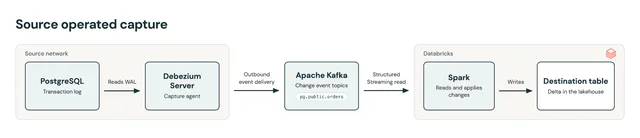
    Debezium Server 3.7 adds a Zerobus Ingest sink that can push CDC events directly into Delta tables in Unity Catalog, without the need for an intermediate Kafka cluster or pull-based connectors. The sink was jointly developed by NVIDIA and Databricks and contributed to the open source Debezium project; NVIDIA added delivery guarantees such as envelope mode, idempotency keys, and persistent acknowledgment before source offset advancement. This push-based architecture also enables environments restricted by private networks and prohibited from inbound connections to securely replicate data outward.

    Architecture with a message bus: source operated capture

    Debezium Server 3.7 adds a Zerobus Ingest sink that can push CDC events directly into Delta tables in Unity Catalog, without the need for an intermediate Kafka cluster or pull-based connectors. The sink was jointly developed by NVIDIA and Databricks and contributed to the open source Debezium project; NVIDIA added delivery guarantees such as envelope mode, idempotency keys, and persistent acknowledgment before source offset advancement. This push-based architecture also enables environments rest

    Matched fieldsBody

  2. MacRumors Apple Intelligence

    iOS 27.3 beta code suggests HomeView may support AI chatbot apps

    Code investigator pdfu found in the iOS 27.3 beta that the HomeView software used to display iPhone/iPad apps has added a "Conversational Apps" category, along with preparations for bidirectional audio routing, session management, and interruption handling, but it is not yet fully connected, and Apple has not announced support for chatbots such as ChatGPT and Claude. HomeView also has built-in anti-deception protection: after three deception attempts on the same profile, iPhone authentication is required to view personal data, and this feature is already enabled in the HomeView 27.2 software. HomeView will go on sale on November 13, priced at $299, in desktop and wall-mounted versions.

    Code investigator pdfu found in the iOS 27.3 beta that the HomeView software used to display iPhone/iPad apps has added a "Conversational Apps" category, along with preparations for bidirectional audio routing, session management, and interruption handling, but it is not yet fully connected, and Apple has not announced support for chatbots such as ChatGPT and Claude. HomeView also has built-in anti-deception protection: after three deception attempts on the same profile, iPhone authentication is

    Matched fieldsBody

  3. 9to5Google

    Google Mandates Gemini and AI Overviews in School Search, Sparking Disputes Between Schools and Regulators

    9to5Google reports that Google's changes to the school search experience require schools to actively opt in to Gemini, Gemini Notebook, Gemini in Classroom, and AI Overviews; Google's rationale is that search and AI are now deeply integrated, so turning off one means turning off the other. Former FTC Chair Lina Khan criticized Google on X for using its search monopoly to force schools to adopt AI. The article also notes that the AI boom has driven up component prices, and some low-income school districts have already taken back students' Chromebooks and reverted to shared devices.

    9to5Google reports that Google's changes to the school search experience require schools to actively opt in to Gemini, Gemini Notebook, Gemini in Classroom, and AI Overviews; Google's rationale is that search and AI are now deeply integrated, so turning off one means turning off the other. Former FTC Chair Lina Khan criticized Google on X for using its search monopoly to force schools to adopt AI. The article also notes that the AI boom has driven up component prices, and some low-income school

    Matched fieldsBody

  4. Hugging Face

    Hugging Face releases on-device speech model Phonon, with the 31m version open-sourced under Apache 2.0

    Hugging Face has released the on-device TTS model Phonon, offering two sizes of approximately 65 MB and 75 MB, covering English, French, German, Spanish, and Portuguese, with more than 100 built-in voices. Among them, Phonon 31m supports only English and is open-sourced under Apache 2.0, allowing use in commercial products; Phonon 40m covers five languages but uses a non-commercial license. The company states that it ranks first in German and Spanish intelligibility on the Open TTS Leaderboard and leads in the CPU streaming first-packet latency benchmark, and that the accompanying inference framework ptts supports more than 10 backends including CPU, GPU, and NPU.

    Hugging Face has released the on-device TTS model Phonon, offering two sizes of approximately 65 MB and 75 MB, covering English, French, German, Spanish, and Portuguese, with more than 100 built-in voices. Among them, Phonon 31m supports only English and is open-sourced under Apache 2.0, allowing use in commercial products; Phonon 40m covers five languages but uses a non-commercial license. The company states that it ranks first in German and Spanish intelligibility on the Open TTS Leaderboard a

    Matched fieldsBody

  5. Browser Use

    Differences Between Computer Use and Browser Use and Their Respective Use Cases

    Browser Use officially compared two types of AI agents, computer use and browser use: the former relies on screenshots to locate screen coordinates and operate the entire desktop, while the latter directly reads the page structure and operates elements via CDP. Browser Use believes that web tasks should prioritize browser use, because page structure allows direct element targeting and headless browsers can run in parallel, with Browser Use Cloud costing $0.02 per browser hour; only desktop applications, system dialogs, or pure canvas pages require computer use.

    Browser Use officially compared two types of AI agents, computer use and browser use: the former relies on screenshots to locate screen coordinates and operate the entire desktop, while the latter directly reads the page structure and operates elements via CDP. Browser Use believes that web tasks should prioritize browser use, because page structure allows direct element targeting and headless browsers can run in parallel, with Browser Use Cloud costing $0.02 per browser hour; only desktop appli

    Matched fieldsBody

  6. Center for Strategic and Security Studies at Tsinghua University

    Sun Chenghao: Southeast Asia's Choices in the China-US AI Rivalry and ASEAN Regional Cooperation

    Sun Chenghao, associate research fellow at the Center for Strategic and Security Studies at Tsinghua University, believes that Southeast Asia's choices in the AI field will be shaped by the China-US rivalry over the long term, but that countries can strengthen their capacity for independent choice through their own investments and regional cooperation. The SEA-LION project of AI Singapore used Llama and Gemma from US companies and Alibaba's Qwen from China to develop Southeast Asian language models. ASEAN has issued the 2025-2030 Responsible AI Roadmap and is advancing the building of a regional AI safety network.

    English text is being prepared.

    Sun Chenghao, associate research fellow at the Center for Strategic and Security Studies at Tsinghua University, believes that Southeast Asia's choices in the AI field will be shaped by the China-US rivalry over the long term, but that countries can strengthen their capacity for independent choice through their own investments and regional cooperation. The SEA-LION project of AI Singapore used Llama and Gemma from US companies and Alibaba's Qwen from China to develop Southeast Asian language mod

    Matched fieldsBody

  7. Goodfire Research

    Goodfire proposes a mechanism shaping framework that constrains model training with internal representations

    Goodfire Research has released a paper proposing a mechanism shaping framework that, through two methods—dependency shaping and expression shaping—adds penalty terms on the model's internal concepts to the training objective, specifying what the model should depend on and what it should not express. In a chest X-ray diagnosis experiment, this method reduced the model's reliance on spurious features such as chest tubes, with accuracy exceeding the soft ceiling of training on balanced data; in DPO post-training of OLMo-3-7B, it suppressed sycophantic behavior, and in the Countdown task with Qwen3.5-9B, it pushed cheating behavior down to a 96–98% honest solution rate. The paper also proposes a five-level monitorability grading; experiments show that shaped concepts typically only shift location rather than disappear, and remain monitorable after retraining the probe.

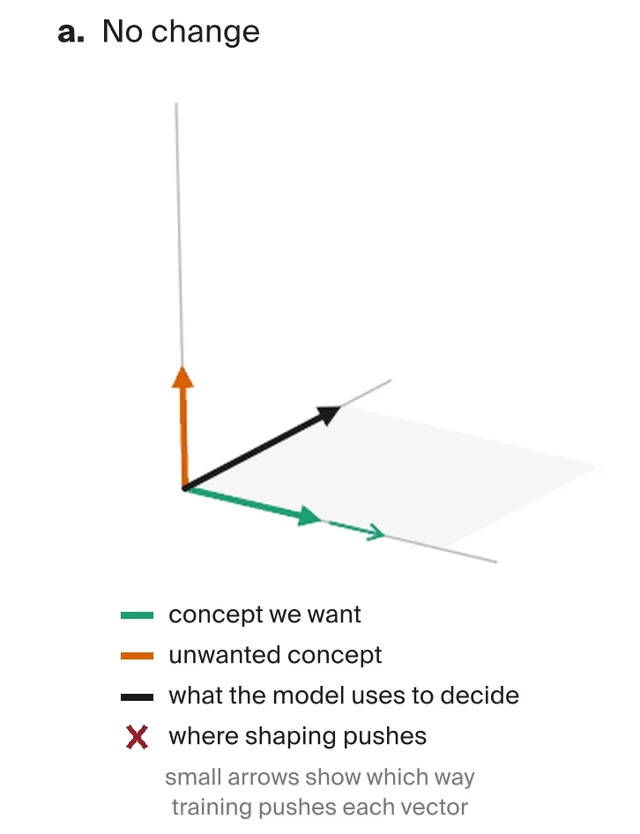
    a. No change (Figure 7): the unwanted concept stays in place while the model stops using it.

    Goodfire Research has released a paper proposing a mechanism shaping framework that, through two methods—dependency shaping and expression shaping—adds penalty terms on the model's internal concepts to the training objective, specifying what the model should depend on and what it should not express. In a chest X-ray diagnosis experiment, this method reduced the model's reliance on spurious features such as chest tubes, with accuracy exceeding the soft ceiling of training on balanced data; in DPO

    Matched fieldsBody

  8. NVIDIA Developer · Generative AISelected

    NVIDIA Releases AI Factory Operations Agent to Troubleshoot DGX Cluster Failures with Multi-Agent Collaboration

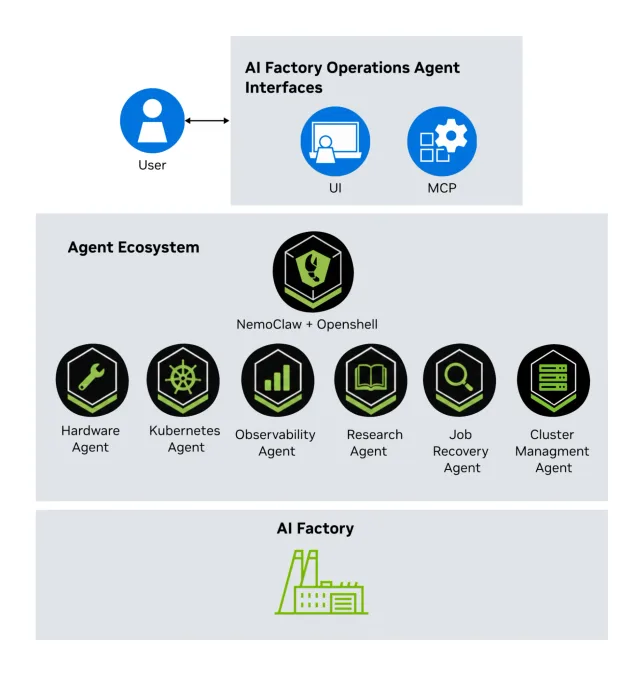
    NVIDIA has released the AI Factory Operations Agent, which collaborates through multiple domain sub-agents to locate root causes across the compute, network, hardware, and scheduling layers, and provides recommendations through a chat interface for its own DGX SuperPOD operations. The framework is built on the NVIDIA NemoClaw blueprint and OpenShell, is fully locally deployed, uses the local open-source NVIDIA Nemotron model for inference, and runs on DGX H100, DGX B200, and DGX GB300 production clusters. The framework includes sub-agents such as Job Recovery, Hardware, Observability, Research, Kubernetes, and Cluster Management, and integrates MCP tools such as web search, code execution, and Grafana dashboards. Developer examples and open-source code are now available.

    Diagram of workflow where either an SRE or agent triggers the AI factory agents powered by NVIDIA Nemotron 3 models that perform reasoning tasks to output root cause analyses, run commands for issue resolution, or generate relevant dashboards.

    NVIDIA has released the AI Factory Operations Agent, which collaborates through multiple domain sub-agents to locate root causes across the compute, network, hardware, and scheduling layers, and provides recommendations through a chat interface for its own DGX SuperPOD operations. The framework is built on the NVIDIA NemoClaw blueprint and OpenShell, is fully locally deployed, uses the local open-source NVIDIA Nemotron model for inference, and runs on DGX H100, DGX B200, and DGX GB300 production

    Matched fieldsBody

  9. SiliconANGLE

    Oracle uses real application testing to ensure the safety of AI-driven security patches

    Oracle Executive Vice President Juan Loaiza said at Oracle AI World that the company obtained early access to the Mythos model in March of this year and used it to scan its own code, discovering a large number of serious security vulnerabilities. The fixes were subsequently included in quarterly patches, and one quarterly security update this year fixed more than 1,400 vulnerabilities. Oracle uses Real Application Testing to capture real workloads to validate patches, and through Deep Data Security, delivered starting in April, it passes user identities into the database as encrypted tokens, enforcing security and business rules at the data layer.

    Oracle Executive Vice President Juan Loaiza said at Oracle AI World that the company obtained early access to the Mythos model in March of this year and used it to scan its own code, discovering a large number of serious security vulnerabilities. The fixes were subsequently included in quarterly patches, and one quarterly security update this year fixed more than 1,400 vulnerabilities. Oracle uses Real Application Testing to capture real workloads to validate patches, and through Deep Data Secur

    Matched fieldsBody

  10. Cognition Model / Devin BlogSelected

    Cognition Releases SWE-2 Flash Coding Model

    Cognition has released the SWE-2 Flash coding model, trained on Thinking Machines' Inkling-Small (276B total parameters, 12B activated parameters), marking the first time a mid-training stage before reinforcement learning was added to the training pipeline. The company claims Terminal-Bench 4.0 improved from 0.9% to 20.0%, FrontierCode 2.0 from 3.2% to 24.0%, and ExploitBench from 11.3% to 34.8%. The model is now available on Devin Desktop and the CLI, priced at one-fifth of its larger sibling SWE-2 and running 3 times faster (200 tok/s versus 60 tok/s). Its weights are not yet public; the company plans to share them securely with trusted industry partners and research institutions through a program.

    Cognition has released the SWE-2 Flash coding model, trained on Thinking Machines' Inkling-Small (276B total parameters, 12B activated parameters), marking the first time a mid-training stage before reinforcement learning was added to the training pipeline. The company claims Terminal-Bench 4.0 improved from 0.9% to 20.0%, FrontierCode 2.0 from 3.2% to 24.0%, and ExploitBench from 11.3% to 34.8%. The model is now available on Devin Desktop and the CLI, priced at one-fifth of its larger sibling S

    Matched fieldsBody

  11. Databricks Blog

    Databricks on why enterprises are turning to open-weight models: Unity AI Gateway provides unified hosting

    Databricks believes open-weight models have approached frontier-model performance at lower cost, prompting enterprises to reassess single frontier-model vendor strategies. Its Unity AI Gateway hosts open-weight, frontier, and external models through a unified API, supporting intelligent routing, fallback, and budget controls; since January, the average number of models used by customers has risen from 4.2 to 7.1, of which about 40% are open-weight models.

    image4.png

    Matched fieldsBody

  12. Google Research

    Agile Deliberation: How Google Research Uses AI to Help Humans Clarify the Gray Areas of Subjective Classification

    Google Research proposes the Agile Deliberation framework, which turns the construction of subjective image classifiers into an iterative dialogue between humans and LLMs: users first break down subcategories and exclusions, then the VLM proactively selects semantically borderline images, and the feedback enters an automatic prompt optimization loop. The team validated this in 18 real-human experiments of 1.5 hours each; the process reduced user fatigue and anxiety, and the resulting classifiers outperformed standard baselines. The code and algorithms are open-sourced on GitHub.

    Abstract artwork blending fluid watercolor washes on the left with geometric network nodes on the right, connected by a glowing central light.

    Google Research proposes the Agile Deliberation framework, which turns the construction of subjective image classifiers into an iterative dialogue between humans and LLMs: users first break down subcategories and exclusions, then the VLM proactively selects semantically borderline images, and the feedback enters an automatic prompt optimization loop. The team validated this in 18 real-human experiments of 1.5 hours each; the process reduced user fatigue and anxiety, and the resulting classifiers

    Matched fieldsBody

  13. SiliconANGLE

    Smartsheet launches AI planning and execution platform vsActual, using Execution Graph to track project deviations

    At the Engage 2026 conference, Smartsheet announced vsActual, an AI-driven planning and execution platform that uses AI agents to continuously monitor work progress across enterprise systems, compare it against strategic goals, and recommend adjustments. Its core Execution Graph is built on roughly 20 years of workflow data and 9 PB of information, underpinned by an AWS Neptune knowledge graph of about 100 million nodes, and can connect to systems such as Oracle, SAP, Workday, Atlassian, and ServiceNow. The platform also adds Agentic Workflows, multiple integrations, and ISO/IEC 42001 certification, while retaining human approval by default.

    At the Engage 2026 conference, Smartsheet announced vsActual, an AI-driven planning and execution platform that uses AI agents to continuously monitor work progress across enterprise systems, compare it against strategic goals, and recommend adjustments. Its core Execution Graph is built on roughly 20 years of workflow data and 9 PB of information, underpinned by an AWS Neptune knowledge graph of about 100 million nodes, and can connect to systems such as Oracle, SAP, Workday, Atlassian, and Ser

    Matched fieldsBody

  14. Figma AI / Agent / Make

    How Figma Manages Sandboxes at Scale: An Analysis of the Nimbus Platform

    Figma built a centralized sandbox management platform called Nimbus. Through namespace configuration files and three APIs—GetOrCreate, Get, and Delete—engineers can create, reuse, and delete sandboxes without needing to understand cloud provider details. Nimbus uses a unified base image, sandbox-base, and a daemon, sandboxd, to manage processes, networking, and health checks. Its goal is to return a fully configured sandbox within 1 second and to load-balance across multiple cloud providers to handle failures.

    Illustrated sandbox factory with workers inside glass spheres moving along conveyor belts as an operator manages the system.

    Figma built a centralized sandbox management platform called Nimbus. Through namespace configuration files and three APIs—GetOrCreate, Get, and Delete—engineers can create, reuse, and delete sandboxes without needing to understand cloud provider details. Nimbus uses a unified base image, sandbox-base, and a daemon, sandboxd, to manage processes, networking, and health checks. Its goal is to return a fully configured sandbox within 1 second and to load-balance across multiple cloud providers to h

    Matched fieldsBody

  15. Wired AI

    US midterm election results are in: candidates opposed to data centers win across the board

    In the US midterm elections, multiple candidates advocating strict regulation of data centers won, including Ohio Senator Sherrod Brown, as well as Democrats Keisha Lance Bottoms and Gina Hinojosa in the Georgia and Texas gubernatorial elections, both of whom advocated a moratorium on data center construction. NBC News exit polls show that nearly a quarter of voters listed data centers as a key factor in their vote, and nearly two-thirds said it was a major or minor factor. In data center referendums in nine states, voters rejected future construction plans and passed moratoriums, with only one county allowing more data center development on the ballot.

    In the US midterm elections, multiple candidates advocating strict regulation of data centers won, including Ohio Senator Sherrod Brown, as well as Democrats Keisha Lance Bottoms and Gina Hinojosa in the Georgia and Texas gubernatorial elections, both of whom advocated a moratorium on data center construction. NBC News exit polls show that nearly a quarter of voters listed data centers as a key factor in their vote, and nearly two-thirds said it was a major or minor factor. In data center refere

    Matched fieldsBody

Wednesday

  1. Google Blog

    Henry Cavill Creates 16-bit Game "Mustache Protocol" with Googlebook

    Actor Henry Cavill used Googlebook's built-in AI tools Antigravity and Rambler to turn a spoken idea into a playable 16-bit game, "Mustache Protocol." Antigravity converts natural-language prompts into game mechanics, Rambler handles speech-to-text to organize ideas, Magic Pointer is used to select and combine visual elements, and Continue On supports seamless switching between an Android phone and Googlebook. After the game was completed and launched, for every play during November, Google will donate $11 to Movember, up to a cap of $500,000, for projects related to men's mental health, suicide prevention, prostate cancer, and testicular cancer.

    Actor Henry Cavill used Googlebook's built-in AI tools Antigravity and Rambler to turn a spoken idea into a playable 16-bit game, "Mustache Protocol." Antigravity converts natural-language prompts into game mechanics, Rambler handles speech-to-text to organize ideas, Magic Pointer is used to select and combine visual elements, and Continue On supports seamless switching between an Android phone and Googlebook. After the game was completed and launched, for every play during November, Google will

    Matched fieldsBody