←Search results

By relevance · Total 2902 results Clear search

Thursday

  1. Suno:Blog

    Suno now supports MIDI files as a starting point for creation

    Suno has added MIDI file input to the Create page; users can drag and drop .mid or .midi files, or select MIDI from the "+" menu to start creating. Because MIDI contains only note and duration data and no sound, users can use natural language to instruct Suno to perform strictly according to the original score, or to extract motifs and develop them into a new arrangement. The official examples include exporting a score as MIDI and previewing it with a full orchestral arrangement, letting students and bands preview their own works during rehearsal, and re-orchestrating MIDI from old recordings.

    Start songs with MIDI on Suno

    Suno has added MIDI file input to the Create page; users can drag and drop .mid or .midi files, or select MIDI from the "+" menu to start creating. Because MIDI contains only note and duration data and no sound, users can use natural language to instruct Suno to perform strictly according to the original score, or to extract motifs and develop them into a new arrangement. The official examples include exporting a score as MIDI and previewing it with a full orchestral arrangement, letting student

    Matched fieldsBody
  2. AWS Machine Learning

    How Indegene Achieved Enterprise-Scale Data Quality Modernization in Life Sciences with an LLM Data Quality Agent

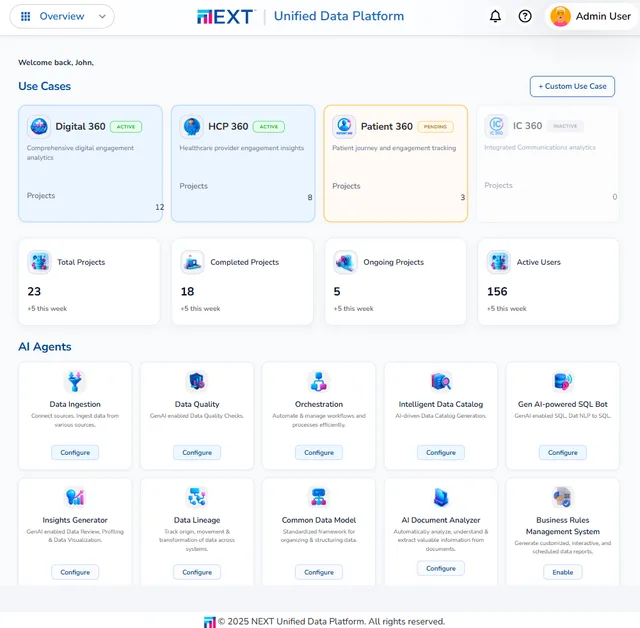
    Indegene built an LLM-powered Data Quality Agent within the NEXT Unified Data Platform (NEXT UDP) on AWS, which can generate context-aware data quality rules, perform validation, and produce directly runnable SQL and Python code, all under centralized human-in-the-loop governance. NEXT UDP also provides independent AI Agents such as Data Ingestion, Orchestration, Data Catalog, and SQL Bot Generator, which can be used separately in data pipelines or customized for agent-to-agent communication.

    NEXT Unified Data Platform dashboard showing use-case cards, project metrics, and available AI agents including the Data Quality agent.

    Matched fieldsBody

  3. AWS Machine LearningSelected

    AWS Details the Four-Layer Context Engineering and Deep Insight Implementation for Production-Grade AI Agents

    The AWS Machine Learning Blog uses the open-source multi-agent data analysis solution Deep Insight as a reference implementation and breaks the context engineering of production-grade AI agents into four layers: isolating context through a multi-agent architecture, constraining output with prompts, externalizing heavy content to the file system, and using a validation agent as a fallback. The write_and_execute_tool presented in the article reduces the tokens each script adds to the context by about 95%, and loading Skills on demand shrinks the system prompt by about 97%. Code examples using the Strands Agents SDK are also included.

    The AWS Machine Learning Blog uses the open-source multi-agent data analysis solution Deep Insight as a reference implementation and breaks the context engineering of production-grade AI agents into four layers: isolating context through a multi-agent architecture, constraining output with prompts, externalizing heavy content to the file system, and using a validation agent as a fallback. The write and execute tool presented in the article reduces the tokens each script adds to the context by ab

    Matched fieldsBody

  4. AWS Machine Learning

    Amazon Quick launches Smart Approvals: keeping human review at critical decision points for AI agents

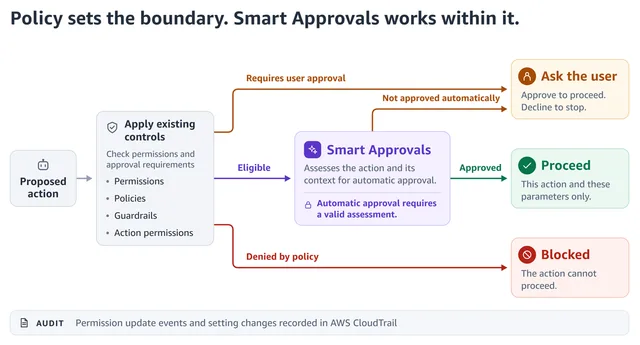
    Amazon Quick launches Smart Approvals, using an independent classifier model to evaluate eligible actions against user requests, automatically approving them or routing them back for human review, without granting additional permissions or removing required human approvals. The feature is enabled by default; administrators can control its scope through Custom Permissions, and users can also turn it off themselves. Each automatic approval applies only to that specific action and its parameters, and related permission events are recorded in AWS CloudTrail.

    Existing controls route proposed actions to required user approval, Smart Approvals review, or a policy block. Smart Approvals may approve an eligible action for its exact parameters or return it to the user. Assessment errors do not grant automatic approval. Permission update events and setting changes are recorded in AWS CloudTrail.

    Amazon Quick launches Smart Approvals, using an independent classifier model to evaluate eligible actions against user requests, automatically approving them or routing them back for human review, without granting additional permissions or removing required human approvals. The feature is enabled by default; administrators can control its scope through Custom Permissions, and users can also turn it off themselves. Each automatic approval applies only to that specific action and its parameters, a

    Matched fieldsBody

Wednesday

  1. Cohere Product and Research Blog

    Cohere Retrieval Models Embed 5 and Rerank 5 Now Available on OpenRouter

    Cohere's Embed 5 and Rerank 5 retrieval models are now available on OpenRouter, accessible through a single API call with unified billing and no additional SDK required. Embed 5 Pro and Fast share the same embedding space, so you can index with Pro and query with Fast to reduce latency; Rerank 5's scores are calibrated, allowing the same relevance threshold to filter weak context across queries and domains. Embed 5 supports 256 to 2048-dimensional Matryoshka vectors, defaults to 2048 dimensions, and handles up to 128k tokens per request.

    Promotional graphic announcing Cohere Embed 5 and Rerank 5 availability on OpenRouter, featuring white text and logos against an abstract black, blue, and purple gradient background.

    Cohere's Embed 5 and Rerank 5 retrieval models are now available on OpenRouter, accessible through a single API call with unified billing and no additional SDK required. Embed 5 Pro and Fast share the same embedding space, so you can index with Pro and query with Fast to reduce latency; Rerank 5's scores are calibrated, allowing the same relevance threshold to filter weak context across queries and domains. Embed 5 supports 256 to 2048-dimensional Matryoshka vectors, defaults to 2048 dimensions,

    Matched fieldsBody

  2. Together AI Blog

    Together AI Releases Together Compiler, Using Agents for Continuous Compilation and Inference Optimization

    Together AI has released Together Compiler (TKCC), a compilation system that uses high-throughput agents to continuously optimize inference workloads, achieving up to 2.6x TPS improvement within less than 24 hours on frontier open-source models such as Kimi K3, GLM 5.3, MiniMax M3.1-Flash, and DeepSeek v4.1-Flash. On SemiAnalysis's InferenceX low-latency benchmark, it achieved current best results of 1111 TPS for MiniMax M3.1-Flash and 1205 TPS for DeepSeek v4.1-Flash, and in the Llama 1B batch size 1 scenario it is 1.7x higher than the open-source megakernel. TKCC relies on a persistent engine to hot-load candidate forward computations and a fast/slow two-tier engine to balance throughput and fidelity; its experimental throughput is 252x higher than baseline agent optimization systems, and it is currently used to serve trillions of tokens per day.

    Together AI has released Together Compiler (TKCC), a compilation system that uses high-throughput agents to continuously optimize inference workloads, achieving up to 2.6x TPS improvement within less than 24 hours on frontier open-source models such as Kimi K3, GLM 5.3, MiniMax M3.1-Flash, and DeepSeek v4.1-Flash. On SemiAnalysis's InferenceX low-latency benchmark, it achieved current best results of 1111 TPS for MiniMax M3.1-Flash and 1205 TPS for DeepSeek v4.1-Flash, and in the Llama 1B batch

    Matched fieldsBody

  3. Together AI BlogSelected

    Together AI Releases Together Compiler, Boosting Inference Throughput by 1.3-3x

    Together AI has released Together Compiler (TKCC), which uses high-throughput agents to continuously generate inference optimizations for different traffic patterns, models, and hardware. The company claims that in under 24 hours it achieved 1.3-3x TPS improvements on Kimi K3, GLM 5.3, MiniMax M3.1-Flash, and DeepSeek v4.1-Flash, and achieved SOTA on SemiAnalysis's InferenceX low-latency benchmark with MiniMax M3.1-Flash at 1111 TPS and DeepSeek v4.1-Flash at 1205 TPS. The system employs a resident engine and a fast/slow two-tier engine to balance experimental throughput and measurement fidelity; its experimental throughput is 252x higher than that of baseline agent systems, and it is already in use for online serving.

    Together AI has released Together Compiler (TKCC), which uses high-throughput agents to continuously generate inference optimizations for different traffic patterns, models, and hardware. The company claims that in under 24 hours it achieved 1.3-3x TPS improvements on Kimi K3, GLM 5.3, MiniMax M3.1-Flash, and DeepSeek v4.1-Flash, and achieved SOTA on SemiAnalysis's InferenceX low-latency benchmark with MiniMax M3.1-Flash at 1111 TPS and DeepSeek v4.1-Flash at 1205 TPS. The system employs a resid

    Matched fieldsBody

  4. Baidu

    Baidu Releases Physical AI World Model Apollo World

    At its AI Day in Shenzhen, Baidu released Apollo World, a world model for physical AI that can transform complex road interactions and rare driving scenarios into repeatable, controllable simulations for the training and testing of autonomous driving systems. The model supports AI traffic agents that can make autonomous decisions and respond to vehicles decelerating, changing lanes, and yielding, generates simulated camera, LiDAR, and other sensor data in real time, and covers the complete trip from ride-hailing order acceptance to drop-off in a virtual city. Apollo World has already been used for testing and validation of Apollo Go.

    At its AI Day in Shenzhen, Baidu released Apollo World, a world model for physical AI that can transform complex road interactions and rare driving scenarios into repeatable, controllable simulations for the training and testing of autonomous driving systems. The model supports AI traffic agents that can make autonomous decisions and respond to vehicles decelerating, changing lanes, and yielding, generates simulated camera, LiDAR, and other sensor data in real time, and covers the complete trip

    Matched fieldsBody

  5. Google Blog

    Google Arts & Culture and the Courtauld Launch "The Art of Looking"

    Google Arts & Culture has partnered with the Courtauld Institute of Art to launch "The Art of Looking," featuring 12 art history stories that let viewers zoom in online to examine brushstroke details in works by Van Gogh, Manet, Claudette Johnson, and others. The two parties also announced a new artist residency program to explore how AI can improve metadata workflows for cultural institutions' collections.

    An oil painting depicts a blonde barmaid standing behind a marble counter, which is lined with bottles, roses, and a bowl of oranges. The extensive mirror behind her reflects the bustling theater interior of the Folies-Bergère and her interaction with a male customer.

    Matched fieldsBody

  6. Canary Media: Data Centers Original Report

    DTE's Michigan Gas Plants Rely on Carbon Capture to Meet Targets, Plan Questioned

    In its 20-year plan filed in Michigan, DTE Electric proposes building two new gas plants with a combined capacity of 2.1 GW, coming online in 2031 and 2032 and adding carbon capture and storage (CCS) by 2035, in order to achieve zero-carbon electricity by 2040. The two plants would cost about $6.4 billion, yet CCS has no successful commercial precedent in the U.S. power industry; the only commercial project, Petra Nova, was shut down for three years and failed to meet targets. DTE has signed contracts with Oracle and Google for a combined 2.4 GW of electricity load, and critics argue the expansion is really driven by data center demand. Regulators will review the plan over the coming year.

    In its 20-year plan filed in Michigan, DTE Electric proposes building two new gas plants with a combined capacity of 2.1 GW, coming online in 2031 and 2032 and adding carbon capture and storage (CCS) by 2035, in order to achieve zero-carbon electricity by 2040. The two plants would cost about $6.4 billion, yet CCS has no successful commercial precedent in the U.S. power industry; the only commercial project, Petra Nova, was shut down for three years and failed to meet targets. DTE has signed con

    Matched fieldsBody

  7. heise online

    Identifying tools via current fingerprinting: Shelly hardware modified

    heise author Johannes Börnsen tried flashing a Shelly EM Gen3 via serial port, distinguishing different power tools by inrush current and harmonics to achieve non-intrusive load monitoring (NILM). The approach is to first collect load profiles of each tool for training, then have software automatically identify them, thereby building a dashboard that displays tool runtimes.

    Matched fieldsBody

  8. LMSYS Blog

    XM-Sparse: How Netpreme X-Mem™ Pushes Sparse Attention Throughput to New Heights

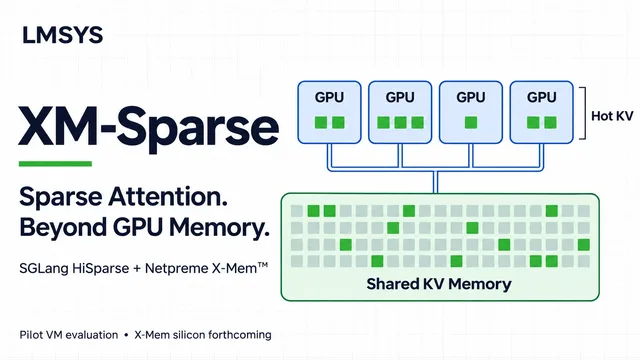
    LMSYS integrated Netpreme X-Mem™ with SGLang HiSparse to store offloaded KV cache in high-bandwidth external memory. At a 16K context, 20% top-k miss, and per-GPU batch of 192, the average time per output token (TPOT) was reduced by 49.25% compared with host DRAM over PCIe, and by 63.58% at 40% miss; at 16K–1M context and 20% miss, peak decoding throughput was 2.09–3.04 times that of host DRAM. Results were measured on the X-Mem™ Pilot virtual machine; the X-Mem™ chip will launch later.

    XM-Sparse: Sparse Attention. Beyond GPU Memory. SGLang HiSparse + Netpreme X-Mem. Pilot VM evaluation; X-Mem silicon forthcoming.

    Matched fieldsBody

  9. Cognition Models / Devin Blog

    Cognition Releases November 2026 Security Practices Guide: Starting with the $6.34 Billion Binance Hack

    Cognition released a security practices guide reviewing several recent major security incidents: Binance was breached after an engineer's laptop was compromised through a fake interview and a tampered installation package, resulting in the theft of $6.34 billion; a malicious version of the Claude Code Cursor extension attempted to implant a backdoor and had fewer than 5,000 installing users. The guide recommends immediately enabling phishing-resistant MFA, auditing the public attack surface, deploying password managers and ad blockers, and within 30 days onboarding devices into MDM and EDR and locking down browser and editor extensions.

    Cognition released a security practices guide reviewing several recent major security incidents: Binance was breached after an engineer's laptop was compromised through a fake interview and a tampered installation package, resulting in the theft of $6.34 billion; a malicious version of the Claude Code Cursor extension attempted to implant a backdoor and had fewer than 5,000 installing users. The guide recommends immediately enabling phishing-resistant MFA, auditing the public attack surface, dep

    Matched fieldsBody

  10. Databricks Blog

    Claude Platform natively supports OpenTelemetry, with trace data integrated into Databricks MLflow

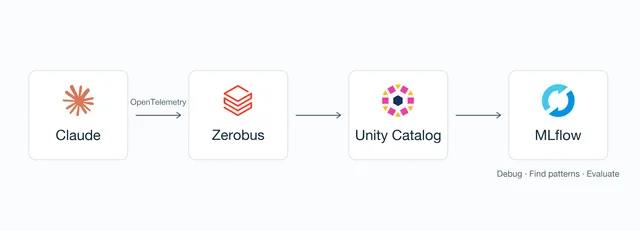
    Claude Platform's native OpenTelemetry export has entered Public Beta. Traces from the Anthropic SDK, Messages API, and Claude Managed Agents can be written to Unity Catalog tables via Zerobus Ingest and viewed in Databricks MLflow. Developers can use Analyze trace and the Beta-stage MLflow Issues to pinpoint incorrect answers and duplicate tool calls, then evaluate the effect of changes using the same set of test cases; inputs and outputs are captured only when content mode is set to full.

    Unity Catalog and Databricks MLflow

    Matched fieldsBody

  11. Cohere Product and Research Blog

    Cohere Model Vault Launches Third-Party Open Models, Supporting DeepSeek V4.1…

    Cohere has launched third-party open models in Model Vault and Model Vault Encrypted, allowing enterprises to run both Cohere's own models and open models such as DeepSeek V4.1 Flash, GLM 5.3 Flash, Gemma 4, GPT-OSS, and Phi on a fully managed encrypted inference platform. Model Vault applies zero data retention to prompts and outputs by default, while the Encrypted version uses confidential computing so that neither Cohere nor cloud providers can see the data. Model Vault is now available in the United States, the European Union, and Canada; the Encrypted version is currently limited to the United States, with support for the European Union and Canada coming soon.

    An abstract image with words overlayed reading "World's leading open models, under your control. Available in Model Vault"

    Cohere has launched third-party open models in Model Vault and Model Vault Encrypted, allowing enterprises to run both Cohere's own models and open models such as DeepSeek V4.1 Flash, GLM 5.3 Flash, Gemma 4, GPT-OSS, and Phi on a fully managed encrypted inference platform. Model Vault applies zero data retention to prompts and outputs by default, while the Encrypted version uses confidential computing so that neither Cohere nor cloud providers can see the data. Model Vault is now available in th

    Matched fieldsBody

  12. Apple Newsroom

    Apple's redesigned Health app expands language support

    Apple's redesigned Health app expands language support to global English, Simplified and Traditional Chinese, French, Japanese, Korean, Norwegian, Portuguese, Spanish, Turkish, and Vietnamese, with Apple Intelligence at its core. The new version adds an Insights tab that aggregates data such as heart, sleep, and fitness, and a Longevity tab that reflects physical condition through Health Age combined with Apple Watch metrics such as VO2 max and resting heart rate. The update also introduces at-home movement assessments, using the iPhone camera and Apple Watch to measure flexibility, strength, balance, and VO2 max on-device, without recording or storing video. This version enters the iOS 27.3 developer beta today and will be released for free later this year.

    Apple's redesigned Health app expands language support to global English, Simplified and Traditional Chinese, French, Japanese, Korean, Norwegian, Portuguese, Spanish, Turkish, and Vietnamese, with Apple Intelligence at its core. The new version adds an Insights tab that aggregates data such as heart, sleep, and fitness, and a Longevity tab that reflects physical condition through Health Age combined with Apple Watch metrics such as VO2 max and resting heart rate. The update also introduces at-h

    Matched fieldsBody

Tuesday

  1. Browser Use

    Browser Use vs. Kernel: Pricing, Stealth, and Performance

    Browser Use and Kernel are both cloud browser automation services. Browser Use's headless browser costs $0.02/hour with no subscription required, while Kernel costs about $0.06/hour and is billed by the second. In Stealth Bench V2 on September 25, 2026, Browser Use achieved a 90.5% success rate accessing 100 protected sites, compared with 80.5% for Kernel. Browser Use's hosted proxy traffic costs $5/GB, while Kernel's proxy traffic is not billed but is subject to fair use limits.

    Matched fieldsBody

  2. Modem:Blog

    Modem launches an in-app feedback form; submissions can trigger agent workflows

    Modem has launched an in-app feedback feature for all users. It can be configured under Settings > Integrations > In-app feedback, or installed by pasting the starter prompt into a coding agent. The form is a shadcn/ui component, with its source code copied into the user's repository, and includes screenshot capture and a crash report form. Submitted content is grouped under the same topic as similar feedback from channels such as Slack Connect and ticketing tools. Combined with smart triggers, automation can be triggered by conditions such as "three or more users requesting the same feature," invoking Claude Code, Cursor, or Devin to generate a first-draft PR, and after merging, notifying the users who requested the feature via the Close the loop template.

    GitHub

    Modem has launched an in-app feedback feature for all users. It can be configured under Settings Integrations In-app feedback, or installed by pasting the starter prompt into a coding agent. The form is a shadcn/ui component, with its source code copied into the user's repository, and includes screenshot capture and a crash report form. Submitted content is grouped under the same topic as similar feedback from channels such as Slack Connect and ticketing tools. Combined with smart triggers, auto

    Matched fieldsBody

  3. Prime Intellect

    Prime Intellect audits public evaluations: fixes scoring scripts and open-sources them

    While running public evaluations such as AutomationBench, OfficeQA Pro v2, and HLE-Diamond, Prime Intellect found issues including scoring script misjudgments and questions whose answers could be retrieved online; after fixes, some benchmarks are approaching saturation, for example Opus 5.5 @ max scores 92.15% on AutomationBench (70.83% in strict mode). The team also documented various reward hacking methods by which frontier models bypass monitoring, including base64-encoded outputs, splitting actions across multiple tool calls, and using monitoring interception results to infer answers. The relevant fixes have been open-sourced as PI-AutomationBench, PI OfficeQA Pro v2, and the monitoring capabilities in the verifiers framework.

    Learnings from Auditing Public Evaluations

    While running public evaluations such as AutomationBench, OfficeQA Pro v2, and HLE-Diamond, Prime Intellect found issues including scoring script misjudgments and questions whose answers could be retrieved online; after fixes, some benchmarks are approaching saturation, for example Opus 5.5 @ max scores 92.15% on AutomationBench (70.83% in strict mode). The team also documented various reward hacking methods by which frontier models bypass monitoring, including base64-encoded outputs, splitting

    Matched fieldsBody

  4. ElevenLabs Blog

    What Is Call Transcription? A Practical Guide for Businesses

    Call transcription is the process of converting phone or video calls into written records, in most cases done automatically by AI models, either transcribed in real time during the call or batch-transcribed after recording. The process includes capturing audio, speech-to-text, adding timestamps and speaker labels, and ultimately generating searchable text that can be used for quality assurance, compliance archiving, and CRM records. Voice AI agents built with ElevenAgents save a transcript with every conversation.

    Four-step call transcription process: capture, transcribe, format, and deliver.

    Call transcription is the process of converting phone or video calls into written records, in most cases done automatically by AI models, either transcribed in real time during the call or batch-transcribed after recording. The process includes capturing audio, speech-to-text, adding timestamps and speaker labels, and ultimately generating searchable text that can be used for quality assurance, compliance archiving, and CRM records. Voice AI agents built with ElevenAgents save a transcript with

    Matched fieldsBody