←Search results

By relevance · Total 2902 results Clear search

Tuesday

  1. Semiconductor Industry Observer

    The Jevons Paradox Meets Chip Iteration: Revisiting AI Compute Investment

    Gartner estimates that by 2030, AI data centers will need approximately $8.5 trillion in revenue to cover their investments, but actual AI-related revenue inflows will reach at most only $3.6 trillion, leaving more than $3.5 trillion in investment exposed to asset impairment risk. Based on Ornn leasing data, a16z points out that the actual rental rates for A100, H100, B200, and H200 are currently 9%, 54%, 111%, and 143% above expected levels, respectively. The author argues that demand growth and impairment of the first wave of infrastructure may occur simultaneously, and that the silicon roadmap determines the true pace of chip depreciation.

    Gartner estimates that by 2030, AI data centers will need approximately $8.5 trillion in revenue to cover their investments, but actual AI-related revenue inflows will reach at most only $3.6 trillion, leaving more than $3.5 trillion in investment exposed to asset impairment risk. Based on Ornn leasing data, a16z points out that the actual rental rates for A100, H100, B200, and H200 are currently 9%, 54%, 111%, and 143% above expected levels, respectively. The author argues that demand growth an

    Matched fieldsBody

  2. Unite.AI

    OpenAI Plans New Security Sprint and Raises Bug Bounty

    OpenAI announced plans to conduct a new round of internal security sprints with external researchers such as Cathedral. On the same day, the bug bounty update raised the median reward ranges for medium-, high-, and critical-severity vulnerabilities by an average of more than fourfold. Critical vulnerabilities in core products such as ChatGPT, Codex, or the API Platform can earn up to $30,000, and particularly severe findings can reach $172,000 after bonuses. In previous sprints, OpenAI committed 25% of its product engineers, used Codex to reproduce vulnerabilities and prepare patches, mobilized more than 250 people covering over 100 service areas, and closed 53 urgent or high-priority issues on the first day. OpenAI will also open its strongest models to Daybreak customers for authorized defensive work, a program corresponding to a $1 billion commitment and a six-month usage target.

    OpenAI announced plans to conduct a new round of internal security sprints with external researchers such as Cathedral. On the same day, the bug bounty update raised the median reward ranges for medium-, high-, and critical-severity vulnerabilities by an average of more than fourfold. Critical vulnerabilities in core products such as ChatGPT, Codex, or the API Platform can earn up to $30,000, and particularly severe findings can reach $172,000 after bonuses. In previous sprints, OpenAI committed

    Matched fieldsBody

  3. Unite.AI

    NVIDIA Partners to Expand City AI: Shared Infrastructure and Digital Twins

    On November 3, 2026, NVIDIA announced that it is working with its partners to expand physical AI and agentic services for cities worldwide, covering resident assistance, traffic management, urban planning, and industrial operations, while allowing local governments to retain control over the processing and use of sensitive data. The project combines shared computing infrastructure, AI agents, and digital twins, and city teams can start with NVIDIA RTX workstations or small GPU systems. ITMAX's SamurAI V2 visual agents are planned to support more than 17,000 camera streams by 2027, and signal timing tests based on TeraSim have reduced corridor travel times during peak hours by up to 26%.

    On November 3, 2026, NVIDIA announced that it is working with its partners to expand physical AI and agentic services for cities worldwide, covering resident assistance, traffic management, urban planning, and industrial operations, while allowing local governments to retain control over the processing and use of sensitive data. The project combines shared computing infrastructure, AI agents, and digital twins, and city teams can start with NVIDIA RTX workstations or small GPU systems. ITMAX's S

    Matched fieldsBody

  4. NVIDIA Blog

    NVIDIA and Global Partners Extend Physical AI and Agentic AI to City Services

    NVIDIA and its partners are extending physical AI and AI agents to cities around the world, covering Spain, the US Bay Area, Poland, Malaysia, Nigeria, Taiwan, and Morocco, among other places. Spain's 1MillionBot combines ALIA and Nemotron models to serve 150+ deployments; Malaysia's ITMAX SamurAI V2 plans to support 17,000+ cameras by 2027, and its TeraSim simulation reduces peak-hour corridor travel time by up to 26%.

    Matched fieldsBody

  5. Google Blog

    How Google is fighting scams in Asia-Pacific through new Android features, industry coalitions, and a $6 million grant

    Google is strengthening scam prevention in the Asia-Pacific region through Android's Fake Call Detection, which identifies AI-driven phone impersonation, on-device scam detection in Pixel, and sharing threat intelligence with the industry. Google.org is also providing $6 million in funding to The Asia Foundation and the Tech for Good Institute to train communities, incubate AI defense prototypes, and expand the educational game Be Scam Ready to Indonesia, Japan, Malaysia, the Philippines, and Vietnam. The original text mentions that scam losses in East Asia, Southeast Asia, Australia, and New Zealand reached up to $114.1 billion in 2025.

    A woman using her smartphone, surrounded by graphic icons representing online security, privacy, and message alerts.

    Google is strengthening scam prevention in the Asia-Pacific region through Android's Fake Call Detection, which identifies AI-driven phone impersonation, on-device scam detection in Pixel, and sharing threat intelligence with the industry. Google.org is also providing $6 million in funding to The Asia Foundation and the Tech for Good Institute to train communities, incubate AI defense prototypes, and expand the educational game Be Scam Ready to Indonesia, Japan, Malaysia, the Philippines, and Vi

    Matched fieldsBody

  6. The Guardian Technology

    UK NCSC warns: AI malware likely to be used to attack critical infrastructure before 2028

    The UK National Cyber Security Centre (NCSC) said in its annual assessment that from now until 2028, AI-driven malware is "likely" to be used in ransomware attacks targeting the UK's critical national infrastructure. The NCSC said AI can help attackers reconnaissance targets, find weaknesses in IT networks and write malicious code, and warned that Russia and China will "routinize" the use of AI in cyberattacks. NCSC Chief Executive Richard Horne will warn in a speech that the number of cyber incidents may rise unprecedentedly in the coming months.

    The UK National Cyber Security Centre (NCSC) said in its annual assessment that from now until 2028, AI-driven malware is "likely" to be used in ransomware attacks targeting the UK's critical national infrastructure. The NCSC said AI can help attackers reconnaissance targets, find weaknesses in IT networks and write malicious code, and warned that Russia and China will "routinize" the use of AI in cyberattacks. NCSC Chief Executive Richard Horne will warn in a speech that the number of cyber inc

    Matched fieldsBody

  7. MacRumors Apple Intelligence

    Apple FY2026 Q4 Earnings Call: iPhone Duo Demand Outstrips Supply, Siri AI to Have Usage Caps

    On Apple's FY2026 Q4 earnings call, CEO John Ternus said demand for the iPhone Duo cannot be met and that the timing for supply to balance is undetermined, and confirmed that usage caps will be set for server-side AI features such as Siri AI, with paid expansion required beyond the limit. In the quarter, iPhone revenue was $57.6 billion, up 17% year over year; Mac revenue was $10.8 billion; Services revenue reached a record high of $31.6 billion; and Greater China revenue grew 21%, setting a quarterly record. Apple called memory costs "unprecedented," expects them to rise further in the December quarter, and forecasts revenue growth of 7% to 10% year over year for the current quarter.

    On Apple's FY2026 Q4 earnings call, CEO John Ternus said demand for the iPhone Duo cannot be met and that the timing for supply to balance is undetermined, and confirmed that usage caps will be set for server-side AI features such as Siri AI, with paid expansion required beyond the limit. In the quarter, iPhone revenue was $57.6 billion, up 17% year over year; Mac revenue was $10.8 billion; Services revenue reached a record high of $31.6 billion; and Greater China revenue grew 21%, setting a qua

    Matched fieldsBody

  8. NVIDIA Developer · Generative AISelected

    NVIDIA Open-Sources NVIDIA Recovery to Automatically Recover Distributed Training Jobs on Clusters

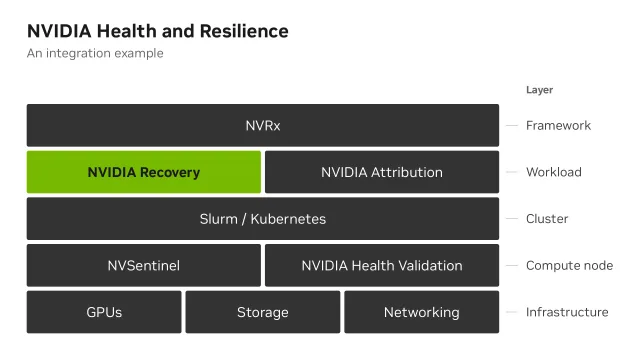
    NVIDIA has released NVIDIA Recovery, an open-source workload-level recovery service that detects training interruptions through application logs, GPU metrics, and scheduler signals, and handles them in a four-stage loop: detection, attribution, isolation, and restart or stop. The service is available under the Apache 2.0 license in the dsx-ai-factory/NVIDIA-Recovery repository. Slurm integration is implemented through an Advisor Controller deployed via a Helm chart, supporting both in-cluster and SSH modes. New deployments default to monitoring mode, which only outputs recovery recommendations without executing scheduling actions; from July 9 to October 9, monitoring on one training cluster covered nearly 200 jobs per day and recorded approximately 8,550 anomaly detections, with average detection and recovery action latencies of 69 seconds and 94 seconds, respectively.

    Five-layer stack diagram showing where NVIDIA Recovery sits in the health and resilience architecture. From the base up: infrastructure, compute node, cluster, workload (where NVIDIA Recovery and NVIDIA Attribution sit), and framework (NVIDIA Resiliency Extension, or NVRx).

    NVIDIA has released NVIDIA Recovery, an open-source workload-level recovery service that detects training interruptions through application logs, GPU metrics, and scheduler signals, and handles them in a four-stage loop: detection, attribution, isolation, and restart or stop. The service is available under the Apache 2.0 license in the dsx-ai-factory/NVIDIA-Recovery repository. Slurm integration is implemented through an Advisor Controller deployed via a Helm chart, supporting both in-cluster an

    Matched fieldsBody

  9. Sierra:Blog

    Sierra Redesigns Agent Studio Around Ghostwriter

    Sierra has redesigned Agent Studio, threading Ghostwriter throughout the entire interface so users can troubleshoot issues, modify journeys, run simulations, and test fixes within the same conversation. Each work item corresponds to a conversation, and changes remain within the conversation until review and merge, with support for sharing and forking; related agents can be grouped into the same project for unified testing and publishing, and it provides line-by-line diffs, Preview Chat, Simulations, and release approval with controlled rollout.

    Ghostwriter

    Sierra has redesigned Agent Studio, threading Ghostwriter throughout the entire interface so users can troubleshoot issues, modify journeys, run simulations, and test fixes within the same conversation. Each work item corresponds to a conversation, and changes remain within the conversation until review and merge, with support for sharing and forking; related agents can be grouped into the same project for unified testing and publishing, and it provides line-by-line diffs, Preview Chat, Simulati

    Matched fieldsBody

  10. NVIDIA Developer · Generative AISelected

    NVIDIA Releases Cosmos Framework and Cosmos NIM, Supporting World Model Training and Deployment

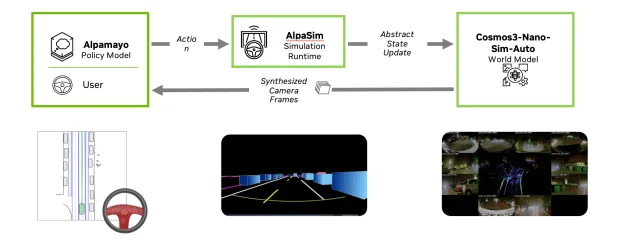
    NVIDIA has released the Cosmos Framework and Cosmos NIM for physical AI. The former provides modular tools and agent skills for training, reinforcement learning, optimization, and inference, while the latter provides accelerated inference services in container form. The Cosmos 3 Nano simulation recipe can generate synchronized camera video and LiDAR observations from released checkpoints, covering autonomous driving, robotics, and surgical scenarios. NIM uses quantization, speculative decoding, and KV-cache-aware routing to achieve a measured speedup of about 2–3x on H200, and Cosmos3-Nano generation tasks require 58 GiB of VRAM under BF16.

    A policy model (e.g., Alpamayo) or user sends an action to the AlpaSim simulation runtime. AlpaSim updates the simulation state and forwards the context to Cosmos3-Nano-Sim-Auto, which synthesizes the next camera frames and returns them to the policy, completing the loop.

    NVIDIA has released the Cosmos Framework and Cosmos NIM for physical AI. The former provides modular tools and agent skills for training, reinforcement learning, optimization, and inference, while the latter provides accelerated inference services in container form. The Cosmos 3 Nano simulation recipe can generate synchronized camera video and LiDAR observations from released checkpoints, covering autonomous driving, robotics, and surgical scenarios. NIM uses quantization, speculative decoding,

    Matched fieldsBody

  11. AWS Machine Learning

    How Circle K Cut DevOps Incident Triage to Under 15 Minutes with Amazon Bedrock

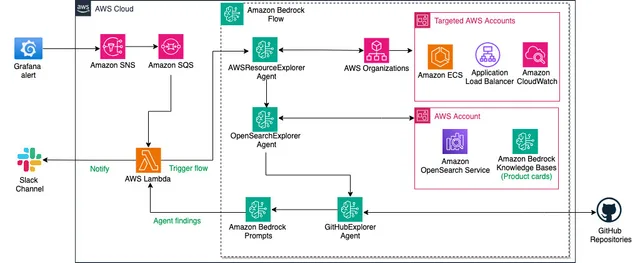
    Circle K built an agentic automated triage system with Amazon Bedrock, reducing average DevOps incident triage time to under 15 minutes—a 67–75% reduction according to internal team metrics. In the system, Grafana alerts trigger AWS Lambda via Amazon SNS and Amazon SQS to invoke Amazon Bedrock Flows, which orchestrates multiple specialized agents in parallel to query logs and infrastructure, and pushes structured summaries to Slack; it has since migrated to Amazon Bedrock AgentCore.

    Amazon Bedrock Flows triage architecture: a Grafana alert flows through Amazon SNS, SQS, and Lambda to parallel agents that post a summary to Slack

    Matched fieldsBody

  12. AWS Machine Learning

    Using Amazon Nova Multimodal Embeddings with Bedrock…

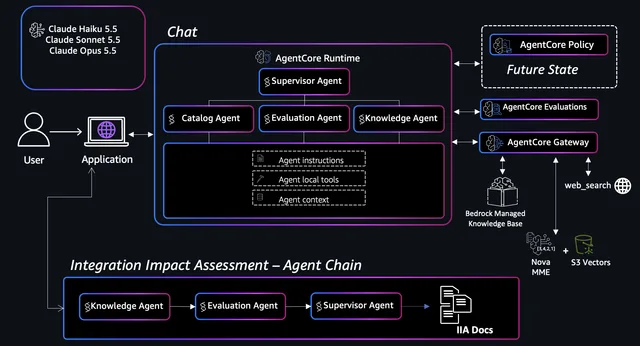
    AWS demonstrated a multi-agent engineering assistant based on Amazon Bedrock AgentCore, Amazon Nova Multimodal Embeddings, and the open-source Strands Agents SDK, designed to reduce manual cross-checking in parts substitution evaluations. In the system, a planner routes tasks to three expert agents—Catalog, Evaluation, and Knowledge—which are respectively responsible for multimodal retrieval, scoring according to Python tolerance rules, and verifying lifecycle information using real-time web data, with a supervisor ultimately aggregating the results. The system only assembles evidence and drafts review documents; it does not itself recommend or approve substitutions, and every evaluation writes an audit record aligned with AS9100 8.4 and 8.5.6.

    Architecture of the multi-agent assistant: a planner routes engineer queries across Catalog, Evaluation, and Knowledge specialists, with a supervisor synthesizing results

    AWS demonstrated a multi-agent engineering assistant based on Amazon Bedrock AgentCore, Amazon Nova Multimodal Embeddings, and the open-source Strands Agents SDK, designed to reduce manual cross-checking in parts substitution evaluations. In the system, a planner routes tasks to three expert agents—Catalog, Evaluation, and Knowledge—which are respectively responsible for multimodal retrieval, scoring according to Python tolerance rules, and verifying lifecycle information using real-time web dat

    Matched fieldsBody

  13. AWS Machine LearningSelected

    Building Efficient Agents with Knowledge Distillation on Amazon SageMaker AI

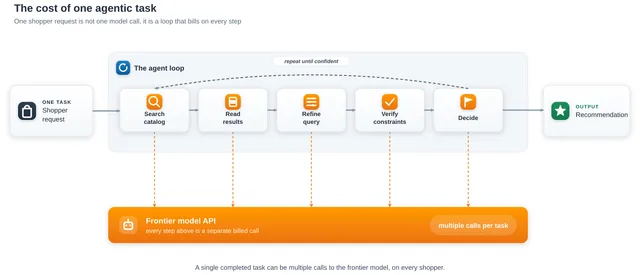
    An AWS official blog post explains how to fine-tune a shopping agent on Amazon SageMaker AI using sequence-level knowledge distillation (SeqKD): using GLM-5.3 on Amazon Bedrock as the teacher model to generate trajectories, using the ShoppingBench scorer to retain only trajectories that solve the task, and then performing serverless SFT on the Qwen3.5-4B student model. On 324 held-out test questions, the distilled 4B student's average absolute success rate increased from 0.297 to 0.541, essentially on par with the teacher model and mid-sized frontier models; when the teacher's reasoning process was removed and only tool calls were learned, the average success rate dropped to 0.415.

    Diagram of an agentic task as a loop: search, read results, refine, verify, and decide, with each step a separate billed call to the frontier model

    An AWS official blog post explains how to fine-tune a shopping agent on Amazon SageMaker AI using sequence-level knowledge distillation (SeqKD): using GLM-5.3 on Amazon Bedrock as the teacher model to generate trajectories, using the ShoppingBench scorer to retain only trajectories that solve the task, and then performing serverless SFT on the Qwen3.5-4B student model. On 324 held-out test questions, the distilled 4B student's average absolute success rate increased from 0.297 to 0.541, essentia

    Matched fieldsBody

Monday

  1. ElevenLabs Blog

    How is synthetic speech created? A step-by-step guide

    Synthetic speech is generated by neural AI models that analyze and replicate human speech patterns, in a three-step process: collecting real human recording data, training or fine-tuning a model, and then generating audio from text. Modern models sound natural because they replicate human prosody and are context-aware, rather than stitching words together one by one; ElevenLabs' generative TTS can also use instructions such as audio tags to control emotion and pacing.

    Collect voice data, train a model, generate speech; voice design needs no recording.

    Matched fieldsBody

  2. Zyphra ResearchSelected

    Zyphra proposes hierarchical attention ZHA, achieving sub-quadratic complexity sparse attention

    Zyphra proposes hierarchical attention ZHA, which selects relevant tokens for each query by constructing and searching a compressed tree of the KV cache, achieving sub-quadratic complexity under an appropriate top-p threshold. ZHA only requires KL distillation with a few billion tokens to adapt an existing pretrained model, adding only 81,920 trainable parameters on Qwen3.6-35B-A3B; on RULER-13 256K, the wide tree reaches 96.2% and the deep tree 93.3%, on LongBench v2 the deep tree reaches 63.4%, higher than dense attention's 58.0%, and on SWE-bench Verified it is comparable to the dense baseline. Its GPU performance model predicts it is faster than dense attention at about 48K tokens and faster than MSA at about 480K tokens, with roughly 32–35x speedup relative to dense attention at a ten-million-token context.

    Top-p Set Growth Rate is Sublinear

    Zyphra proposes hierarchical attention ZHA, which selects relevant tokens for each query by constructing and searching a compressed tree of the KV cache, achieving sub-quadratic complexity under an appropriate top-p threshold. ZHA only requires KL distillation with a few billion tokens to adapt an existing pretrained model, adding only 81,920 trainable parameters on Qwen3.6-35B-A3B; on RULER-13 256K, the wide tree reaches 96.2% and the deep tree 93.3%, on LongBench v2 the deep tree reaches 63.4%

    Matched fieldsBody

  3. Pydantic AI official article

    Pydantic AI Compares Nine Python Agent Frameworks in 2026

    Pydantic AI officially released a 2026 comparison of Python AI agent frameworks, evaluating nine frameworks item by item against criteria such as model switchability, durable execution after crashes, human approval, frontend and voice integration, MCP, and observability, and giving the applicable scenarios for each. The article states that Pydantic AI supports 30+ model providers, 8 durable execution engines (Temporal, DBOS, Prefect, Restate, AWS Lambda, Absurd, pgtask, Apache Airflow), 5 speech-to-speech providers, and 10 sandboxes, while also noting that it supports only Python, does not offer a hosted platform, and has fewer retrieval-related integrations than LangChain. The comparison also covers LangGraph/LangChain, OpenAI Agents SDK, Google ADK, Microsoft Agent Framework, Strands Agents, CrewAI, Claude Agent SDK, and Agno, and separately lists the two voice frameworks LiveKit Agents and Pipecat.

    Douwe Maan avatar

    Pydantic AI officially released a 2026 comparison of Python AI agent frameworks, evaluating nine frameworks item by item against criteria such as model switchability, durable execution after crashes, human approval, frontend and voice integration, MCP, and observability, and giving the applicable scenarios for each. The article states that Pydantic AI supports 30+ model providers, 8 durable execution engines (Temporal, DBOS, Prefect, Restate, AWS Lambda, Absurd, pgtask, Apache Airflow), 5 speech

    Matched fieldsBody

  4. Databricks Blog

    Lakebase Postgres Generally Available on Google Cloud

    Databricks announced that its fully managed serverless Postgres database, Lakebase Postgres, is generally available on Google Cloud, supporting autoscaling, scale-to-zero, second-level branching, and point-in-time recovery. It shares the same storage layer with analytical data, eliminating the need to maintain ETL pipelines, and provides unified governance through Unity Catalog; multi-availability-zone endpoints offer a 99.99% SLA, while single availability zones offer 99.9%. Lakebase Search delivers 2x the vector and full-text search throughput of pgvector at 4x lower cost.

    Databricks announced that its fully managed serverless Postgres database, Lakebase Postgres, is generally available on Google Cloud, supporting autoscaling, scale-to-zero, second-level branching, and point-in-time recovery. It shares the same storage layer with analytical data, eliminating the need to maintain ETL pipelines, and provides unified governance through Unity Catalog; multi-availability-zone endpoints offer a 99.99% SLA, while single availability zones offer 99.9%. Lakebase Search del

    Matched fieldsBody

  5. LMSYS Blog

    LMSYS explains in detail how HiCache adapts to multi-parallelism and distributed inference

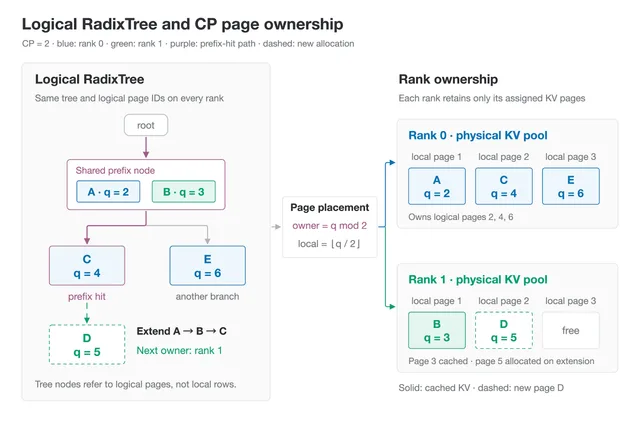
    The LMSYS blog introduces how HiCache is implemented in context parallelism, pipeline parallelism, speculative decoding, unified KV layout, and P/D disaggregation scenarios, with the core being to keep cache decisions consistent across ranks. The iFlytek Spark MaaS team used HiCache plus external storage to serve GLM-5.1/5.2 CodingPlan workloads, raising the cache hit rate from about 30% to 95% and reducing median TTFT to under 3 seconds. In CP sharding tests, the GPU token hit rate increased by 40.48 percentage points, the host memory serving token volume dropped by 81.2%, and the average prefill queueing time decreased by 56.2%.

    A logical radix tree shared by two CP ranks: logical page IDs map to rank 0 or rank 1 by q mod 2, and extending the A/B/C prefix allocates page D on rank 1.

    The LMSYS blog introduces how HiCache is implemented in context parallelism, pipeline parallelism, speculative decoding, unified KV layout, and P/D disaggregation scenarios, with the core being to keep cache decisions consistent across ranks. The iFlytek Spark MaaS team used HiCache plus external storage to serve GLM-5.1/5.2 CodingPlan workloads, raising the cache hit rate from about 30% to 95% and reducing median TTFT to under 3 seconds. In CP sharding tests, the GPU token hit rate increased by

    Matched fieldsBody

  6. Google Blog

    Google's October AI Update: Gemini 4 Argon Launches Globally, Gemini 4…

    In October, Google launched its frontier reasoning model Gemini 4 Argon globally, covering Google AI Studio, the Gemini API, Google Cloud, Search, and the Gemini app. Two weeks later, it announced Gemini 4 Carbon, focused on long-horizon engineering and cybersecurity defense, which is currently undergoing pre-release testing with the U.S. government and select trusted cybersecurity parties through the Fairwind Program. In the same period, it released Genie 4, a real-time interactive world model that supports native audio and natural-language scene control; SynthID Detector opened globally in English and can identify AI content from partners such as OpenAI, NVIDIA, Kakao, and Apple.

    Text with a rainbow colored gradient "The big picture"

    In October, Google launched its frontier reasoning model Gemini 4 Argon globally, covering Google AI Studio, the Gemini API, Google Cloud, Search, and the Gemini app. Two weeks later, it announced Gemini 4 Carbon, focused on long-horizon engineering and cybersecurity defense, which is currently undergoing pre-release testing with the U.S. government and select trusted cybersecurity parties through the Fairwind Program. In the same period, it released Genie 4, a real-time interactive world model

    Matched fieldsBody

  7. Figma AI / Agent / Make

    How Figma brought Hello Kitty and Friends into FigJam

    Figma partnered with Sanrio to launch Hello Kitty and Friends in FigJam for one week starting November 1. Users can choose one of 12 Sanrio characters to join brainstorming, and each character comes with its own cursor, washi tape, and sticky note theme. The team used Figma Motion to create the loading animation and used Figma agent to complete batch edits; a free Hello Kitty birthday pop-up event will also be held in New York from November 6–8.

    Three vertical panels showing tightly cropped views of Keroppi, My Melody, and Hello Kitty against green, pink, and red backgrounds, with matching character-themed cursors and name labels.

    Matched fieldsBody