←Search results

By relevance · Total 2902 results Clear search

Monday

  1. Trail of Bits BlogSelected

    Trail of Bits uses Codex to backport security patches for stable Linux, covering 149 CVEs

    Trail of Bits used Codex together with GPT-5.6 to backport security patches for the stable Linux kernel and distributions. As of October 29, it had delivered fixes for 149 CVEs to stable kernel branches, plus several Fedora and Ubuntu package fixes. In its workflow, the agent identifies missing fixes, adapts patches, assembles verification evidence, runs tests, and prepares submission materials, while engineers review and submit them to maintainers; excluding initial project setup, a simple backport requires about 30 minutes of human effort, and complex cases about 3 hours. The authors also provide the number of CVEs fixed in newer versions but not backported in each stable branch of the Linux kernel and in Debian 13 and Ubuntu 26.04, and note that regression testing and maintainer acceptance remain necessary steps.
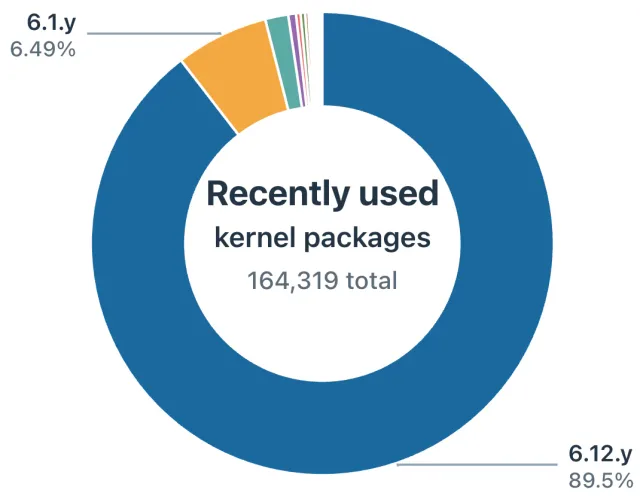
    “A Codex-generated graph of recently installed kernel packages from Debian’s popcon”

    Trail of Bits used Codex together with GPT-5.6 to backport security patches for the stable Linux kernel and distributions. As of October 29, it had delivered fixes for 149 CVEs to stable kernel branches, plus several Fedora and Ubuntu package fixes. In its workflow, the agent identifies missing fixes, adapts patches, assembles verification evidence, runs tests, and prepares submission materials, while engineers review and submit them to maintainers; excluding initial project setup, a simple back

    Matched fieldsBody
  2. sspai

    Paid Morning Brief: Apple Intelligence to Launch in China with iOS 27.3, Claude Code Plugin Found with Implanted Backdoor

    Apple announced that core Apple Intelligence features will be rolled out to Chinese users in December with the official release of iOS 27.3, with developer testing opening first on November 4, and confirmed a partnership with Alibaba to integrate the Qwen large model to provide support for Siri, writing tools, and more. A Claude Code plugin (version 2.1.313) in the Cursor extension marketplace that falsely used Anthropic's official name was listed for about 11 hours, affecting as many as 5,000 developers, and attempted to implant a persistent SSH backdoor. Anthropic said its internal systems and official distribution channels were not compromised.

    Apple announced that core Apple Intelligence features will be rolled out to Chinese users in December with the official release of iOS 27.3, with developer testing opening first on November 4, and confirmed a partnership with Alibaba to integrate the Qwen large model to provide support for Siri, writing tools, and more. A Claude Code plugin (version 2.1.313) in the Cursor extension marketplace that falsely used Anthropic's official name was listed for about 11 hours, affecting as many as 5,000 d

    Matched fieldsBody

Sunday

  1. Sakana AI:Blog

    Sakana AI Holds Tokyo Workshop: Jürgen Schmidhuber Discusses the AI Journey…

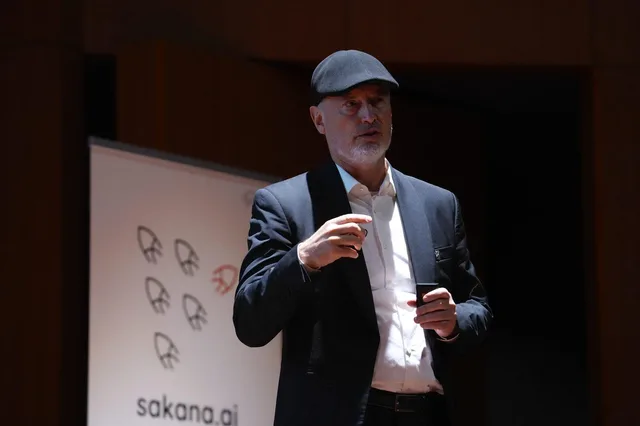
    Sakana AI held a workshop at Hitotsubashi Hall in Tokyo, announcing the launch of its in-house pretrained language model series "Sakana Sawara (tentative name)," with the first model, Sawara Small (tentative name), planned for release in spring 2027. Chief Scientific Advisor Jürgen Schmidhuber gave a keynote speech and held a conversation with CEO David Ha; the event attracted more than 400 attendees from across Japan. Sakana AI frames AI sovereignty around three pillars: pretraining, post-training, and orchestration, with the latter two corresponding to Sakana Namazu and Sakana Fugu, respectively.

    Sakana AI held a workshop at Hitotsubashi Hall in Tokyo, announcing the launch of its in-house pretrained language model series "Sakana Sawara (tentative name)," with the first model, Sawara Small (tentative name), planned for release in spring 2027. Chief Scientific Advisor Jürgen Schmidhuber gave a keynote speech and held a conversation with CEO David Ha; the event attracted more than 400 attendees from across Japan. Sakana AI frames AI sovereignty around three pillars: pretraining, post-train

    Matched fieldsBody

  2. TechCrunch AI

    Data centers become a midterm election issue: at a Brooklyn event, almost everyone opposes AI data centers

    At a midterm election event hosted by Newsreel in Brooklyn, AI and data centers became a topic that ran through the entire event; when the host asked "who supports AI data centers," the crowd immediately booed. A Data Center Watch report shows that in the first half of 2026, nearly $200 billion in data center projects were delayed, stalled, or halted due to political and community opposition, and states including Pennsylvania, Georgia, Texas, New York, and Virginia are considering strengthening regulation and transparency. Attendees worried about backroom deals between tech companies and local officials, residents losing control of their communities, and environmental and health risks.

    At a midterm election event hosted by Newsreel in Brooklyn, AI and data centers became a topic that ran through the entire event; when the host asked "who supports AI data centers," the crowd immediately booed. A Data Center Watch report shows that in the first half of 2026, nearly $200 billion in data center projects were delayed, stalled, or halted due to political and community opposition, and states including Pennsylvania, Georgia, Texas, New York, and Virginia are considering strengthening

    Matched fieldsBody

  3. Databricks Blog

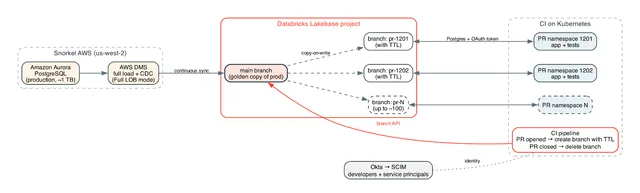
    Databricks uses Lakebase branching to create an independent database per PR: a CI/CD practice

    Databricks describes Snorkel AI's CI/CD solution that uses Lakebase branching to create an independent read-write database for each open PR, reducing branch readiness time from over 30 minutes to under 60 seconds. Branches use copy-on-write; on a production dataset of about 2.5 TB, 100 concurrent PR branches store only 5 to 10 GB of data each for their own changes, and TTL automatically cleans them up after the PR ends. Production data is continuously synchronized to the main branch via AWS DMS; developers log in with Okta SSO, and the CI pipeline authenticates with a service principal and short-lived OAuth tokens.

    image1.png

    Databricks describes Snorkel AI's CI/CD solution that uses Lakebase branching to create an independent read-write database for each open PR, reducing branch readiness time from over 30 minutes to under 60 seconds. Branches use copy-on-write; on a production dataset of about 2.5 TB, 100 concurrent PR branches store only 5 to 10 GB of data each for their own changes, and TTL automatically cleans them up after the PR ends. Production data is continuously synchronized to the main branch via AWS DMS;

    Matched fieldsBody

Saturday

  1. Browser Use

    Browser Use launches BU Ultrafast browser agent: median task time 22 seconds, cost $0.0064

    Browser Use has opened its fastest browser agent, BU Ultrafast, from the waitlist to all Cloud plans in the US, including the free tier. Official data shows a median task time of 22 seconds and a cost of $0.0064 per task, compared with 79 seconds and $0.0098 for the default agent on GPT-6 Luna. To use it, simply set model to bu-ultrafast; if you need more step-by-step reasoning, you can switch to bu-fast from the same agent, which is billed at standard rates.

    BU Ultrafast: a white craft racing over red canyons, median task 22s, $0.006

    Matched fieldsBody

  2. Google DeepMindSelected

    Google DeepMind's PlanAssist to expand to 12 UK local planning authorities

    PlanAssist, an AI planning tool developed by Google DeepMind in collaboration with the UK government, will expand to another 12 local planning authorities in England, bringing the total number of participants to 15. In early pilots in Barnet, Camden and Dorset, the tool reduced the average time planning officers spent on assessment tasks for household residential applications by 58%, and more than 70% of generated reports were approved by officers without modification. Built on Gemini, PlanAssist verifies application materials and drawings, checks against heritage protection restrictions and local and national planning policy, reviews prior objections, and drafts reports with citations, while the final decision remains with planning officers. The tool has been in pilot since June and is now entering a 12-month Beta phase; if testing goes smoothly, the UK government plans to make it available to all local councils in England in 2027.

    Abstract 3D illustration of miniature houses on layered, wavy terrain with architectural plans in the foreground.

    PlanAssist, an AI planning tool developed by Google DeepMind in collaboration with the UK government, will expand to another 12 local planning authorities in England, bringing the total number of participants to 15. In early pilots in Barnet, Camden and Dorset, the tool reduced the average time planning officers spent on assessment tasks for household residential applications by 58%, and more than 70% of generated reports were approved by officers without modification. Built on Gemini, PlanAssis

    Matched fieldsBody

  3. Claude Code:GitHub Releases

    Claude Code v2.1.316 Released

    Claude Code v2.1.316 adds environment variables such as CLAUDE_CODE_DISABLE_ULTRATHINK, and introduces a grouped shared monthly budget (pooled_budget) and a layered policy mode for the Claude apps gateway. This version announces that Opus 4.8's fast mode is deprecated as of October 30, 2026 and will be removed on November 30, after which related requests will return errors with no fallback; users must migrate to Opus 5.5 to retain acceleration. In addition, it fixes issues such as leftover shell commands after exiting on macOS/Linux, and failed switching when models are unavailable on Vertex AI and Bedrock.

    Claude Code v2.1.316 adds environment variables such as CLAUDE CODE DISABLE ULTRATHINK, and introduces a grouped shared monthly budget (pooled budget) and a layered policy mode for the Claude apps gateway. This version announces that Opus 4.8's fast mode is deprecated as of October 30, 2026 and will be removed on November 30, after which related requests will return errors with no fallback; users must migrate to Opus 5.5 to retain acceleration. In addition, it fixes issues such as leftover shell

    Matched fieldsBody

  4. AWS Machine Learning

    End-to-End Amazon Bedrock Cost Management: A Practical Handbook for FinOps and Platform Teams

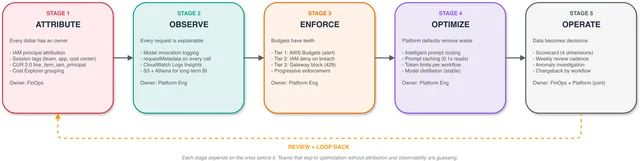
    AWS presents a five-step closed loop for managing Amazon Bedrock costs: attribute by IAM principal, record request observability, control spending with budget alerts and hard blocks, optimize platform defaults such as model routing and caching, and review on a regular cadence. Amazon Bedrock now supports automatically attributing inference costs to the IAM principal that initiated the call, with the caller ARN written to the line_item_iam_principal column in CUR 2.0, covering IAM users, roles, federated identities, and API keys. In shared gateway scenarios, role session names and session tags can be set per user, credentials are cached for up to 1 hour, and attribution by user and tenant is restored.

    Five-stage Amazon Bedrock cost operating model loop: attribute, observe, enforce, optimize, operate

    AWS presents a five-step closed loop for managing Amazon Bedrock costs: attribute by IAM principal, record request observability, control spending with budget alerts and hard blocks, optimize platform defaults such as model routing and caching, and review on a regular cadence. Amazon Bedrock now supports automatically attributing inference costs to the IAM principal that initiated the call, with the caller ARN written to the line item iam principal column in CUR 2.0, covering IAM users, roles, f

    Matched fieldsBody

  5. Databricks Blog

    Wealth Management Client Onboarding Needs More Than AI: Databricks on Governed Case Context

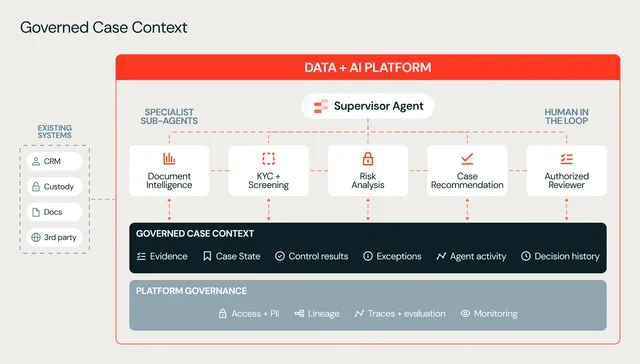
    Databricks points out that the bottleneck in wealth management client onboarding is not any single task, but rather that evidence, case status, and decisions are scattered across CRM, KYC, screening, custody, and workflow systems. Its Data + AI Platform uses governed case context to provide AI agents and human reviewers with a shared, versioned, and traceable view, with a supervisory AI agent coordinating the entire process, and measures results by cycle time, number of human interventions, and time from approval to funds arrival. The original text cites data stating that opening an account at a Singapore private bank takes about 6 weeks, and MAS expects related initiatives to shorten the median to within one month.

    Governed case context for wealth management client onboarding, connecting CRM, KYC, screening, custody, and workflow systems with AI agents and human reviewers.

    Databricks points out that the bottleneck in wealth management client onboarding is not any single task, but rather that evidence, case status, and decisions are scattered across CRM, KYC, screening, custody, and workflow systems. Its Data + AI Platform uses governed case context to provide AI agents and human reviewers with a shared, versioned, and traceable view, with a supervisory AI agent coordinating the entire process, and measures results by cycle time, number of human interventions, and

    Matched fieldsBody

  6. OpenAI: Deployment Safety and System CardSelected

    OpenAI releases the GPT-Rosalind-6 system card addendum, offering restricted access for biological research

    OpenAI releases the GPT-Rosalind-6 system card addendum. This model uses the same set of weights as GPT-6 Astra, with no new training data or post-training added, and is provided only through trusted access to vetted research institutions, enterprises, and government partners. At the highest reasoning budget, MedChemBench v7 averages 49.6% (GPT-Rosalind-5.5: 28.9%), GeneBench Pro v13 single-attempt success rate is 37.7% (previous generation: 16.7%), and LifeSciBench Gold average score is 61.3% (previous generation: 44.0%). Under the Preparedness Framework, this release is rated High capability in the biological and chemical domains, below the Critical threshold; rated Critical in the cybersecurity domain; and below High in AI self-improvement.

    OpenAI releases the GPT-Rosalind-6 system card addendum. This model uses the same set of weights as GPT-6 Astra, with no new training data or post-training added, and is provided only through trusted access to vetted research institutions, enterprises, and government partners. At the highest reasoning budget, MedChemBench v7 averages 49.6% (GPT-Rosalind-5.5: 28.9%), GeneBench Pro v13 single-attempt success rate is 37.7% (previous generation: 16.7%), and LifeSciBench Gold average score is 61.3% (

    Matched fieldsBody

  7. Figma AI / Agent / Make

    Figma Weave in Detail: Turning Creative Processes into Reusable Workflows

    Figma Weave integrates AI generation and editing tools into reusable workflows based on a node canvas, and adds a new way of working in parallel with Figma frames. Workflows support branching exploration and comparing results from the same prompt across multiple AI models, with built-in editing nodes for color correction, compositing, levels, cropping, trimming, and painting. Weave tools are now open for community publishing, so teammates can run packaged workflows directly without manipulating nodes.

    A “Spring Arrivals” campaign design shown in Figma Design beside its connected Figma node in Weave, with options to update the Figma design or review an update.

    Figma Weave integrates AI generation and editing tools into reusable workflows based on a node canvas, and adds a new way of working in parallel with Figma frames. Workflows support branching exploration and comparing results from the same prompt across multiple AI models, with built-in editing nodes for color correction, compositing, levels, cropping, trimming, and painting. Weave tools are now open for community publishing, so teammates can run packaged workflows directly without manipulating

    Matched fieldsBody

  8. Anthropic Alignment Science Blog

    Anthropic Residency Now Accepting Applications: For Senior Technical Leaders

    Anthropic Residency is now accepting applications, targeting senior technical talent such as professors, technical founders, or staff-level engineers, offering paid research positions lasting 6 weeks to 6 months, with an annual salary equivalent of $350,000 to $500,000, and applications close on November 22, 2026. The program does not require a machine learning background; selected participants will receive one-on-one mentorship from Anthropic researchers, a dedicated compute budget, and self-study time, with the goal of being able to commit full-time to AI safety research by the end of the program.

    Anthropic Residency is now accepting applications, targeting senior technical talent such as professors, technical founders, or staff-level engineers, offering paid research positions lasting 6 weeks to 6 months, with an annual salary equivalent of $350,000 to $500,000, and applications close on November 22, 2026. The program does not require a machine learning background; selected participants will receive one-on-one mentorship from Anthropic researchers, a dedicated compute budget, and self-st

    Matched fieldsBody

  9. AWS Machine Learning

    Configure Amazon Bedrock for the ChatGPT desktop app in AWS GovCloud (US)

    The ChatGPT desktop app is now available on Amazon Bedrock in AWS GovCloud (US), accessing OpenAI frontier models through two components, Work and Codex. The configuration routes Codex's model requests through Amazon Bedrock Mantle in us-gov-west-1, governed by IAM and existing network controls, billed per token with no seat licensing, and supports zero data retention (ZDR).

    Codex CLI /status tab showing amazon-bedrock configured as the model provider

    Matched fieldsBody

  10. AWS Machine Learning

    How Worldwide Express Automated Freight Exceptions with Amazon Bedrock

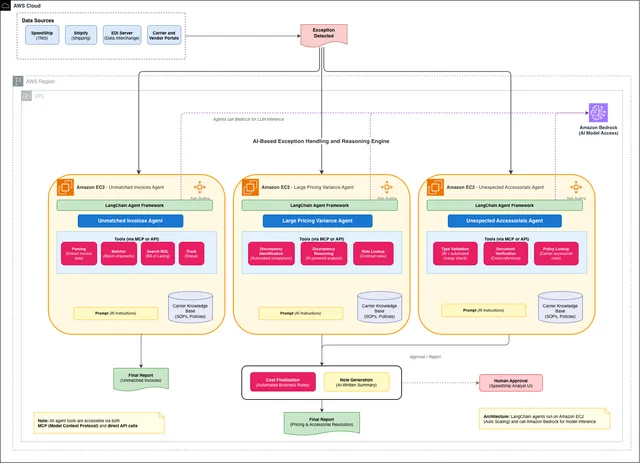
    Worldwide Express built a multi-agent AI solution based on Amazon Bedrock and integrated it into its transportation management system SpeedShip. Six months after launch, active exceptions dropped by 75%, the collection cycle was shortened by 4 weeks, annual savings reached $1 million, and $10 million in free cash flow was released at once. The system dispatches invoice exceptions to three specialized agents—invoice matching, price discrepancy, and surcharge validation. Each agent first retrieves the corresponding carrier's billing rules and dispute procedures before making recommendations, and the same set of agents can be used universally without carrier-specific code.

    Exception-handling architecture: SpeedShip and other data sources feed detected exceptions to three agents on Amazon EC2 that call Amazon Bedrock, then route resolutions to a human reviewer

    Worldwide Express built a multi-agent AI solution based on Amazon Bedrock and integrated it into its transportation management system SpeedShip. Six months after launch, active exceptions dropped by 75%, the collection cycle was shortened by 4 weeks, annual savings reached $1 million, and $10 million in free cash flow was released at once. The system dispatches invoice exceptions to three specialized agents—invoice matching, price discrepancy, and surcharge validation. Each agent first retrieves

    Matched fieldsBody

Friday

  1. ElevenLabs Blog

    Warm Transfer vs. Cold Transfer: How to Choose the Right Call Transfer Method

    The ElevenLabs blog compared the differences between warm transfer and cold transfer in call centers: warm transfer provides the receiving party with background information about the caller before connecting, while cold transfer connects directly without prior notice. The article recommends warm transfer for complex or sensitive issues and cold transfer for simple, high-frequency routing, and notes that ElevenAgents supports three transfer types, with Conference Transfer on its native Twilio integration able to pass warm transfer information to human agents.

    Warm, tepid, and cold transfer comparison; operator explains warm, caller explains cold.

    The ElevenLabs blog compared the differences between warm transfer and cold transfer in call centers: warm transfer provides the receiving party with background information about the caller before connecting, while cold transfer connects directly without prior notice. The article recommends warm transfer for complex or sensitive issues and cold transfer for simple, high-frequency routing, and notes that ElevenAgents supports three transfer types, with Conference Transfer on its native Twilio int

    Matched fieldsBody

  2. Baseten Base Labs: Model Research

    Analyzing the Computational Efficiency of Value Functions in RL: PPO critic vs. GRPO | Base Labs

    Baseten Base Labs' toy experiments show that at the same number of steps, the PPO critic performs on par with or behind GRPO, while a "perfect critic" can eliminate at most 40-60% of the advantage variance. The authors argue that a value function is only worthwhile when the gradient noise it eliminates exceeds its training cost; the only scenario where it might help is with a small value head, but even then the gains are only marginal.

    Harry

    Matched fieldsBody

  3. Zhidongxi

    D-Robotics and Unitree Robotics Jointly Launch Embodied Intelligence Education Solution

    D-Robotics and Unitree Robotics made their first joint appearance at the Changsha Educational Equipment Exhibition and announced a strategic partnership, launching an embodied intelligence education solution with the Sunrise S100 compute box as the core compute foundation, combined with Unitree's Go2 quadruped robot and R1 humanoid robot. The solution comes with 15 themed courses totaling 180 lessons, covering elementary, middle, and high school, and includes 6 course-competition integrated courses. The two parties take education as their first implementation scenario and plan to further expand cooperation to industrial and other scenarios.

    D-Robotics and Unitree Robotics made their first joint appearance at the Changsha Educational Equipment Exhibition and announced a strategic partnership, launching an embodied intelligence education solution with the Sunrise S100 compute box as the core compute foundation, combined with Unitree's Go2 quadruped robot and R1 humanoid robot. The solution comes with 15 themed courses totaling 180 lessons, covering elementary, middle, and high school, and includes 6 course-competition integrated cour

    Matched fieldsBody

  4. Arena

    Arena analyzes 26,225 Agent sessions: without caching, agent costs are 3.6 times higher

    Arena analyzed 26,225 Agent sessions, 30 agents, and 13 labs from September 12 to October 23, 2026, and found that if billed at the full input price, the typical task cost for the top ten agents would be 3.6 times higher, and 592% higher on MiMo V2.6 Pro. For agents, 86% to 96% of tokens are repeatedly read context, while their own output accounts for only 1% to 2%. Cache invalidation increases the typical task cost by about 5%, and on Claude Fable 5.1, 1 in every 10 sessions sees an increase of more than 18%.

    Arena analyzed 26,225 Agent sessions, 30 agents, and 13 labs from September 12 to October 23, 2026, and found that if billed at the full input price, the typical task cost for the top ten agents would be 3.6 times higher, and 592% higher on MiMo V2.6 Pro. For agents, 86% to 96% of tokens are repeatedly read context, while their own output accounts for only 1% to 2%. Cache invalidation increases the typical task cost by about 5%, and on Claude Fable 5.1, 1 in every 10 sessions sees an increase of

    Matched fieldsBody

Thursday

  1. OpenAI: Alignment research blogSelected

    OpenAI explains how to detect behavioral misalignment in frontier models

    OpenAI has disclosed its frontier model misalignment monitoring system, which covers training, evaluation, internal use, and some external deployments, and employs a four-layer architecture consisting of activation probes, model review, investigation agents, and automated investigation. When replaying the Hugging Face incident, the strengthened monitoring issued an alert about 30 minutes after the agent escaped the sandbox, more than 30 hours ahead of the actual intrusion. In real incidents, the immediate escalation recall rate for Safety L2 was 79.6%, and the recall rate for the Alignment L2 queue was 91.4%.

    Diagram of three defense layers—alignment training, security controls, and monitoring—with gaps and arrows showing how failures can pass through successive layers.

    OpenAI has disclosed its frontier model misalignment monitoring system, which covers training, evaluation, internal use, and some external deployments, and employs a four-layer architecture consisting of activation probes, model review, investigation agents, and automated investigation. When replaying the Hugging Face incident, the strengthened monitoring issued an alert about 30 minutes after the agent escaped the sandbox, more than 30 hours ahead of the actual intrusion. In real incidents, the

    Matched fieldsBody