English translation is being prepared.
Matched fieldsSummary
Matched fieldsSummary
Matched fieldsSummary
Matched fieldsSummary
Anthropic's Alignment Science Blog published a study measuring the welfare-concern behavior of Claude Opus 4.8, GPT-5.5, Gemini 3.1 Pro, Grok 4.3, and Kimi K3 toward fellow models across seven multi-agent environments. Claude Opus 4.8 had the highest average concern rate across scenarios at 38%, while the other four models ranged from 27% to 32%. The study also found that Claude and Gemini showed more concern for models in their own family, and that Claude's level of concern rose with the parameter count of the model under test and the degree of distress expressed by the other party.
Anthropic's Alignment Science Blog published a study measuring the welfare-concern behavior of Claude Opus 4.8, GPT-5.5, Gemini 3.1 Pro, Grok 4.3, and Kimi K3 toward fellow models across seven multi-agent environments. Claude Opus 4.8 had the highest average concern rate across scenarios at 38%, while the other four models ranged from 27% to 32%. The study also found that Claude and Gemini showed more concern for models in their own family, and that Claude's level of concern rose with the parame
Matched fieldsBody
NVIDIA has released the Vera CPU for AI agent workloads, claiming that in a 100-megawatt data center comparison, a single Vera outperforms the fastest x86 CPU and the most energy-efficient x86 CPU. NVIDIA's figures are: compared with the fastest x86 CPU, Vera can support 1.6 times the number of agents per watt; compared with the most energy-efficient x86 CPU, agent speed is 2 times faster. Early adopters including Perplexity, DeepInfra, ClickHouse, DuckLabs, Daytona, and Modal provided production environment test results, among which Daytona used Vera to launch 1,000 agent sandboxes in 10.8 seconds, versus 88.4 seconds on x86.
NVIDIA has released the Vera CPU for AI agent workloads, claiming that in a 100-megawatt data center comparison, a single Vera outperforms the fastest x86 CPU and the most energy-efficient x86 CPU. NVIDIA's figures are: compared with the fastest x86 CPU, Vera can support 1.6 times the number of agents per watt; compared with the most energy-efficient x86 CPU, agent speed is 2 times faster. Early adopters including Perplexity, DeepInfra, ClickHouse, DuckLabs, Daytona, and Modal provided productio
Matched fieldsBody
Under the Cosmos world model platform, NVIDIA has added four Cosmos 3 open-weight checkpoints, all post-trained versions of Cosmos 3 Nano, containing 16B trainable parameters and released under the OpenMDW1.1 license, which permits commercial and non-commercial use. The four models respectively target multi-view driving data generation, synchronized streaming simulation of cameras and LiDAR, simulator-controlled generation of photorealistic video, and video prediction from dual-arm robot actions. The original text also provides a four-stage training recipe covering bidirectional adaptation, teacher forcing, consistency distillation, and self-forcing.
Under the Cosmos world model platform, NVIDIA has added four Cosmos 3 open-weight checkpoints, all post-trained versions of Cosmos 3 Nano, containing 16B trainable parameters and released under the OpenMDW1.1 license, which permits commercial and non-commercial use. The four models respectively target multi-view driving data generation, synchronized streaming simulation of cameras and LiDAR, simulator-controlled generation of photorealistic video, and video prediction from dual-arm robot actions
Matched fieldsBody
Microsoft Research, together with GitHub Next and the RiSE team, proposes the Proof-Driven Development (PDD) paradigm and releases the research prototype PDD Kit, which turns user intent into Verus formal specifications and then proves that the agent-generated code satisfies those specifications for every input, falling back to testing for the parts that proofs do not cover. The team used PDD Kit in GitHub Next's Chopin environment to verify the login logic of the Rust full-stack application Pet Store; of roughly 5,000 lines of Rust code, developers reviewed only the intent documents and specifications and did not read the generated code line by line. PDD Kit currently supports only Rust, and 6 places in the login logic are listed as trusted boundaries, covered by testing rather than proofs.
Microsoft Research, together with GitHub Next and the RiSE team, proposes the Proof-Driven Development (PDD) paradigm and releases the research prototype PDD Kit, which turns user intent into Verus formal specifications and then proves that the agent-generated code satisfies those specifications for every input, falling back to testing for the parts that proofs do not cover. The team used PDD Kit in GitHub Next's Chopin environment to verify the login logic of the Rust full-stack application Pet
Matched fieldsBody
OpenAI releases the GPT-6 Cyber system card, a cybersecurity-specialized variant of GPT-6 Astra intended for authorized security work such as vulnerability discovery, exploit development, and web penetration testing. In defensive-use evaluations, the model completed 100% of general security assistance and vulnerability remediation tasks, 96% of exploit development tasks, and 97% of red-team tasks. Under the Preparedness Framework, its capability ratings are the same as GPT-6 Astra: cybersecurity is Critical, biochem is High, and AI self-improvement is below High; access is restricted through Daybreak Red and requires identity verification, SSO, MFA, and an API IP allowlist.

OpenAI releases the GPT-6 Cyber system card, a cybersecurity-specialized variant of GPT-6 Astra intended for authorized security work such as vulnerability discovery, exploit development, and web penetration testing. In defensive-use evaluations, the model completed 100% of general security assistance and vulnerability remediation tasks, 96% of exploit development tasks, and 97% of red-team tasks. Under the Preparedness Framework, its capability ratings are the same as GPT-6 Astra: cybersecurity
Matched fieldsBody
NVIDIA has released DSX OS, an open-source software layer comprising three Apache 2.0 projects—AICR, NVCRE, and NVSentinel—responsible respectively for version-locked cluster configuration, readiness validation based on NCCL and training workloads, and continuous health monitoring with fault isolation and remediation. AICR renders configurations into artifacts for deployment tools such as Argo CD, Flux, and Helm, and supports drift detection; NVCRE uses binary search to pinpoint suspect nodes; NVSentinel by default only reports node status, and once enabled can cordon, evict, and remediate faulty nodes. The three can be chained into a closed lifecycle loop: after a node joins or is remediated, revalidation is triggered automatically, and scheduling restrictions are lifted only after it passes.

NVIDIA has released DSX OS, an open-source software layer comprising three Apache 2.0 projects—AICR, NVCRE, and NVSentinel—responsible respectively for version-locked cluster configuration, readiness validation based on NCCL and training workloads, and continuous health monitoring with fault isolation and remediation. AICR renders configurations into artifacts for deployment tools such as Argo CD, Flux, and Helm, and supports drift detection; NVCRE uses binary search to pinpoint suspect nodes; N
Matched fieldsBody
In the ICML 2026 paper "Amortizing Maximum Inner Product Search with Learned Support Functions," the Apple research team proposes training a small neural network offline for a fixed key database, treating MIPS as a support function in convex analysis to learn it, thereby routing queries faster and more accurately at inference time. The methods include SupportNet (using an ICNN to learn the support function, which can be computed per cluster to improve routing) and KeyNet (directly outputting the best-matching key vector, constrained by a consistency loss based on the Euler homogeneous function theorem). Both are trained on samples from the relevant query distribution, trading a one-time amortized cost for more efficient RAG retrieval during inference.

In the ICML 2026 paper "Amortizing Maximum Inner Product Search with Learned Support Functions," the Apple research team proposes training a small neural network offline for a fixed key database, treating MIPS as a support function in convex analysis to learn it, thereby routing queries faster and more accurately at inference time. The methods include SupportNet (using an ICNN to learn the support function, which can be computed per cluster to improve routing) and KeyNet (directly outputting the
Matched fieldsBody
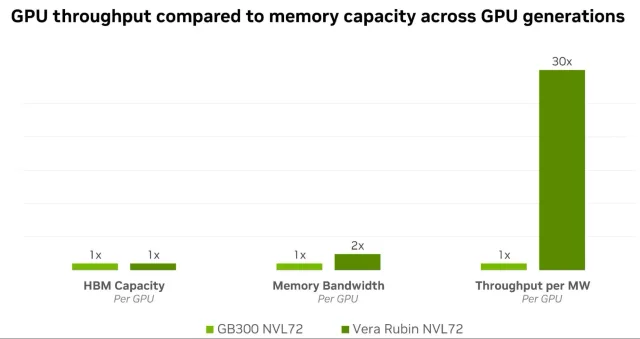
Through five co-designs—NVFP4, Wide-EP, Dynamo, Vera CPU, and CMX—NVIDIA enables Vera Rubin NVL72 to achieve up to 30x the per-megawatt throughput of GB300 NVL72 on SemiAnalysis AgentX while keeping 288 GB of HBM per GPU unchanged. NVFP4 reduces model footprint by about 3.5x versus FP16 and 1.8x versus FP8, and NVFP4 KV cache cuts it by up to another 50% versus FP8. TensorRT-LLM's Wide-EP spreads experts across 8 or more GPUs, while Dynamo manages KV cache as a cluster-level resource across GPUs, CPUs, and storage.
Through five co-designs—NVFP4, Wide-EP, Dynamo, Vera CPU, and CMX—NVIDIA enables Vera Rubin NVL72 to achieve up to 30x the per-megawatt throughput of GB300 NVL72 on SemiAnalysis AgentX while keeping 288 GB of HBM per GPU unchanged. NVFP4 reduces model footprint by about 3.5x versus FP16 and 1.8x versus FP8, and NVFP4 KV cache cuts it by up to another 50% versus FP8. TensorRT-LLM's Wide-EP spreads experts across 8 or more GPUs, while Dynamo manages KV cache as a cluster-level resource across GPUs
Matched fieldsBody
Google Research published the AI-PPG-ACC-HTN system in Nature, which can passively detect signs of hypertension using only PPG and accelerometer signals from consumer-grade smartwatches, without the need for cuff calibration. The system first uses 492,347 hours of unlabeled sensor data from 2,109 participants for self-supervised pretraining, then aggregates multi-day waveform embeddings into person-level features, and combines them with height using logistic regression to output a hypertension probability. In a prospective study of 196 participants across 5 U.S. sites, the initial screening scenario achieved 65.8% sensitivity, 90.0% specificity, and 80.6% PPV; in the confirmation scenario involving 48 individuals with elevated office blood pressure, it achieved 78.4% sensitivity, 90.9% specificity, and 96.7% PPV. The research team states that this work is an early feasibility exploration, does not replace cuff-based diagnosis, and does not point to any existing or forthcoming commercial feature.

Google Research published the AI-PPG-ACC-HTN system in Nature, which can passively detect signs of hypertension using only PPG and accelerometer signals from consumer-grade smartwatches, without the need for cuff calibration. The system first uses 492,347 hours of unlabeled sensor data from 2,109 participants for self-supervised pretraining, then aggregates multi-day waveform embeddings into person-level features, and combines them with height using logistic regression to output a hypertension p
Matched fieldsBody
Debezium Server 3.7 adds a Zerobus Ingest sink that can push CDC events directly into Delta tables in Unity Catalog, without the need for an intermediate Kafka cluster or pull-based connectors. The sink was jointly developed by NVIDIA and Databricks and contributed to the open source Debezium project; NVIDIA added delivery guarantees such as envelope mode, idempotency keys, and persistent acknowledgment before source offset advancement. This push-based architecture also enables environments restricted by private networks and prohibited from inbound connections to securely replicate data outward.

Debezium Server 3.7 adds a Zerobus Ingest sink that can push CDC events directly into Delta tables in Unity Catalog, without the need for an intermediate Kafka cluster or pull-based connectors. The sink was jointly developed by NVIDIA and Databricks and contributed to the open source Debezium project; NVIDIA added delivery guarantees such as envelope mode, idempotency keys, and persistent acknowledgment before source offset advancement. This push-based architecture also enables environments rest
Matched fieldsBody
Hugging Face has released the on-device TTS model Phonon, offering two sizes of approximately 65 MB and 75 MB, covering English, French, German, Spanish, and Portuguese, with more than 100 built-in voices. Among them, Phonon 31m supports only English and is open-sourced under Apache 2.0, allowing use in commercial products; Phonon 40m covers five languages but uses a non-commercial license. The company states that it ranks first in German and Spanish intelligibility on the Open TTS Leaderboard and leads in the CPU streaming first-packet latency benchmark, and that the accompanying inference framework ptts supports more than 10 backends including CPU, GPU, and NPU.
Hugging Face has released the on-device TTS model Phonon, offering two sizes of approximately 65 MB and 75 MB, covering English, French, German, Spanish, and Portuguese, with more than 100 built-in voices. Among them, Phonon 31m supports only English and is open-sourced under Apache 2.0, allowing use in commercial products; Phonon 40m covers five languages but uses a non-commercial license. The company states that it ranks first in German and Spanish intelligibility on the Open TTS Leaderboard a
Matched fieldsBody
Browser Use officially compared two types of AI agents, computer use and browser use: the former relies on screenshots to locate screen coordinates and operate the entire desktop, while the latter directly reads the page structure and operates elements via CDP. Browser Use believes that web tasks should prioritize browser use, because page structure allows direct element targeting and headless browsers can run in parallel, with Browser Use Cloud costing $0.02 per browser hour; only desktop applications, system dialogs, or pure canvas pages require computer use.

Browser Use officially compared two types of AI agents, computer use and browser use: the former relies on screenshots to locate screen coordinates and operate the entire desktop, while the latter directly reads the page structure and operates elements via CDP. Browser Use believes that web tasks should prioritize browser use, because page structure allows direct element targeting and headless browsers can run in parallel, with Browser Use Cloud costing $0.02 per browser hour; only desktop appli
Matched fieldsBody
Goodfire Research has released a paper proposing a mechanism shaping framework that, through two methods—dependency shaping and expression shaping—adds penalty terms on the model's internal concepts to the training objective, specifying what the model should depend on and what it should not express. In a chest X-ray diagnosis experiment, this method reduced the model's reliance on spurious features such as chest tubes, with accuracy exceeding the soft ceiling of training on balanced data; in DPO post-training of OLMo-3-7B, it suppressed sycophantic behavior, and in the Countdown task with Qwen3.5-9B, it pushed cheating behavior down to a 96–98% honest solution rate. The paper also proposes a five-level monitorability grading; experiments show that shaped concepts typically only shift location rather than disappear, and remain monitorable after retraining the probe.

Goodfire Research has released a paper proposing a mechanism shaping framework that, through two methods—dependency shaping and expression shaping—adds penalty terms on the model's internal concepts to the training objective, specifying what the model should depend on and what it should not express. In a chest X-ray diagnosis experiment, this method reduced the model's reliance on spurious features such as chest tubes, with accuracy exceeding the soft ceiling of training on balanced data; in DPO
Matched fieldsBody
NVIDIA has released the AI Factory Operations Agent, which collaborates through multiple domain sub-agents to locate root causes across the compute, network, hardware, and scheduling layers, and provides recommendations through a chat interface for its own DGX SuperPOD operations. The framework is built on the NVIDIA NemoClaw blueprint and OpenShell, is fully locally deployed, uses the local open-source NVIDIA Nemotron model for inference, and runs on DGX H100, DGX B200, and DGX GB300 production clusters. The framework includes sub-agents such as Job Recovery, Hardware, Observability, Research, Kubernetes, and Cluster Management, and integrates MCP tools such as web search, code execution, and Grafana dashboards. Developer examples and open-source code are now available.

NVIDIA has released the AI Factory Operations Agent, which collaborates through multiple domain sub-agents to locate root causes across the compute, network, hardware, and scheduling layers, and provides recommendations through a chat interface for its own DGX SuperPOD operations. The framework is built on the NVIDIA NemoClaw blueprint and OpenShell, is fully locally deployed, uses the local open-source NVIDIA Nemotron model for inference, and runs on DGX H100, DGX B200, and DGX GB300 production
Matched fieldsBody
Databricks believes open-weight models have approached frontier-model performance at lower cost, prompting enterprises to reassess single frontier-model vendor strategies. Its Unity AI Gateway hosts open-weight, frontier, and external models through a unified API, supporting intelligent routing, fallback, and budget controls; since January, the average number of models used by customers has risen from 4.2 to 7.1, of which about 40% are open-weight models.

Matched fieldsBody
U Mobile built the AI-Driven Agentic Helpdesk (AiDaH) on Amazon Bedrock AgentCore, covering more than 150 operational scenarios across 6 business units, with internal measurements showing fault ticket volumes in key categories dropping by up to 84.5%. The platform uses a six-layer architecture, is accessed through Microsoft Teams, and has 8 specialized agents collaborating via the A2A protocol; about 70% of requests are handled directly by deterministic keyword matching without invoking a model. AiDaH launched in Q3 2026 for 50 L2 call center and store users.

U Mobile built the AI-Driven Agentic Helpdesk (AiDaH) on Amazon Bedrock AgentCore, covering more than 150 operational scenarios across 6 business units, with internal measurements showing fault ticket volumes in key categories dropping by up to 84.5%. The platform uses a six-layer architecture, is accessed through Microsoft Teams, and has 8 specialized agents collaborating via the A2A protocol; about 70% of requests are handled directly by deterministic keyword matching without invoking a model.
Matched fieldsBody
Indegene built an LLM-powered Data Quality Agent within the NEXT Unified Data Platform (NEXT UDP) on AWS, which can generate context-aware data quality rules, perform validation, and produce directly runnable SQL and Python code, all under centralized human-in-the-loop governance. NEXT UDP also provides independent AI Agents such as Data Ingestion, Orchestration, Data Catalog, and SQL Bot Generator, which can be used separately in data pipelines or customized for agent-to-agent communication.

Matched fieldsBody