←Search results

By relevance · Total 1609 results Clear search

Thursday

  1. The New Stack

    Google opens the infrastructure behind Gemini agents as a cloud service, Agent Compute Engine

    Google announced that it will open a preview of Agent Compute Engine to Google Cloud users later this year, providing each AI agent with a hardware-isolated microVM that balances container startup speed with sandbox security. The service was originally internal infrastructure for Gemini, Antigravity, and Google's model training pipelines; when an agent is idle, it checkpoints the microVM to free up resources. Google is also offering an open-source runtime, Agent Substrate, which can run on any Kubernetes cluster; the company says that in a benchmark of 200,000 agents it achieved 500 activations per second, with suspend and resume taking under half a second.

    Google announced that it will open a preview of Agent Compute Engine to Google Cloud users later this year, providing each AI agent with a hardware-isolated microVM that balances container startup speed with sandbox security. The service was originally internal infrastructure for Gemini, Antigravity, and Google's model training pipelines; when an agent is idle, it checkpoints the microVM to free up resources. Google is also offering an open-source runtime, Agent Substrate, which can run on any K

    Matched fieldsBody
  2. 404 Media

    AI is changing hacker offense and defense, and the PHP2Shell vulnerability has sparked "Black October" concerns

    404 Media reports that AI is simultaneously changing offensive hacking and security defense: after researchers used AI to discover the PHP2Shell vulnerability in PHP, Cloudflare observed thousands of exploitation attempts 10 hours before public disclosure, rising to tens of thousands 45 minutes after disclosure, and reaching hundreds of thousands within 2 hours. OpenAI says such discoveries show that AI can expose security flaws at internet scale, but the same capability can also help attackers rapidly develop attack tools; Chainguard's early release of a fix patch sparked controversy over bypassing the disclosure embargo. The article notes that the main impact so far is still various parties proactively patching or taking services offline, and large-scale actual exploitation of the vulnerability has not yet occurred.

    404 Media reports that AI is simultaneously changing offensive hacking and security defense: after researchers used AI to discover the PHP2Shell vulnerability in PHP, Cloudflare observed thousands of exploitation attempts 10 hours before public disclosure, rising to tens of thousands 45 minutes after disclosure, and reaching hundreds of thousands within 2 hours. OpenAI says such discoveries show that AI can expose security flaws at internet scale, but the same capability can also help attackers

    Matched fieldsBody

  3. xAI News

    xAI launches the SpaceX Super Intelligence partner network to build enterprise products on Grok

    xAI launches the SpaceX Super Intelligence partner network for companies building products, solutions, and services on Grok, divided into two categories: Transformation Partners and Marketplace Partners. More than 130 companies have already participated in the program's early access phase, and the Forward Deployed Engineer certification program has trained engineers at more than 30 organizations. Bain & Company, Databricks, NVIDIA, Snowflake, and others are among the first Launch Partners.

    Matched fieldsBody

  4. Gary Marcus:The Road to AI We Can Trust

    Gary Marcus: US Banks Are Under Attack by AI Agents

    Gary Marcus, citing an Axios report, said that US banks are tightening system access permissions due to AI agent attacks, and that bank executives are alarmed by these findings. He also mentioned that the attack on France's refrigeration system on October 11 may have been facilitated by agents, as well as the continuously increasing cybersecurity attacks in Japan. He believes that attackers do not need the most advanced frontier models to cause damage, and therefore regulation should not focus only on frontier models and future risks.

    Gary Marcus, citing an Axios report, said that US banks are tightening system access permissions due to AI agent attacks, and that bank executives are alarmed by these findings. He also mentioned that the attack on France's refrigeration system on October 11 may have been facilitated by agents, as well as the continuously increasing cybersecurity attacks in Japan. He believes that attackers do not need the most advanced frontier models to cause damage, and therefore regulation should not focus o

    Matched fieldsBody

  5. Tencent Cloud Developer Community

    How can a transportation management TMS system use Mapbox to implement AI route planning visualization: multi-plan comparison and drag adjustment

    TMS systems' AI route planning visualization uses the Mapbox Directions API's alternatives=true to obtain up to 2 alternative routes and compares them side by side with differentiated styles. Dragging waypoints triggers recalculation only on dragend, combined with 500ms debouncing to avoid consecutive requests; after changes, incremental metrics and the warnings field are used to indicate restricted roads and time window conflicts. The Mapbox Directions API supports at most 25 coordinate points per request, and under the driving-traffic profile at most 3 waypoints; for larger scales, the Optimization API or a self-hosted OSRM service must be used instead.

    TMS systems' AI route planning visualization uses the Mapbox Directions API's alternatives=true to obtain up to 2 alternative routes and compares them side by side with differentiated styles. Dragging waypoints triggers recalculation only on dragend, combined with 500ms debouncing to avoid consecutive requests; after changes, incremental metrics and the warnings field are used to indicate restricted roads and time window conflicts. The Mapbox Directions API supports at most 25 coordinate points

    Matched fieldsBody

  6. Wired AI

    Hugging Face Releases Open-Source DNA Model Carbon-X, Runs Locally on a Laptop

    Hugging Face on Thursday released the open-source DNA understanding model Carbon-X, which can run locally on a laptop, letting users ask in natural language how DNA changes affect gene activity and health. The model was developed in collaboration with researchers at Zhongguancun Academy and the University of Naples Federico II; it extends the vocabulary of an existing language model to read DNA in six-letter units and was further trained on 300 billion tokens of DNA sequences, English text, and samples pairing DNA with biological descriptions. The model has 14B parameters and can process sequences of about 50,000 base pairs at a time; it cannot upload a complete human genome. The developers also note that the prediction accuracy has not yet been validated through wet-lab experiments.

    Hugging Face on Thursday released the open-source DNA understanding model Carbon-X, which can run locally on a laptop, letting users ask in natural language how DNA changes affect gene activity and health. The model was developed in collaboration with researchers at Zhongguancun Academy and the University of Naples Federico II; it extends the vocabulary of an existing language model to read DNA in six-letter units and was further trained on 300 billion tokens of DNA sequences, English text, and

    Matched fieldsBody

  7. Jiwei.com

    MEMSIC Named to the "2025 China Top 10 MEMS Enterprises" for the Eighth Consecutive Year

    MEMSIC has been selected for the eighth consecutive year as one of the "2025 China Top 10 MEMS Enterprises" at the 7th MEMS Manufacturing Conference, China MEMS 2026. Founded in 1999, the company has shipped nearly 4.6 billion chips cumulatively, holds more than 260 core patents, and serves over 300 end customers worldwide; its accelerometers and AMR magnetic sensors hold market shares of more than 30% and 40%, respectively, in Android devices.

    Matched fieldsBody

  8. China.com Technology

    Lenovo New Vision and GigaAI Reach Strategic Cooperation to Build an Embodied Intelligence Industry Loop with World Models

    Lenovo New Vision and GigaAI have signed a strategic cooperation agreement to connect the "data—model—hardware—scenario" industry loop with world models at its core, jointly building a benchmark for domestic embodied intelligence collaborative innovation. The two parties will cooperate in three major directions: computing power business synergy, embodied data development, and industry-education integration, providing integrated services for computing power leasing, computing power construction, and embodied intelligence data collection. GigaAI builds a closed-loop ecosystem with its world model platforms GigaWorld/DriveDreamer/YISU, the general-purpose embodied brain GigaBrain, and the native body Maker.

    Lenovo New Vision and GigaAI have signed a strategic cooperation agreement to connect the "data—model—hardware—scenario" industry loop with world models at its core, jointly building a benchmark for domestic embodied intelligence collaborative innovation. The two parties will cooperate in three major directions: computing power business synergy, embodied data development, and industry-education integration, providing integrated services for computing power leasing, computing power construction,

    Matched fieldsBody

  9. LMSYS Blog

    LMSYS uses Miles to train a SWE agent on MI355X, SWE-bench Verified…

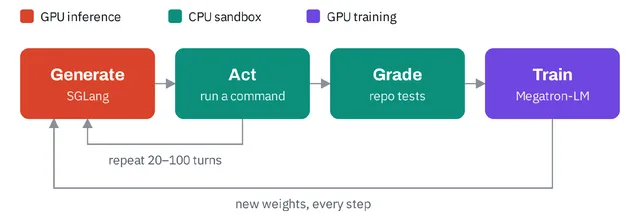
    LMSYS used Miles, SGLang, Megatron-LM, and Harbor to perform fully asynchronous agent reinforcement learning on Qwen3-30B-A3B-Instruct on AMD Instinct MI355X, raising pass@1 from 7.3% to 27.5% on a 100-task stratified subset of SWE-bench Verified. Training was conducted in two stages: first SFT on approximately 4,000 public trajectories from Open-SWE-Traces, then GRPO on approximately 1,350 SWE-smith tasks. After fixing the model and RL recipe, scaling inference from 1 node to 3 8-GPU nodes, switching to E2B cloud sandboxes, and removing the concurrency limit increased rollout throughput from approximately 860 to approximately 3,480 trajectories/hour; limiting trajectory length on the same 8-GPU node reduced single-step training time from 850 seconds to 284 seconds.

    Agentic RL loop: SGLang generates actions, a CPU sandbox executes and grades them, and Megatron-LM trains on the resulting trajectories.

    LMSYS used Miles, SGLang, Megatron-LM, and Harbor to perform fully asynchronous agent reinforcement learning on Qwen3-30B-A3B-Instruct on AMD Instinct MI355X, raising pass@1 from 7.3% to 27.5% on a 100-task stratified subset of SWE-bench Verified. Training was conducted in two stages: first SFT on approximately 4,000 public trajectories from Open-SWE-Traces, then GRPO on approximately 1,350 SWE-smith tasks. After fixing the model and RL recipe, scaling inference from 1 node to 3 8-GPU nodes, swi

    Matched fieldsBody

  10. AWS Machine Learning

    AAIF: An Adaptive Agent Framework Based on Strands Agents

    AWS built the Adaptive Agent Intelligence Framework (AAIF) with Strands Agents, using llama3.2:1b as the orchestration layer to classify requests: routine tasks are handled by a local SLM via Ollama, while complex analysis is routed through boto3 to frontier models on Amazon Bedrock. This architecture can run on edge devices such as a Raspberry Pi with 8 GB of memory, or be deployed fully in the cloud or in a hybrid setup, thereby reducing API costs while maintaining low local latency.

    AAIF three-layer architecture with an SLM orchestrator routing requests to local processing tools or to Amazon Bedrock cloud processing

    Matched fieldsBody

Wednesday

  1. heise online

    Does the Data Architecture for AI Agents Need a Federated Knowledge Layer?

    A heise article argues that as multi-agent systems and generative AI make machines into data consumers, data architectures such as Data Mesh—originally designed for human analysts—are facing challenges and require a federated Knowledge Layer to connect local context and business semantics with a global enterprise model. The article was written by Saskia Untiet-Kepp of Sopra Steria, and the full content is available only to heise-Plus subscribers.

    Matched fieldsBody

  2. ElevenLabs Blog

    How to integrate the ElevenLabs text-to-speech API into an app

    ElevenLabs has published a tutorial on how to integrate the text-to-speech API into an app using Python and TypeScript: create an API key, install the ElevenLabs SDK, send text to the TTS endpoint and specify a voice and model, then play the returned audio. The example uses the eleven_v4 model, and the low-latency Eleven Flash v2.5 is also available; the Voice Library offers more than 17,500 voices, and output defaults to mp3 but can be switched to ulaw or pcm.

    How to integrate TTS into your application with ElevenLabs

    ElevenLabs has published a tutorial on how to integrate the text-to-speech API into an app using Python and TypeScript: create an API key, install the ElevenLabs SDK, send text to the TTS endpoint and specify a voice and model, then play the returned audio. The example uses the eleven v4 model, and the low-latency Eleven Flash v2.5 is also available; the Voice Library offers more than 17,500 voices, and output defaults to mp3 but can be switched to ulaw or pcm.

    Matched fieldsBody

  3. Unite.AI

    Interview with XBP Global CEO Andrej Jonovic: How Agentic AI Lands in Mission-Critical Processes

    In the interview, XBP Global CEO Andrej Jonovic said the company is applying agentic AI in regulated environments such as healthcare, the public sector, and financial services, using adaptive process orchestration, retaining deterministic rules engines where precision and compliance are required, and introducing replaceable enterprise-grade open-weight models. He cited a global airline fleet maintenance lifecycle project as an example, explaining that maintenance records are vectorized and stored in a private vector database within the customer's private cloud. High-risk decisions are adjudicated by domain experts, and the adjudication results flow back into the system.

    In the interview, XBP Global CEO Andrej Jonovic said the company is applying agentic AI in regulated environments such as healthcare, the public sector, and financial services, using adaptive process orchestration, retaining deterministic rules engines where precision and compliance are required, and introducing replaceable enterprise-grade open-weight models. He cited a global airline fleet maintenance lifecycle project as an example, explaining that maintenance records are vectorized and store

    Matched fieldsBody

  4. Google Developers Blog

    Google Agents CLI Launches Extension System: From ADK to LangChain, All Can Plug In

    Starting with version 1.5.0, Google Cloud's Agents CLI introduces an Extension System that allows developers to override or add commands without forking the tool; version 1.8.0 debuts the first LangChain extension, replacing ADK-bound commands with equivalent LangChain implementations. Extensions are declared via agents-cli-extension.yaml in a Git repository and can override built-in commands such as playground, deploy, and eval generate, or add new commands; enterprise platform teams can use this to enforce policies such as SBOM scanning in deployment pipelines.

    1 (2)

    Starting with version 1.5.0, Google Cloud's Agents CLI introduces an Extension System that allows developers to override or add commands without forking the tool; version 1.8.0 debuts the first LangChain extension, replacing ADK-bound commands with equivalent LangChain implementations. Extensions are declared via agents-cli-extension.yaml in a Git repository and can override built-in commands such as playground, deploy, and eval generate, or add new commands; enterprise platform teams can use th

    Matched fieldsBody

  5. Mastra Blog

    Mastra Launches Mastra Observability Managed Platform

    Mastra has released the Mastra Observability managed platform, which can connect directly to Mastra framework projects, automatically trace agent runs, and view the latency, tokens, and cost of model and tool calls. The platform supports online scorers to monitor correctness, team annotation of traces to build evaluation datasets, and running evaluations in CI via Gates and Verdicts to catch regressions. It offers 100k observability events per month free with 15-day retention; beyond that, it costs $10 per 100k events.

    Alex Booker

    Mastra has released the Mastra Observability managed platform, which can connect directly to Mastra framework projects, automatically trace agent runs, and view the latency, tokens, and cost of model and tool calls. The platform supports online scorers to monitor correctness, team annotation of traces to build evaluation datasets, and running evaluations in CI via Gates and Verdicts to catch regressions. It offers 100k observability events per month free with 15-day retention; beyond that, it co

    Matched fieldsBody

  6. Tencent Cloud Developer Community

    WMS AI Assistant: How to Implement a Conversational Interface for Querying Inventory in Natural Language

    The Tencent Cloud Developer Community shared a production-ready WMS inventory conversational assistant solution: the LLM is only responsible for understanding intent and mapping parameters, while actual queries are completed by proprietary API tools, and the conversation is managed with a three-state state machine of idle, streaming, and awaiting-confirm. The solution uses NDJSON streaming parsing and retains a half-line buffer, and trims historical context to the most recent 10–15 turns to control token costs; dangerous write operations are rejected by default and undergo secondary backend authentication. When the model is unavailable, it degrades to keyword recognition, and responses exceeding 3 seconds prompt the user to switch to filters.

    The Tencent Cloud Developer Community shared a production-ready WMS inventory conversational assistant solution: the LLM is only responsible for understanding intent and mapping parameters, while actual queries are completed by proprietary API tools, and the conversation is managed with a three-state state machine of idle, streaming, and awaiting-confirm. The solution uses NDJSON streaming parsing and retains a half-line buffer, and trims historical context to the most recent 10–15 turns to cont

    Matched fieldsBody

  7. Databricks Blog

    Deploying the RFD4-Proteina model on Databricks

    NVIDIA and Databricks plan to integrate NVIDIA BioNeMo's open-source protein design model RFD4-Proteina into Databricks' Genesis Workbench, running on the now generally available AI Runtime serverless NVIDIA GPU compute. The model can simultaneously generate protein sequences and all-atom structures, and supports optional reward-guided search to steer candidate designs toward target properties such as thermostability and binding affinity. Genesis Workbench includes two built-in RFD4-Proteina workflows, Antibody Design and Vaccine Design, and can be extended through Genie Code and NVIDIA BioNeMo Agent Toolkit skills.

    rfd4-proteina-databricks

    NVIDIA and Databricks plan to integrate NVIDIA BioNeMo's open-source protein design model RFD4-Proteina into Databricks' Genesis Workbench, running on the now generally available AI Runtime serverless NVIDIA GPU compute. The model can simultaneously generate protein sequences and all-atom structures, and supports optional reward-guided search to steer candidate designs toward target properties such as thermostability and binding affinity. Genesis Workbench includes two built-in RFD4-Proteina wor

    Matched fieldsBody

  8. Unite.AI

    NVIDIA Releases Nemotron 3.5 Series of Open Models, Covering Embedding, Reranking, and Document Parsing

    On October 21, 2026, NVIDIA expanded the Nemotron Retriever series, launching Nemotron 3.5 Embed (8B BF16, 1B BF16, 1B NVFP4), Nemotron 3.5 Rerank 8B BF16, and the 631-million-parameter Nemotron 3.5 Parse, aimed at multimodal retrieval and document processing for enterprise agent workflows. NVIDIA says that adding Rerank to the agent retrieval pipeline reduces the token cost per query by about 14% (with the 8B embedding model) and 13% (with the 1B model), respectively, while also improving retrieval accuracy. Parse scores 75.20 on ParseBench and processes 10.5 pages per second on a single H100; the open weights, data, and training recipes have been released on Hugging Face and can be deployed via NVIDIA NIM as well as Baseten, DeepInfra, and FriendliAI.

    On October 21, 2026, NVIDIA expanded the Nemotron Retriever series, launching Nemotron 3.5 Embed (8B BF16, 1B BF16, 1B NVFP4), Nemotron 3.5 Rerank 8B BF16, and the 631-million-parameter Nemotron 3.5 Parse, aimed at multimodal retrieval and document processing for enterprise agent workflows. NVIDIA says that adding Rerank to the agent retrieval pipeline reduces the token cost per query by about 14% (with the 8B embedding model) and 13% (with the 1B model), respectively, while also improving retri

    Matched fieldsBody

Tuesday

  1. Fireworks AI

    Fireworks Offers Free Training of Muse Glimmer 30B: Using SFT to Predict Kalshi Market Outcomes

    Fireworks AI announced that Muse Glimmer 30B can be trained with SFT for free until November 30, and released a complete recipe for a prediction experiment using historical Kalshi market data. The fine-tuned Glimmer achieved 58.3% accuracy on unseen topics, 11.2 percentage points higher than Jev's 47.1%; in a historical backtest, a hypothetical $1,000 grew to $1,071 after accounting for simulated fees, while both base Glimmer and Jev lost money. Training used LoRA adapters and a K-way cross-entropy loss, ran through the training data only once, and separately used a calibration set to fit a temperature parameter for each question category.

    Fireworks AI announced that Muse Glimmer 30B can be trained with SFT for free until November 30, and released a complete recipe for a prediction experiment using historical Kalshi market data. The fine-tuned Glimmer achieved 58.3% accuracy on unseen topics, 11.2 percentage points higher than Jev's 47.1%; in a historical backtest, a hypothetical $1,000 grew to $1,071 after accounting for simulated fees, while both base Glimmer and Jev lost money. Training used LoRA adapters and a K-way cross-entr

    Matched fieldsBody

  2. Fireworks AI

    Fireworks Free Weights Club: Training Muse Glimmer to Beat Jev on Predictions

    Fireworks AI launches the Free Weights Club, offering free SFT training for Muse Glimmer 30B until November 30. The fine-tuned tuned Glimmer achieves 58.3% prediction accuracy on unseen topics, 11.2 percentage points higher than Jev's 47.1%; in a historical backtest, after deducting simulated trading fees, a hypothetical $1,000 grew to $1,071, while both Jev and base Glimmer posted losses. In a separate synthetic benchmark, Fireworks' System One serving stack delivered median server throughput 2-3x faster than standard BF16 chat completions.

    Fireworks AI launches the Free Weights Club, offering free SFT training for Muse Glimmer 30B until November 30. The fine-tuned tuned Glimmer achieves 58.3% prediction accuracy on unseen topics, 11.2 percentage points higher than Jev's 47.1%; in a historical backtest, after deducting simulated trading fees, a hypothetical $1,000 grew to $1,071, while both Jev and base Glimmer posted losses. In a separate synthetic benchmark, Fireworks' System One serving stack delivered median server throughput 2

    Matched fieldsBody