←Search results

By relevance · Total 2896 results Clear search

Tuesday

  1. Browser Use

    What to Do When Headless Browsers Are Blocked by Cloudflare: Which Solutions Work (2026)

    Stealth Bench V2, released by Browser Use, shows that headless Chrome without a proxy passes only 3% of visits, headed Chrome with a US proxy reaches 14%, and Browser Use Cloud reaches 90.5%. Cloudflare identifies automation through navigator.webdriver, TLS and request header fingerprints, IP reputation, and cookie and behavioral signals; stealth plugins alone cannot change TLS and IP. Browser Use Cloud is priced at $0.02 per browser hour plus $5/GB for proxies, and its official documentation states that access to all sites is not guaranteed.

    Stealth Bench V2, released by Browser Use, shows that headless Chrome without a proxy passes only 3% of visits, headed Chrome with a US proxy reaches 14%, and Browser Use Cloud reaches 90.5%. Cloudflare identifies automation through navigator.webdriver, TLS and request header fingerprints, IP reputation, and cookie and behavioral signals; stealth plugins alone cannot change TLS and IP. Browser Use Cloud is priced at $0.02 per browser hour plus $5/GB for proxies, and its official documentation st

    Matched fieldsBody

  2. Replit Blog

    Replit Cloud Agents are now available to Pro and Enterprise users…

    Replit announced that Cloud Agents are now available to all Pro and Enterprise customers. Non-engineers can describe changes in natural language, and the agent locates the code, runs the application in a cloud sandbox to verify it, and submits a PR or MR with screenshots and video to GitHub or GitLab. Teams can configure a shared environment once, and review feedback can be turned into skill updates that require engineer approval; the feature is in early access. The Slack integration is now available to all customers, and Microsoft Teams support is coming soon.

    Anyone can now bring their ideas into the company codebase — cover image

    Replit announced that Cloud Agents are now available to all Pro and Enterprise customers. Non-engineers can describe changes in natural language, and the agent locates the code, runs the application in a cloud sandbox to verify it, and submits a PR or MR with screenshots and video to GitHub or GitLab. Teams can configure a shared environment once, and review feedback can be turned into skill updates that require engineer approval; the feature is in early access. The Slack integration is now avai

    Matched fieldsBody

  3. a16z:News

    a16z Long Read: Databricks and the Enterprise in the Agent Era

    a16z partners Ben Horowitz and Michael McGuiness wrote the article, using Databricks' four generations of technological evolution—from Spark and Lakehouse to Lakebase and agents—as a thread to discuss how agents are changing enterprises. The article states that Databricks has surpassed $7 billion in annualized revenue, up 80% year over year, at a valuation of $190 billion, with more than 17 million databases launched by agents every day. The authors argue that enterprises need an agent-facing system of record that captures definitions, permissions, and evaluation results, and believe that in the future more people's work will shift toward specifying tasks, delegating execution, and checking results.

    a16z partners Ben Horowitz and Michael McGuiness wrote the article, using Databricks' four generations of technological evolution—from Spark and Lakehouse to Lakebase and agents—as a thread to discuss how agents are changing enterprises. The article states that Databricks has surpassed $7 billion in annualized revenue, up 80% year over year, at a valuation of $190 billion, with more than 17 million databases launched by agents every day. The authors argue that enterprises need an agent-facing sy

    Matched fieldsBody

  4. Google Developers Blog

    Google A2UI Introduces Swappable Inference Formats, Express Cuts Latency by Up to 3x

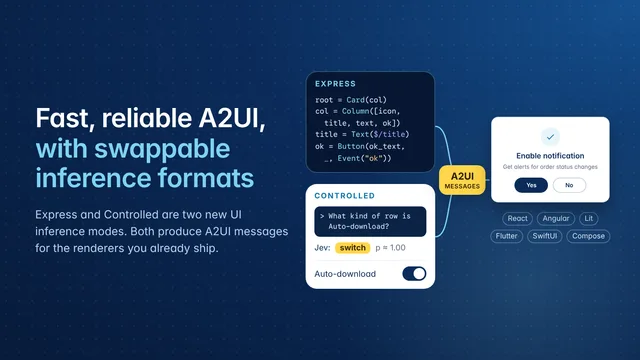
    Google A2UI adds swappable inference formats, among which A2UI Express, as the new default format, can reduce latency by up to 3x and cut the tokens needed to generate comparable UIs by up to 3x; when combined with decision models such as Jev for layout decisions, latency reductions can reach up to 80x. Express is now available in the Python agent SDK (a2ui-agent-sdk 0.9.0), the TypeScript SDK (@a2ui/agent), and the Dart SDK (a2ui_agent 0.0.1-wip004); developers can switch formats with a single parameter when creating a generator.

    00-header-1600x900 (1)

    Google A2UI adds swappable inference formats, among which A2UI Express, as the new default format, can reduce latency by up to 3x and cut the tokens needed to generate comparable UIs by up to 3x; when combined with decision models such as Jev for layout decisions, latency reductions can reach up to 80x. Express is now available in the Python agent SDK (a2ui-agent-sdk 0.9.0), the TypeScript SDK (@a2ui/agent), and the Dart SDK (a2ui agent 0.0.1-wip004); developers can switch formats with a single

    Matched fieldsBody

  5. Claude BlogSelected

    Anthropic Launches Claude for Financial Advisors Connectors and Skills Suite

    Anthropic has released Claude for Financial Advisors, connecting data from custodians, asset management and wealthtech platforms into Claude, and providing skills tailored to financial advisors' daily work. The suite includes connectors such as Addepar, BlackRock, Charles Schwab, Envestnet, FactSet, Orion and Wealthbox, as well as skills for meeting preparation, portfolio rebalancing review, post-meeting notes and follow-up, and compliance and AI policy checks; regulated steps such as investment advice and client communication still require human review. The advisor plugin is available starting today, and the official recommendation is for registered investment advisors to use the Enterprise plan with audit logs.

    Anthropic has released Claude for Financial Advisors, connecting data from custodians, asset management and wealthtech platforms into Claude, and providing skills tailored to financial advisors' daily work. The suite includes connectors such as Addepar, BlackRock, Charles Schwab, Envestnet, FactSet, Orion and Wealthbox, as well as skills for meeting preparation, portfolio rebalancing review, post-meeting notes and follow-up, and compliance and AI policy checks; regulated steps such as investment

    Matched fieldsBody

  6. Claude Blog

    How to manage Claude Code costs on Google Cloud and prove ROI

    Based on a recent webinar with Google Cloud, Anthropic presents a three-lever framework—control, track, prove—for managing Claude Code costs on Google Cloud and measuring return on investment. The Claude apps gateway supports setting daily/weekly/monthly spending limits by user, IdP group, or organization, alerts within the CLI when usage reaches 75% and 95%, and returns 429 once the cap is hit. On the Google Cloud side, native capabilities include per-project billing, budget alerts, Spend caps (preview), BigQuery export, and quotas.

    Based on a recent webinar with Google Cloud, Anthropic presents a three-lever framework—control, track, prove—for managing Claude Code costs on Google Cloud and measuring return on investment. The Claude apps gateway supports setting daily/weekly/monthly spending limits by user, IdP group, or organization, alerts within the CLI when usage reaches 75% and 95%, and returns 429 once the cap is hit. On the Google Cloud side, native capabilities include per-project billing, budget alerts, Spend caps

    Matched fieldsBody

  7. ElevenLabs Blog

    ElevenLabs Retail AI Agent Field Test: Nearly Half of Shoppers Choose Voice Interaction After Trying It

    Three studies by ElevenLabs of shoppers in the US, UK and other countries show that when shoppers were asked to actually use the ElevenLabs voice Agent first before answering, nearly half chose "speak and listen to the reply," about 30% chose "speak and read text on screen," and voice ranked first across all six shopping task categories. Among respondents who had not tried it, preference for typing led voice by more than 4:1. The more serious the problem, the less willing shoppers were to hand it over to the Agent; in the erroneous charge scenario, only 34% chose the Agent, and if the Agent failed once, 61% demanded transfer to a human.

    Headshot

    Three studies by ElevenLabs of shoppers in the US, UK and other countries show that when shoppers were asked to actually use the ElevenLabs voice Agent first before answering, nearly half chose "speak and listen to the reply," about 30% chose "speak and read text on screen," and voice ranked first across all six shopping task categories. Among respondents who had not tried it, preference for typing led voice by more than 4:1. The more serious the problem, the less willing shoppers were to hand i

    Matched fieldsBody

  8. ElevenLabs Blog

    How to Build an AI Voice Assistant: An ElevenLabs Practical Guide

    ElevenLabs has released a practical guide on how to build an AI voice assistant by chaining speech-to-text, an LLM, and text-to-speech into a real-time pipeline. The guide recommends keeping round-trip responses within 500 ms and pairing this with VAD, while also connecting to internal knowledge bases and business tools, and putting safety measures such as verbal confirmation and handoff to a human agent in place. Developers can build directly with ElevenAPI, or configure and launch on the ElevenAgents managed platform.

    AI voice assistant benchmarks: <500 ms response target, 92% accuracy, and 90+ languages.

    ElevenLabs has released a practical guide on how to build an AI voice assistant by chaining speech-to-text, an LLM, and text-to-speech into a real-time pipeline. The guide recommends keeping round-trip responses within 500 ms and pairing this with VAD, while also connecting to internal knowledge bases and business tools, and putting safety measures such as verbal confirmation and handoff to a human agent in place. Developers can build directly with ElevenAPI, or configure and launch on the Eleve

    Matched fieldsBody

Wednesday

  1. BBC ChineseSelected

    Anthropic Publishes IPO Prospectus, Disclosing Five Key Pieces of Information

    Anthropic has published the 335-page prospectus required for a U.S. stock market listing, with the market expecting its listing valuation could reach $2 trillion or more. The document shows the company lost $80.7 billion in the first half of this year, twice its full-year loss for 2025, while revenue over the same period was $16.2 billion; its business is highly dependent on a small number of major customers, with just five enterprise clients contributing a quarter of its business. The document also lists the catastrophic or existential risks that advanced AI may bring, and says AI is expected to deliver benefits in fields such as healthcare, education and power grids.

    Anthropic has published the 335-page prospectus required for a U.S. stock market listing, with the market expecting its listing valuation could reach $2 trillion or more. The document shows the company lost $80.7 billion in the first half of this year, twice its full-year loss for 2025, while revenue over the same period was $16.2 billion; its business is highly dependent on a small number of major customers, with just five enterprise clients contributing a quarter of its business. The document

    Matched fieldsBody

  2. Cognition Model / Devin Blog

    Cognition Releases FrontierCode 2.0 Coding Benchmark: Opus 5.5 Scores Only 45%

    Cognition launches the FrontierCode 2.0 coding benchmark to assess whether the code produced by models can actually be merged; even the highest-scoring Opus 5.5 scores only 45%, showing the benchmark is far from saturated. Compared with version 1.1, reference solutions modify on average 67% more files and 89% more lines of code, the codebase size is 25% larger, task-covered repositories increase by 55%, and blocking scoring criteria increase by 43%. DeepSeek V4.1 Flash drops from 43.9% to 19.3%, and Kimi K3 drops from 44.2% to 17.7%; open-source models, especially Western open-source models, still have significant room for improvement.

    Cognition launches the FrontierCode 2.0 coding benchmark to assess whether the code produced by models can actually be merged; even the highest-scoring Opus 5.5 scores only 45%, showing the benchmark is far from saturated. Compared with version 1.1, reference solutions modify on average 67% more files and 89% more lines of code, the codebase size is 25% larger, task-covered repositories increase by 55%, and blocking scoring criteria increase by 43%. DeepSeek V4.1 Flash drops from 43.9% to 19.3%,

    Matched fieldsBody

  3. Codex:GitHub Releases

    OpenAI Codex 0.165.0 Released: Adds Google Cloud Vertex AI Provider and…

    OpenAI Codex 0.165.0 adds a built-in Google Cloud Vertex AI provider (configured via model_provider = "gcp") and adds GPT-6.1 Terra to the model catalog. This version also enables memory v2 by default and supports importing external agent memory, while allowing reasoning effort to be adjusted during conversations by default. The session selector adds repository filtering, and the agent command center supports grouping by directory.

    OpenAI Codex 0.165.0 adds a built-in Google Cloud Vertex AI provider (configured via model provider = "gcp") and adds GPT-6.1 Terra to the model catalog. This version also enables memory v2 by default and supports importing external agent memory, while allowing reasoning effort to be adjusted during conversations by default. The session selector adds repository filtering, and the agent command center supports grouping by directory.

    Matched fieldsBody

  4. NVIDIA Developer · Generative AI

    NVIDIA Explains How to Fine-Tune Nemotron 3.5 Lightning with the Nemotron-Personas Dataset

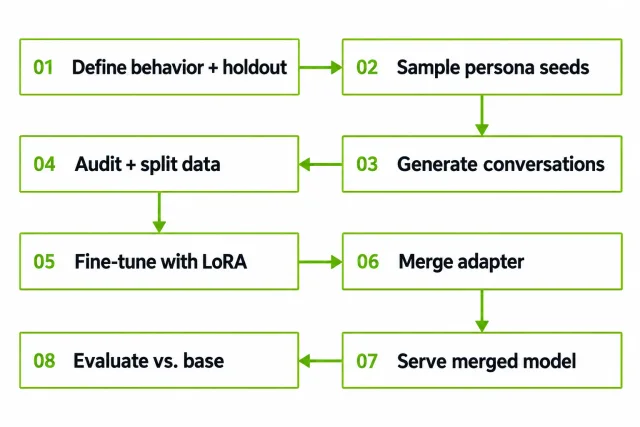
    NVIDIA has released the Nemotron-Personas France and Belgium datasets and provided a complete post-training workflow for fine-tuning Nemotron 3.5 Lightning with them. The workflow includes defining behavior contracts, generating synthetic conversations with personas, fine-tuning with LoRA on NVIDIA NeMo, merging adapters, and then comparing and evaluating item by item against the base model on a frozen test set. The France dataset was built in collaboration with Pleias, and the Belgium dataset involved Pleias and KU Leuven; the Nemotron repository provides reusable steps and agent skills for data generation, training, and evaluation.

    Flowchart showing eight stages: define target behavior and a holdout set, sample personas, generate conversations, audit and split data, fine-tune with LoRA, merge the adapter, serve the adapted model, and evaluate it against the base model.

    NVIDIA has released the Nemotron-Personas France and Belgium datasets and provided a complete post-training workflow for fine-tuning Nemotron 3.5 Lightning with them. The workflow includes defining behavior contracts, generating synthetic conversations with personas, fine-tuning with LoRA on NVIDIA NeMo, merging adapters, and then comparing and evaluating item by item against the base model on a frozen test set. The France dataset was built in collaboration with Pleias, and the Belgium dataset i

    Matched fieldsBody

  5. Hugging FaceSelected

    Liquid AI Releases the LFM3 Series of Models, Including 1.7B Text, Vision, Audio, and Omni Versions

    Liquid AI has released the LFM3 series of open-weight models, all branched from LFM3-1.7B-Base, covering text, vision, audio, Omni, and the d1 decision model. LFM3-1.7B-Base adopts a three-hybrid-layer architecture, is pretrained on 22T tokens, and in the mid-training stage over the final 3.5T tokens incorporates more agent trajectories and tool-calling data, with the context window extended to 256K tokens. The company says LFM3-1.7B is about 25% faster than LFM2-1.2B at an 8K context, and scores 38.42 versus 3.02 on WebArena-Verified; LFM3-VL-2B's average score across 62 vision benchmarks rises from 57.6 to 71.4. All models are available for download on Hugging Face, along with a single-GPU fine-tuning notebook.

    Liquid AI has released the LFM3 series of open-weight models, all branched from LFM3-1.7B-Base, covering text, vision, audio, Omni, and the d1 decision model. LFM3-1.7B-Base adopts a three-hybrid-layer architecture, is pretrained on 22T tokens, and in the mid-training stage over the final 3.5T tokens incorporates more agent trajectories and tool-calling data, with the context window extended to 256K tokens. The company says LFM3-1.7B is about 25% faster than LFM2-1.2B at an 8K context, and score

    Matched fieldsBody

  6. Latent SpaceSelected

    Anthropic's Engineering and Product Leads Discuss the Opus 5.5 Release and Claude's Agent Architecture

    In a Latent Space podcast interview, Anthropic engineering lead Katelyn Lesse and product lead Angela Jiang discussed the Opus 5.5 release, covering adjustments to the model's writing style, pricing based on intelligence per dollar, and API changes such as requiring thinking blocks to be retained across turns to prevent distillation. The interview also described Claude Managed Agents' approach of separating sessions and the harness from the sandbox that executes code, with credentials mounted separately through a proxy so that a sandbox failure does not take down the entire session; Dreaming, meanwhile, is implemented as one managed agent inspecting another agent's history and writing back to memory. The team said that as safety work for model releases has grown heavier, recent efforts have shifted more toward safety, with progress on features such as skills and memory slowing relatively.

    In a Latent Space podcast interview, Anthropic engineering lead Katelyn Lesse and product lead Angela Jiang discussed the Opus 5.5 release, covering adjustments to the model's writing style, pricing based on intelligence per dollar, and API changes such as requiring thinking blocks to be retained across turns to prevent distillation. The interview also described Claude Managed Agents' approach of separating sessions and the harness from the sandbox that executes code, with credentials mounted se

    Matched fieldsBody

  7. Google DeepMindSelected

    Google DeepMind releases world model Genie 4, supporting native audio and real-time interaction

    Google DeepMind has released the world model Genie 4, which can generate interactive worlds in real time and, for the first time, natively generate ambient sound and character dialogue. The model builds on capabilities from the Gemini series; Gemini 3.8 Flash breaks down goals in a loop and checks frames to maintain causal coherence across multi-step events, and Gemini 4 Argon has also been used for joint simulation tasks with Gemini Robotics. The company says it remains an early experimental model: over long runs, object permanence and complex physical interactions still drift, all generated content carries a SynthID watermark, and it is currently available in preview to trusted testers first.

    Google DeepMind has released the world model Genie 4, which can generate interactive worlds in real time and, for the first time, natively generate ambient sound and character dialogue. The model builds on capabilities from the Gemini series; Gemini 3.8 Flash breaks down goals in a loop and checks frames to maintain causal coherence across multi-step events, and Gemini 4 Argon has also been used for joint simulation tasks with Gemini Robotics. The company says it remains an early experimental mo

    Matched fieldsBody

  8. AWS Machine Learning

    Fixing evaluation bias to select a better model on Amazon Bedrock

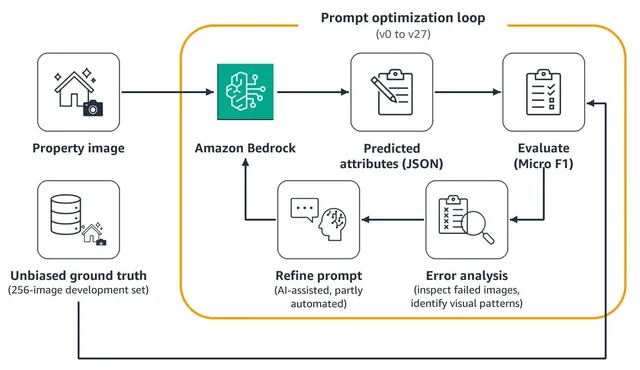
    Property Finder found that 96.8% of its evaluation labels came directly from predictions of an existing vision-language model rather than human verification, causing any alternative model to be structurally disadvantaged in comparisons. The team re-annotated 356 UAE images by hand and switched to multi-label classification, then iterated and optimized prompts from v0 to v27 to select a model on Amazon Bedrock, ultimately achieving higher accuracy and an 86% cost reduction.

    Diagram of the prompt optimization loop: a property image goes to Amazon Bedrock, the predicted attributes are scored with Micro F1 against the expert-annotated development set, error analysis informs the next prompt version, and the loop repeats from v0 to v27.

    Matched fieldsBody

  9. AWS Machine Learning

    AWS launches SOCI index images for SageMaker AI training and processing jobs

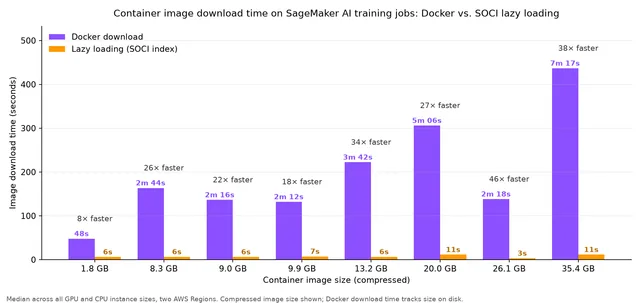
    AWS has launched SOCI index images for Amazon SageMaker AI training and processing jobs, enabling containers to start within seconds through lazy loading, with no changes to job definitions required. Official benchmarks show that image download times for 1.8–35.4 GB images dropped from 48 seconds to 7 minutes 17 seconds down to 3–11 seconds, a speedup of 8x–46x, and GPU idle time reduced by up to 90%. If the index is unreadable or lazy loading fails, jobs automatically fall back to standard downloads.

    Bar chart comparing Docker pull and SOCI lazy-loading download times across eight image sizes, with speedups from about 10x to over 35x

    AWS has launched SOCI index images for Amazon SageMaker AI training and processing jobs, enabling containers to start within seconds through lazy loading, with no changes to job definitions required. Official benchmarks show that image download times for 1.8–35.4 GB images dropped from 48 seconds to 7 minutes 17 seconds down to 3–11 seconds, a speedup of 8x–46x, and GPU idle time reduced by up to 90%. If the index is unreadable or lazy loading fails, jobs automatically fall back to standard down

    Matched fieldsBody

  10. AWS Machine Learning

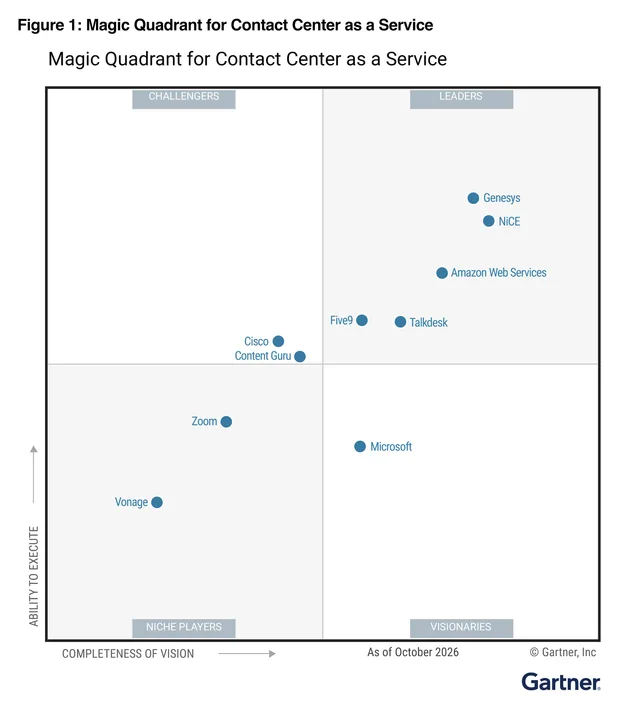
    AWS Named a Leader for the Fourth Consecutive Year in the 2026 Gartner Magic Quadrant for CCaaS

    AWS's Amazon Connect has been named a Leader for the fourth consecutive year in the 2026 Gartner Magic Quadrant for Contact Center as a Service (CCaaS). Connect Customer combines customer context with generative and agentic AI, emphasizing driving complex issues all the way through to resolution rather than just transferring them, with every step auditable and human intervention available when needed.

    Matched fieldsBody

  11. Meta Engineering Blog

    PrivacyLib: Meta implements privacy controls at the data access boundary

    The Meta engineering team has introduced PrivacyLib, a general-purpose privacy library that runs within clients across hundreds of data and processing systems and performs billions of checks per second. A system only needs to integrate it once, and new privacy requirements can reuse that integration as modules, without the need to reimplement them in each system. The newly added Agent Observability module can observe data access events of internal AI agents, and systems that have already integrated it can enable it without additional modifications.

    The Meta engineering team has introduced PrivacyLib, a general-purpose privacy library that runs within clients across hundreds of data and processing systems and performs billions of checks per second. A system only needs to integrate it once, and new privacy requirements can reuse that integration as modules, without the need to reimplement them in each system. The newly added Agent Observability module can observe data access events of internal AI agents, and systems that have already integra

    Matched fieldsBody

  12. Databricks Blog

    From local patching to quantifiable improvement: Using ai_extract and MLflow Prompt Registry to improve document extraction accuracy

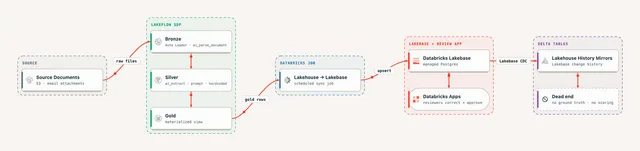
    Databricks shared its approach to improving document extraction accuracy using ai_extract and MLflow Prompt Registry: in a project that extracted about 40 structured fields from dozens of PDF layouts, merely modifying the schema halved the errors in the revision field, but the total extraction errors across all fields actually increased by 9%. The article recommends describing field-level rules with the schema, using global instructions for document-level logic, and using precision mode when the structure is complex; it also recommends storing prompts and schemas in MLflow Prompt Registry for version management and alias-based rollback, then evaluating accuracy, coverage, and run-to-run variance based on human-reviewed ground truth. Genie Code can automatically perform per-field scoring, propose reviewable diffs, and rerun evaluations.

    Document Extraction Pipeline

    Databricks shared its approach to improving document extraction accuracy using ai extract and MLflow Prompt Registry: in a project that extracted about 40 structured fields from dozens of PDF layouts, merely modifying the schema halved the errors in the revision field, but the total extraction errors across all fields actually increased by 9%. The article recommends describing field-level rules with the schema, using global instructions for document-level logic, and using precision mode when the

    Matched fieldsBody