←Search results

By relevance · Total 566 results Clear search

Thursday

  1. Full Artificial Analysis article

    Thinking Machines releases Inkling 2 Small, scoring 31 on the Intelligence Index

    Thinking Machines releases Inkling 2 Small, which scores 31 on the Artificial Analysis Intelligence Index v5.0.1, 18 points higher than Inkling Small and on par with Gemini 3.8 Flash (high). The model is currently proprietary, offered through the Tinker platform and Tinker Playground, with plans to later open its weights under the Apache 2.0 license. The model has 594B total parameters and 17B activated parameters, supports text and image input, and is priced at $0.30/$1.00 per 1M input/output tokens.

    Thinking Machines releases Inkling 2 Small, which scores 31 on the Artificial Analysis Intelligence Index v5.0.1, 18 points higher than Inkling Small and on par with Gemini 3.8 Flash (high). The model is currently proprietary, offered through the Tinker platform and Tinker Playground, with plans to later open its weights under the Apache 2.0 license. The model has 594B total parameters and 17B activated parameters, supports text and image input, and is priced at $0.30/$1.00 per 1M input/output t

    Matched fieldsBody
  2. Cognition Model / Devin BlogSelected

    Cognition Releases SWE-2 Flash Coding Model

    Cognition has released the SWE-2 Flash coding model, trained on Thinking Machines' Inkling-Small (276B total parameters, 12B activated parameters), marking the first time a mid-training stage before reinforcement learning was added to the training pipeline. The company claims Terminal-Bench 4.0 improved from 0.9% to 20.0%, FrontierCode 2.0 from 3.2% to 24.0%, and ExploitBench from 11.3% to 34.8%. The model is now available on Devin Desktop and the CLI, priced at one-fifth of its larger sibling SWE-2 and running 3 times faster (200 tok/s versus 60 tok/s). Its weights are not yet public; the company plans to share them securely with trusted industry partners and research institutions through a program.

    Cognition has released the SWE-2 Flash coding model, trained on Thinking Machines' Inkling-Small (276B total parameters, 12B activated parameters), marking the first time a mid-training stage before reinforcement learning was added to the training pipeline. The company claims Terminal-Bench 4.0 improved from 0.9% to 20.0%, FrontierCode 2.0 from 3.2% to 24.0%, and ExploitBench from 11.3% to 34.8%. The model is now available on Devin Desktop and the CLI, priced at one-fifth of its larger sibling S

    Matched fieldsBody

  3. CognitionSelected

    Cognition Releases Coding Model SWE-2 Flash, Built on Inkling-Small

    Cognition has released the fast coding model SWE-2 Flash, built on thinkymachines' Inkling-Small, with 276B total parameters and 12B activated parameters. The company claims it costs 5 times less and is 3 times faster than SWE-2, and surpasses all US open-weight models on major benchmarks, including models 3 times larger. The model will be free this month for Pro, Max, and Teams users of Devin Desktop and Devin CLI, and its weights will be released on a targeted basis through partner programs.

    Matched fieldsBody

Friday

  1. Hugging FaceSelected

    NVIDIA Releases Four Open-Weight World Models in the Cosmos 3 Series

    Under the Cosmos world model platform, NVIDIA has added four Cosmos 3 open-weight checkpoints, all post-trained versions of Cosmos 3 Nano, containing 16B trainable parameters and released under the OpenMDW1.1 license, which permits commercial and non-commercial use. The four models respectively target multi-view driving data generation, synchronized streaming simulation of cameras and LiDAR, simulator-controlled generation of photorealistic video, and video prediction from dual-arm robot actions. The original text also provides a four-stage training recipe covering bidirectional adaptation, teacher forcing, consistency distillation, and self-forcing.

    Under the Cosmos world model platform, NVIDIA has added four Cosmos 3 open-weight checkpoints, all post-trained versions of Cosmos 3 Nano, containing 16B trainable parameters and released under the OpenMDW1.1 license, which permits commercial and non-commercial use. The four models respectively target multi-view driving data generation, synchronized streaming simulation of cameras and LiDAR, simulator-controlled generation of photorealistic video, and video prediction from dual-arm robot actions

    Matched fieldsBody

  2. OpenAI: Deployment Safety and System CardSelected

    OpenAI releases the GPT-6 Cyber system card, a specialized model for authorized security work

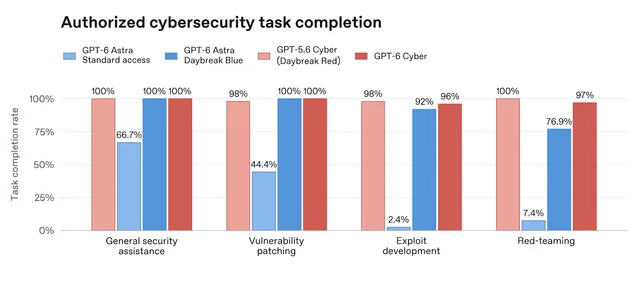
    OpenAI releases the GPT-6 Cyber system card, a cybersecurity-specialized variant of GPT-6 Astra intended for authorized security work such as vulnerability discovery, exploit development, and web penetration testing. In defensive-use evaluations, the model completed 100% of general security assistance and vulnerability remediation tasks, 96% of exploit development tasks, and 97% of red-team tasks. Under the Preparedness Framework, its capability ratings are the same as GPT-6 Astra: cybersecurity is Critical, biochem is High, and AI self-improvement is below High; access is restricted through Daybreak Red and requires identity verification, SSO, MFA, and an API IP allowlist.

    Figure 1

    OpenAI releases the GPT-6 Cyber system card, a cybersecurity-specialized variant of GPT-6 Astra intended for authorized security work such as vulnerability discovery, exploit development, and web penetration testing. In defensive-use evaluations, the model completed 100% of general security assistance and vulnerability remediation tasks, 96% of exploit development tasks, and 97% of red-team tasks. Under the Preparedness Framework, its capability ratings are the same as GPT-6 Astra: cybersecurity

    Matched fieldsBody

Wednesday

  1. Tencent Hunyuan ResearchSelected

    Tencent Hunyuan Releases Hy4 Official Version, Introducing Vision and Computer Operation Capabilities for the First Time

    Tencent Hunyuan Releases Hy4 Official Version, Significantly Expanding Pre-training and Post-training Scale Compared with Hy4 preview, Introducing Vision Capabilities and Supporting Computer Operation for the First Time. The company says Hy4 has for the first time ranked among the strongest open-source models, improving by 19.1% and 9.8% on the GameDev and GameLogic benchmarks respectively, while the hallucination rate dropped from 15.76% to 5.45%. Hy4 is now available on Tencent Cloud and OpenRouter and can be experienced in products such as WorkBuddy/CodeBuddy, Yuanbao, and ima. API pricing remains unchanged at 6 yuan for input and 18 yuan for output per million Tokens, and the model weights are planned to be open-sourced.

    Tencent Hunyuan Releases Hy4 Official Version, Significantly Expanding Pre-training and Post-training Scale Compared with Hy4 preview, Introducing Vision Capabilities and Supporting Computer Operation for the First Time. The company says Hy4 has for the first time ranked among the strongest open-source models, improving by 19.1% and 9.8% on the GameDev and GameLogic benchmarks respectively, while the hallucination rate dropped from 15.76% to 5.45%. Hy4 is now available on Tencent Cloud and OpenR

    Matched fieldsBody

Tuesday

  1. Sarvam AI Blog

    Sarvam AI Releases Sarvam Prism, a Decision Model Based on Sarvam 105B

    Sarvam AI has released Sarvam Prism, a System One decision model based on Sarvam 105B, which achieves an average score of 71.8 with a median response time of 44 ms on B200 GPUs, the highest score within 100 ms among the 25 decision models it tested. At confidence levels above 90%, the model's actual error rate is lower than expected: 2.2% versus 3.3% for English and 4.4% versus 5.4% for Indic languages, and it keeps its answers unchanged in a 2,000-question option-shuffling test. The weights are open-sourced under the Apache 2.0 license on Hugging Face, requiring at least 120 GB of VRAM on a single GPU to run in FP8, and it is also available via the Sarvam API.

    Introducing Sarvam Prism

    Sarvam AI has released Sarvam Prism, a System One decision model based on Sarvam 105B, which achieves an average score of 71.8 with a median response time of 44 ms on B200 GPUs, the highest score within 100 ms among the 25 decision models it tested. At confidence levels above 90%, the model's actual error rate is lower than expected: 2.2% versus 3.3% for English and 4.4% versus 5.4% for Indic languages, and it keeps its answers unchanged in a 2,000-question option-shuffling test. The weights are

    Matched fieldsBody

Friday

  1. Cailian Press

    Mistral Releases Large 4 Open-Weight Model, Focused on Coding and Cyber Defense

    French company Mistral AI has released the Large 4 model (ML4), featuring advanced coding and cyber defense capabilities; enterprises can download the open-weight version and deploy it to run on their own infrastructure. The model has a total of 1.05 trillion parameters, with approximately 52 billion parameters actually activated per task execution, and was trained in a European data center using 3,800 NVIDIA Grace Blackwell GPUs. Mistral claims it is comparable to other leading open models on coding tasks and emphasizes that open source helps prevent frontier AI technology from concentrating in the hands of a few players.

    French company Mistral AI has released the Large 4 model (ML4), featuring advanced coding and cyber defense capabilities; enterprises can download the open-weight version and deploy it to run on their own infrastructure. The model has a total of 1.05 trillion parameters, with approximately 52 billion parameters actually activated per task execution, and was trained in a European data center using 3,800 NVIDIA Grace Blackwell GPUs. Mistral claims it is comparable to other leading open models on c

    Matched fieldsBody

  2. MarkTechPost

    Edge0 Releases Audio8-TTS-Realistic: A 0.6B Open-Source Voice Cloning TTS Model

    Edge0 has released the open-weight voice cloning TTS model Audio8-TTS-Realistic, with 601M parameters, supporting 23 languages, with weights and code released under Apache 2.0. The model requires only 1 reference audio clip and its corresponding text for zero-shot voice cloning, and can also directly generate speech when no reference voice is available. Self-reported results show an average error rate of 4.86% on the CV3 nine-language benchmark, lower than Qwen3-TTS-1.7B's 7.73%, but it lags behind 4B-class models on the MiniMax benchmark, with Thai WER reaching 48.57%.

    Edge0 has released the open-weight voice cloning TTS model Audio8-TTS-Realistic, with 601M parameters, supporting 23 languages, with weights and code released under Apache 2.0. The model requires only 1 reference audio clip and its corresponding text for zero-shot voice cloning, and can also directly generate speech when no reference voice is available. Self-reported results show an average error rate of 4.86% on the CV3 nine-language benchmark, lower than Qwen3-TTS-1.7B's 7.73%, but it lags beh

    Matched fieldsBody

  3. TMTPost · AGI

    Google releases Gemini 4 Carbon, topping the Artificial Analysis Intelligence Index with 59 points

    Google has released its new-generation flagship model Gemini 4 Carbon, which tops the Artificial Analysis Intelligence Index v5.0 with 59 points, surpassing Claude Opus 5.5 and GPT-6 Astra. On Terminal-Bench 4.0, the model improved from Argon's 57.1% to 65.2%, and on the GraphWalks long-context test it rose from 84.2% to 96.2%, but developers report that its generation speed is about 2 to 4 times slower than Argon. This week Google first opened it to a small number of cybersecurity defense organizations, then expanded it to trusted partners through the Fairwind program; the opening time for general users has not yet been announced.

    Google has released its new-generation flagship model Gemini 4 Carbon, which tops the Artificial Analysis Intelligence Index v5.0 with 59 points, surpassing Claude Opus 5.5 and GPT-6 Astra. On Terminal-Bench 4.0, the model improved from Argon's 57.1% to 65.2%, and on the GraphWalks long-context test it rose from 84.2% to 96.2%, but developers report that its generation speed is about 2 to 4 times slower than Argon. This week Google first opened it to a small number of cybersecurity defense organ

    Matched fieldsBody

  4. Ant Group inclusionAI: New GitHub Repository

    Ant Group's inclusionAI Open-Sources 2B Visual Forensics Model DefakerOne2

    Ant Group's GuangJian team has open-sourced DefakerOne2 on GitHub, a 2B-parameter unified visual forensics model built on the Qwen3.5-2B multimodal backbone, covering AI-generated content, DeepFake faces, document tampering, natural image tampering, face and ID anti-counterfeiting, and AI-generated video detection. The model was trained on approximately 50 million samples, employs a three-stage Tide-Style Tuning process from LoRA to full parameters and back to LoRA, and uses entropy-based test-time routing to select between the video and frame pathways. The team claims that it achieves SOTA on 40 of 53 detection benchmarks and on 11 of 14 localization benchmarks, and that the weights and the RRVBench benchmark have been released on ModelScope.

    GitHub

    Ant Group's GuangJian team has open-sourced DefakerOne2 on GitHub, a 2B-parameter unified visual forensics model built on the Qwen3.5-2B multimodal backbone, covering AI-generated content, DeepFake faces, document tampering, natural image tampering, face and ID anti-counterfeiting, and AI-generated video detection. The model was trained on approximately 50 million samples, employs a three-stage Tide-Style Tuning process from LoRA to full parameters and back to LoRA, and uses entropy-based test-t

    Matched fieldsBody

  5. Baseten Engineering BlogSelected

    Baseten releases decision model joey-1, with P50 latency of 20ms and $0.01 per million tokens

    Baseten's Base Labs has released joey-1, a 2B decision model that directly outputs a single-token label and calibrated confidence, with a P50 end-to-end latency of 20ms, about 2.5 times faster than elephant-1 (49ms), at a price of $0.01 per million tokens, one-tenth that of mammoth-1. joey-1 is post-trained from Qwen3.5-2B and shares the same data recipe and API with elephant-1 and mammoth-1, so switching requires changing only one line. The model is now available on Baseten Model APIs, with zero data retention by default, and its weights are open-sourced on Hugging Face; Model APIs supports a 16k context window, while dedicated deployments can unlock a 262k context window and support fine-tuned weights.

    joey-1

    Baseten's Base Labs has released joey-1, a 2B decision model that directly outputs a single-token label and calibrated confidence, with a P50 end-to-end latency of 20ms, about 2.5 times faster than elephant-1 (49ms), at a price of $0.01 per million tokens, one-tenth that of mammoth-1. joey-1 is post-trained from Qwen3.5-2B and shares the same data recipe and API with elephant-1 and mammoth-1, so switching requires changing only one line. The model is now available on Baseten Model APIs, with zer

    Matched fieldsBody

Wednesday

  1. OpenBMB

    OpenBMB Releases MiniCPM-OCR 1.0 and Verification Model Jev

    OpenBMB releases MiniCPM-OCR 1.0, a 1B-scale OCR model that achieves 93.68 on Real5-OmniDocBench and 54.7 on OCRBench v2. It also releases MiniCPM-OCR Jev, a 2B decision model used to compare parsing results with the original image and give a 0–1 correctness score, approaching Qwen3.5-397B-A17B on JevOCRBench. Both models have open weights, support deployment via llama.cpp, vLLM, SGLang, and Ollama, and come with open-source fine-tuning code.

    Matched fieldsBody

  2. Hugging FaceSelected

    NVIDIA Releases Nemotron 3.5 Transcribe and Granary v2 Data Pipeline

    NVIDIA has released the open-weight model Nemotron 3.5 Transcribe on Hugging Face and ModelScope, integrating transcription, speaker diarization, translation, and audio question answering into a single checkpoint. It supports transcription in 40 languages, translation between 31 languages and English, and speaker labeling in 13 languages, can process recordings up to 1 hour long, and can label up to 8 speakers. The model ranks first among open-weight models on the English leaderboard of the Hugging Face Open ASR Leaderboard with an average WER of 5.33%, and achieves 2.8% AA-WER on Artificial Analysis with approximately 4B activated parameters. The simultaneously released Granary v2 covers 48 languages and 463,062 hours of speech data, and the accompanying NeMo Speech fine-tuning recipe reduced WER on held-out speakers from 22.44% to 12.17% in a medical case.

    NVIDIA has released the open-weight model Nemotron 3.5 Transcribe on Hugging Face and ModelScope, integrating transcription, speaker diarization, translation, and audio question answering into a single checkpoint. It supports transcription in 40 languages, translation between 31 languages and English, and speaker labeling in 13 languages, can process recordings up to 1 hour long, and can label up to 8 speakers. The model ranks first among open-weight models on the English leaderboard of the Hugg

    Matched fieldsBody

Thursday

  1. Artificial AnalysisSelected

    Mistral Large 4 Opens Its Weights, Becoming the Top Non-Chinese Open-Source Model

    Mistral AI updated and opened the weights of its flagship model Mistral Large 4, with 1.05T total parameters and 52B activated parameters. It scores 26 on the Artificial Analysis Intelligence Index v5, 1 point higher than the Preview version, and leads the US open-source model Muse Spark Open (25) by 1 point. The model outputs 82K tokens per task, 39% fewer than the Preview's 135K, and its hallucination rate on AA-Omniscience v1.1 dropped from 41% to 28%, though accuracy remains 26%. Pricing is $0.70/$2.10 per 1M input/output tokens, about 50% lower than the Preview, under the MEOW license; operating a Model-as-a-Service business requires a separate commercial license.

    Mistral AI updated and opened the weights of its flagship model Mistral Large 4, with 1.05T total parameters and 52B activated parameters. It scores 26 on the Artificial Analysis Intelligence Index v5, 1 point higher than the Preview version, and leads the US open-source model Muse Spark Open (25) by 1 point. The model outputs 82K tokens per task, 39% fewer than the Preview's 135K, and its hallucination rate on AA-Omniscience v1.1 dropped from 41% to 28%, though accuracy remains 26%. Pricing is

    Matched fieldsBody

  2. Zhidongxi

    Chaoyan Intelligence Open-Sources 35B Model Apex-35B-V1.0, with AI Participating in Its Own R&D

    Beijing-based large model startup Chaoyan Intelligence has released and open-sourced its first large model, Apex-35B-V1.0, with 35 billion total parameters, approximately 3 billion parameters activated per token, and support for a 262,000-token context window, optimized through mid-training and post-training based on Qwen3.6-35B-A3B. The model scored 60.9 and 40.0 on the paper reproduction test PaperBench and the scientific research challenge test FrontierScience, respectively, higher than GLM-5.3's 42.5 and 30.7; it scored 84.0 on the tool-calling test BFCL V4, higher than DeepSeek-V4.1-Flash-1017's 75.0. The model has been released with open weights under the Apache 2.0 license, and the official release provides approximately 72GB of BF16 weights and GGUF quantized versions at various precisions.

    Beijing-based large model startup Chaoyan Intelligence has released and open-sourced its first large model, Apex-35B-V1.0, with 35 billion total parameters, approximately 3 billion parameters activated per token, and support for a 262,000-token context window, optimized through mid-training and post-training based on Qwen3.6-35B-A3B. The model scored 60.9 and 40.0 on the paper reproduction test PaperBench and the scientific research challenge test FrontierScience, respectively, higher than GLM-5

    Matched fieldsBody

  3. Analytics India Magazine

    NVIDIA Releases Nemotron 3.5 Transcribe Open-Weight Speech Model, Supporting 40 Languages

    On October 28, NVIDIA released Nemotron 3.5 Transcribe, an open-weight speech model that can transcribe audio in 40 languages, translate speech, and identify speakers, and developers can control the transcription format with natural language instructions without retraining. The model consists of a Transformer speech encoder, a speaker diarization model, and the Nemotron 3.5 Lightning language model, with approximately 4.3 billion activated parameters, and the released checkpoint is labeled 30B-A4B. NVIDIA says it achieves an average word error rate of 4.71% on nine public test sets of the English Open ASR Leaderboard and 4.62% on seven languages of the multilingual leaderboard, and calls it the best open-weight model on both leaderboards; the model is released in BF16, FP8, and NVFP4 formats as well as GGUF files, under the OpenMDW-1.1 license.

    On October 28, NVIDIA released Nemotron 3.5 Transcribe, an open-weight speech model that can transcribe audio in 40 languages, translate speech, and identify speakers, and developers can control the transcription format with natural language instructions without retraining. The model consists of a Transformer speech encoder, a speaker diarization model, and the Nemotron 3.5 Lightning language model, with approximately 4.3 billion activated parameters, and the released checkpoint is labeled 30B-A

    Matched fieldsBody

  4. The DecoderSelected

    Google DeepMind releases Gemini 4 Carbon, just two weeks after Argon

    Google DeepMind launched Gemini 4 Carbon two weeks after the release of Argon. The model scored 59 on the Artificial Analysis Intelligence Index v5.0, higher than Argon's 50, ranking first. Carbon is designed for long-horizon engineering tasks, rose to 1769 points and fourth place on WebDev Arena, and reduced the attack success rate from 0.7% to 0.0% on the Gray Swan indirect prompt injection benchmark. The model is first being made available to select cybersecurity experts, priced at $2 per million input tokens and $10 per million output tokens, in line with Argon's introductory pricing.

    Google DeepMind launched Gemini 4 Carbon two weeks after the release of Argon. The model scored 59 on the Artificial Analysis Intelligence Index v5.0, higher than Argon's 50, ranking first. Carbon is designed for long-horizon engineering tasks, rose to 1769 points and fourth place on WebDev Arena, and reduced the attack success rate from 0.7% to 0.0% on the Gray Swan indirect prompt injection benchmark. The model is first being made available to select cybersecurity experts, priced at $2 per mil

    Matched fieldsBody

  5. The Decoder

    Mistral Releases Mistral Large 4 Weights: Coding Ability Leads Open-Source Models but Overall Trails Chinese Models

    Mistral has released the weights of Mistral Large 4 on Hugging Face. The model, nicknamed Le Chonk, has approximately 1 trillion parameters with 52 billion activated per step, and supports text and image inputs. On Terminal-Bench 4.0, its score rose from 28% in the preview version to 41%, slightly above GLM-5.3's 40%, but on the new version of the Artificial Analysis Intelligence Index it scored only 26 points, below the 32 points of DeepSeek V4.1 Flash and GLM-5.3. API pricing is $0.70 per million input tokens and $2.10 per million output tokens, under a modified MIT license; using it as a commercial cloud service requires separate authorization.

    Mistral has released the weights of Mistral Large 4 on Hugging Face. The model, nicknamed Le Chonk, has approximately 1 trillion parameters with 52 billion activated per step, and supports text and image inputs. On Terminal-Bench 4.0, its score rose from 28% in the preview version to 41%, slightly above GLM-5.3's 40%, but on the new version of the Artificial Analysis Intelligence Index it scored only 26 points, below the 32 points of DeepSeek V4.1 Flash and GLM-5.3. API pricing is $0.70 per mill

    Matched fieldsBody

  6. Latent SpaceSelected

    Google DeepMind releases Gemini 4 Carbon, topping Artificial…

    Google DeepMind has released Gemini 4 Carbon, which ranks first on the Artificial Analysis Intelligence Index v5 with a score of 59 and leads in 4 of 9 evaluations including HLE-Diamond and TB-Science. The model focuses on cybersecurity and long-horizon tasks, claiming 88.2% on SEC-bench Pro, 54.8% on ExploitGym, and 71.0% on CWE-bench, and is initially available only to trusted cybersecurity personnel through the Fairwind Program. In terms of specifications, it supports a 1M token context and 1M maximum output, with input covering text, images, video, and speech, and output in text; Artificial Analysis lists a standard price of $4/$20 per million input/output tokens, plus a 50% launch discount.

    Google DeepMind has released Gemini 4 Carbon, which ranks first on the Artificial Analysis Intelligence Index v5 with a score of 59 and leads in 4 of 9 evaluations including HLE-Diamond and TB-Science. The model focuses on cybersecurity and long-horizon tasks, claiming 88.2% on SEC-bench Pro, 54.8% on ExploitGym, and 71.0% on CWE-bench, and is initially available only to trusted cybersecurity personnel through the Fairwind Program. In terms of specifications, it supports a 1M token context and 1

    Matched fieldsBody