NAll news

Friday74 items

  1. MiniMaxFirst-partyProduct release
    AI score58

    MiniMax-M3.1-Flash Opens Its Weights, NVIDIA NeMo Supports Day-0 Fine-Tuning

    MiniMax officially thanked the NVIDIA NeMo team for providing day-0 fine-tuning support for MiniMax-M3.1-Flash. The cited post by Huiying Li states that before its public release, the model had processed 200T+ tokens through Space Bunny and has now opened its weights; NeMo-AutoModel's day-0 fine-tuning support includes FSDP2, expert parallelism, pipeline parallelism, and context parallelism, can scale up to 128 GPUs, and can directly load NVFP4 checkpoints.

    You’ve probably already used it: Space Bunny pushed 200T+ tokens before anyone knew it was MiniMax-M3.1-Flash. Now it’s open weights 🔥 Thank you @MiniMax_AI for open sourcing it! Day-0 fine-tuning in NVIDIA NeMo-AutoModel ✅ FSDP2, expert, pipeline, and context parallelism, ✅scaling up to 128 GPUs, and the NVFP4 checkpoint loads directly. https://t.co/mJbil96cax

    #Product updates#Open-source ecosystem#English text is being prepared.
  2. MiniMaxFirst-partyProduct release
    AI score55

    MiniMax M3.1 Flash Gets Day-One Support from SGLang and Miles

    MiniMax announced that M3.1 Flash is ready from inference to RL, with SGLang and Miles providing support on the very first day of release. According to SGLang, the model achieves over 1K tok/s for bs1 decode on SGLang, supports NVIDIA Blackwell and Hopper (GB300/B300/B200/H200) as well as AMD Instinct MI350X and MI355X, and supports MiniMax's DSpark draft model along with HiCache and multimodal input.

    Space Bunny is here! 🐰 MiniMax M3.1 Flash hits >1K tok/s, bs1 decode with SGLang, production-ready from Day 0. This integration is a joint effort by @MiniMax_AI, @NVIDIAAI, @AMD, and @radixark, and you can also run RL with Miles! -Broad hardware support: NVIDIA Blackwell and Hopper (GB300/B300/B200/H200), plus AMD Instinct MI350X and MI355X. -Agentic serving at scale: ~100K total tok/s per GPU on the AgentX coding-agent trace with 96 concurrent sessions. -Speculative decoding: Supports MiniMax's DSpark draft and a DFlash2 draft trained by @radixark; supports HiCache and multimodal input. -Ultra-low-latency inference: MegaKernels deliver 2.15× faster single-request decode.

    #Product updates#Reasoning#English text is being prepared.

  3. Testing CatalogProduct release
    AI score66

    OpenAI Decisions API Now Generally Available, Supporting Three Types of Decision Calls

    OpenAI announced that the Decisions API is now generally available and can be used via the API and the OpenAI Platform. The interface is used to classify text and images, evaluate inputs, and decide the next step without generating a full model response, offering three types of decisions: Predicate, Choice, and Score. The publisher said it is similar to Jev and noted that the API puts the probability of the GPT-7 series being released this year at 21%.

    Add near real-time decisions to your workflow with the Decisions API, now generally available. Build faster, more cost-efficient apps and agents that can classify text and images, evaluate inputs, and determine what happens next without generating a full model response.

    Same story · 7 reports

    #Product updates#OpenAI#English text is being prepared.

  4. Testing CatalogProduct release
    AI score60

    Grok Bot can connect to phone system apps such as Calendar and Reminders

    Grok Bot can now connect to system apps on your phone, including Calendar, Reminders, and Contacts, and this capability is rolling out on iOS and Android. TestingCatalog says similar integrations have so far only been seen on Perplexity and Claude, and considers this an important capability opening for mobile agents.

    Grok Bot can now use Calendar, Reminders, Contacts, and more apps on your phone. Rolling out now on iOS and Android. https://t.co/wM0lssJP1X

    Same story · 2 reports

    #Product updates#Agents#English text is being prepared.

  5. Testing CatalogProduct release
    AI score58

    Claude platform features launch on Google Cloud via Anthropic hosting

    Claude Models on Google Cloud (Anthropic managed) is now generally available, and Google Cloud customers get the full set of Claude API features, with new features and betas launching the same day as on the native Claude Platform. The offering covers Claude Managed Agents, Code Execution, Computer Use, Agent Skills, and Advisor Strategy, and supports Google Cloud IAM credentials, billing, and commitment retirement.

    Claude Models on Google Cloud (Anthropic managed) is now generally available. Get the full set of Claude Platform features on Google Cloud, with Google Cloud IAM credentials, billing, and commitment retirement. https://t.co/JyRT8Y401r

    Same story · 3 reports

    #Product updates#Agents#English text is being prepared.

  6. 36Kr · AIProduct release
    AI score52

    Aerial uses AI to give smart TVs a clean desktop, replacing the system launcher without root

    The open-source tool Aerial overlays the system launcher via a background desktop daemon, leaving only the wallpaper, clock, and apps on the TV home screen, with no root permission required. It leverages Android's notification listening feature introduced in July 2013, automatically reviving within 0.5 seconds after background apps are cleared during standby, and gained over 200 stars on GitHub in less than a day after release. To install, enable adb debugging on the TV, enter the TV's IP address, then hand the prompt from the official website to agents such as Doubao and WorkBuddy for automatic deployment.

    #Tutorials / practice#Agents#Open-source ecosystem

  7. SiliconANGLEProduct release
    AI score67

    Google Cloud launches Agent Compute Engine to host AI agents

    Google Cloud has launched Agent Compute Engine, an infrastructure service purpose-built for hosting AI agents, whose sandboxes are implemented as microVMs, combining the hardware efficiency of containers with the isolation capabilities of traditional virtualization. The service limits the attack surface with stateless devices, an immutable file system, Titan chip-verified firmware, and a multi-layer proxy network, and automatically shuts down sandboxes when idle and rapidly restores them when needed, enabling a single physical node to host far more agent microVMs than conventional VMs. Agent login credentials are stored outside the sandbox and retrieved on the agent's behalf by Agent Gateway; the service will launch in the coming months alongside a new version of Agent Gateway, which adds model routing and token consumption control capabilities.

    Same story · 6 reports

    #Product updates#Agents#English text is being prepared.

  8. Phoenix TechnologyProduct release
    AI score75

    Microsoft Launches AI Diagnostic System MAI-DxO, Achieving 83% Accuracy on Complex Cases

    Microsoft announced the launch of its AI diagnostic system, Microsoft AI Diagnostic Orchestrator (MAI-DxO), which simulates a multidisciplinary expert consultation by orchestrating multiple AI agents. In an evaluation based on common cases from U.S. emergency departments using the MIMIC-IV-ED dataset, its diagnostic accuracy was 1.7 times that of human physicians; in a simulated evaluation based on complex cases from The New England Journal of Medicine, it achieved 83% accuracy, compared with 36% for primary care general practitioners and general internists who could independently consult reference materials, while specialists were not included in the comparison. Officials said the system's cost is only half or even one-third that of physicians, and the research findings have been published in the journal Science.

    Same story · 4 reports

    #Model releases#Agents#Reasoning

  9. Phoenix TechProduct release
    AI score75

    OpenAI Fully Opens the Decisions API Based on GPT-6 Luna

    OpenAI announced the full opening of the Decisions API built on GPT-6 Luna, aimed at questions with a limited set of answers, with response speeds up to 10 times faster than calling GPT-6 Luna through the Responses API. The API charges $0.10 per million input tokens, $0.01 per million cached input tokens, bills only for input tokens, and output tokens are free. Since the public beta, it has added native GPT-Live integration, prompt caching, and inference data residency support in the United States and the European Union, and up to 400 questions can be submitted per request.

    Same story · 7 reports

    #Product updates#OpenAI#Agents

  10. IT Home · Artificial IntelligenceProduct release
    AI score73

    Microsoft launches AI medical diagnostic system MAI-DxO, achieving 83% accuracy on complex cases

    Microsoft announced the launch of the AI diagnostic system MAI-DxO (Microsoft AI Diagnostic Orchestrator), which simulates a multidisciplinary expert consultation of physicians by uniformly orchestrating multiple AI agents. In a simulated evaluation based on complex NEJM cases, its diagnostic accuracy reached 83%, compared with 36% for primary care general practitioners and general internists who could independently consult reference materials; in an evaluation of common U.S. emergency department visit cases based on the MIMIC-IV-ED dataset, its accuracy was 1.7 times that of human physicians. Officials said the system costs only half or even one-third of what physicians cost, and the research results have been published in the journal Science.

    Same story · 4 reports

    #Model releases#Agents#Papers/Research

  11. IT Home · Artificial IntelligenceProduct release
    AI score79

    OpenAI fully opens its decision API, based on GPT-6 Luna, at $0.1 per million input tokens

    OpenAI announced the full opening of the Decisions API, which is built on GPT-6 Luna and is aimed at questions with bounded answers, helping applications and agents make near-real-time decisions based on text, images, and structured inputs, with response speeds up to 10 times faster than calling GPT-6 Luna through the Responses API. On pricing, input is charged at $0.1 per million tokens, cached input hits are charged at $0.01 per million tokens, and billing is based only on input tokens, with output tokens free. Since the public beta, native GPT-Live integration, Prompt caching, and inference data residency support in the United States and the European Union have been added, and up to 400 questions can be submitted per request.

    Same story · 7 reports

    #Product updates#OpenAI#Agents

  12. IT Home · Artificial IntelligenceProduct release
    AI score58

    1Password launches 1Password for Agents agent password authorization feature

    1Password launches the 1Password for Agents platform, enabling personal AI agents to complete website logins on users' behalf without accessing or storing users' passwords or verification codes. The feature is aimed at individual and family plan users, with initial support for agents including Meta Muse, OpenAI ChatGPT Work and Dots, Anthropic Claude Duet, Grok Bot, and Town. In the flow, the agent first proves its identity to 1Password using a digital key; the user sees on their device the account credentials and task requested for use and approves or rejects; after approval, 1Password directly fills in the username, password, or one-time verification code, and the password always remains in the vault.

    Same story · 13 reports

    #Product updates#Agents#English text is being prepared.

  13. Sakana AI:BlogFirst-partyProduct release
    AI score52

    Sakana AI Releases Ontology-Based AI Agent Platform Sakana Aquarium

    Sakana AI has released Sakana Aquarium, an AI agent building and operations platform that centers on ontology, organizing the knowledge, rules, and data scattered across an organization into a unified semantic layer so that agents can confirm information, make judgments, and execute tasks. The platform comprises three layers of mechanisms—ontology, governance, and managed agents—and allows access permissions and pre-execution approvals to be configured, while recording the entire process from the basis of a judgment to the execution result. The organized data and ontology can be directly reused by other agents, and Sakana AI says it will subsequently develop mechanisms that let agents continuously update the ontology as the organization changes, as well as AI-assisted agent building.

    #Product updates#Agents#English text is being prepared.

  14. The Verge AIProduct release
    AI score65

    Canva releases its first in-house image model, Canva Craft, which plans the design first and then generates the image

    Canva has released its first in-house image generation model, Canva Craft, which uses a two-stage architecture: it plans the design first and then generates the image, supporting up to 2K resolution and more than 30 aspect ratios. The model was trained on millions of human-made templates in the platform's content library, and it currently ranks fourth on the Design Arena image generation model leaderboard, behind OpenAI's GPT-Image-2.5 Sunburst, GPT-Image-2.5 Flare and GPT-Image-2. Canva Craft is now available to all users worldwide and can be accessed from the three-dot option in the left-hand menu to enter Dream Lab; Canva also plans to let AI agents access the model via MCP and will launch Craft-fast and Craft-ultrafast versions.

    Same story · 4 reports

    #Model releases#Image generation#Product updates

  15. Claude BlogFirst-partyProduct release
    AI score55

    Claude Platform now generally available on Google Cloud, operated by Anthropic

    Claude Models on Google Cloud (Anthropic-hosted) is now generally available. Google Cloud customers can use the full Claude Platform capabilities with their existing IAM credentials, billing, and committed use discounts, and new features and betas launch on the same day as the native Claude Platform. This version supports Claude Managed Agents (beta), code execution, computer use, Agent skills, MCP connector, Prompt caching, and other capabilities, and provides Claude Console; Claude Fable 5.1, Opus 5.5, Sonnet 5.5, and Haiku 5.5 are already available, and Claude Opus 5.5's Fast Mode delivers up to 2.5x faster output speed, with input and output pricing at $8 and $40 per million tokens. Anthropic operates this service as the data processor and currently offers US and global endpoints; customers who require Google as the data processor or have regional data residency requirements can still choose the Google-hosted version.

    Same story · 3 reports

    #Product updates#English text is being prepared.#Agents

  16. Testing CatalogProduct release
    AI score69

    Starting next week, Claude will enable automatic permission mode by default on Pro, Max, and Team plans

    Anthropic announced that starting next week, Claude on web, desktop, and mobile will run in automatic mode by default on Pro, Max, and Team plans. This mode no longer asks for user approval at each step; instead, automated checks block risky actions, and users can switch back to manual mode at any time.

    Starting next week, sessions across Claude web, desktop, and mobile apps will run in auto mode by default on Pro, Max, and Team plans. Rather than asking you to approve each step, an automated check blocks risky actions. Switch back to manual anytime.

    Same story · 3 reports

    #Product updates#Anthropic#Safety / alignment

  17. Unite.AIProduct release
    AI score71

    OpenAI officially opens the Decisions API, powered by GPT-6 Luna

    On October 22, OpenAI officially opened the Decisions API. The interface is powered by GPT-6 Luna, with an input price of $0.10 per million tokens, and only input tokens are billed. The interface returns three types of bounded answers—probabilities, options, or scores—via POST /v1/decisions, and up to 400 questions can be submitted per request. OpenAI says it is up to 10 times faster than calling GPT-6 Luna through the Responses API. The official version adds GPT-Live integration, prompt caching, US and EU inference residency, and supports native JSON input and image input.

    Same story · 7 reports

    #Product updates#OpenAI#Reasoning

  18. MacRumors Apple IntelligenceProduct release
    AI score62

    1Password Launches 1Password for Agents, Letting AI Agents Access Accounts Without Touching Passwords

    1Password has released 1Password for Agents, allowing AI agents to access user accounts without viewing or storing login information. After an agent initiates a login request, the user approves or rejects it; the agent verifies its identity with a unique digital key, and the login information is filled directly into the form. The feature will roll out to Grok Bot and Muse in the coming days, with integrations for Claude Duet, ChatGPT Work, and Dots and Town's Townie launching soon, and it is free for individual and family accounts.

    Same story · 13 reports

    #Product updates#Agents#English text is being prepared.

  19. CNETProduct release
    AI score62

    Anthropic launches Claude Duet agent app, aimed at professional users

    Anthropic has launched Claude Duet, an agent app for professionals and business owners, built on Opus 5.5. It can connect to thousands of office apps including Gmail, Calendar, and Slack, continuously identifying matters that need attention and proactively prioritizing them. The app automatically rejects highly sensitive content such as credit card numbers and identity information, while health and financial information requires user confirmation before being sent externally. Duet is currently in research preview, available only to Pro or Max subscribers, who can join the waitlist.

    Same story · 44 reports

    #Product updates#Agents#Anthropic

  20. Modal official engineering blogFirst-partyProduct release
    AI score71

    Modal releases open-source training server Spindle, compatible with the Tinker API

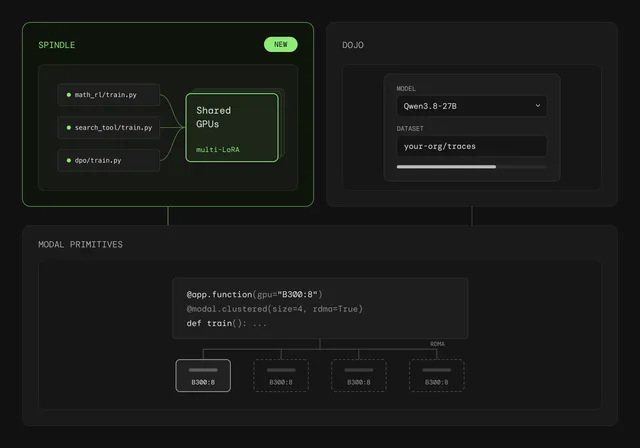
    Modal releases the open-source training server Spindle, which can run in your own Modal workspace, is compatible with the Tinker API, and bills by GPU time rather than tokens. Deployment only requires running spindle deploy, and it supports full-parameter training and multiple LoRAs, covering a variety of open-source models. In the official comparison, a single-round DAPO-math task with 8-card H200 training, 8-card H200 inference, and 8 clients sharing costs $1.99 per million output tokens, 80% lower than Tinker.

    The Modal post-training stack: Modal Dojo for hands-off training, Spindle for writing your own loop, and Modal primitives for full control

    #Product updates#Open-source ecosystem#English text is being prepared.