English translation is being prepared.
Matched fieldsSummary
Matched fieldsSummary
Matched fieldsSummary

Matched fieldsSummary
Bria AI's Bria Fibo 2.0 has launched on the fal platform. The model ranks first among open-weight image editing models on Artificial Analysis and supports both text-to-image and targeted editing. It can accept up to four input images, supports background replacement, product repositioning, and lighting adjustments, and can handle reasoning-intensive prompts; the model was trained solely on licensed data, with clear commercial rights.
Matched fieldsSummary、Body

Matched fieldsSummary
The Stanford course CME 295 Transformers & Large Language Models has been updated to Lecture 4, Reinforcement learning with LLMs, and both the video and lecture notes are now public. This lecture goes from RL and Reward Design to PPO, GRPO, RLVR, and DAPO, explaining the notation in each one by one. The course is taught by Afshine and Shervine Amidi, with 9 lectures in total, covering Transformer architecture, attention variants, RoPE, LoRA fine-tuning, RLHF/GRPO training, Flash Attention inference optimization, MCP and AI Agents, and diffusion language models.
The Stanford course CME 295 Transformers & Large Language Models has been updated to Lecture 4, Reinforcement learning with LLMs, and both the video and lecture notes are now public. This lecture goes from RL and Reward Design to PPO, GRPO, RLVR, and DAPO, explaining the notation in each one by one. The course is taught by Afshine and Shervine Amidi, with 9 lectures in total, covering Transformer architecture, attention variants, RoPE, LoRA fine-tuning, RLHF/GRPO training, Flash Attention infere
Matched fieldsSummary
According to The Information, Anthropic has an unreleased model that can infer user goals from sparse instructions. The model outperforms Anthropic's current models in reasoning and intuitive judgment, including in cases where users have never explicitly stated their needs.
Matched fieldsSummary、Body
Matched fieldsSummary、Body
Matched fieldsSummary、Body
An AI English writing agent is implemented through the collaboration of a multi-agent pipeline, and can be split into agents for outline and idea generation, grammar and spelling, discourse logic, style polishing, and evaluation and scoring, built on LangGraph or PydanticAI. The recommended tech stack is Python (FastAPI) paired with PydanticAI, LangGraph, and LlamaIndex; the main reasoning model can be DeepSeek-V3, Claude 3.5 Sonnet, or GPT-4o, with GPT-4o-mini and Qwen-Turbo for lightweight validation. The system also uses RAG to connect to authoritative corpora such as the Oxford and Longman dictionaries and the Academic Phrasebank, and sets up anti-hallucination and academic integrity guardrails.
An AI English writing agent is implemented through the collaboration of a multi-agent pipeline, and can be split into agents for outline and idea generation, grammar and spelling, discourse logic, style polishing, and evaluation and scoring, built on LangGraph or PydanticAI. The recommended tech stack is Python (FastAPI) paired with PydanticAI, LangGraph, and LlamaIndex; the main reasoning model can be DeepSeek-V3, Claude 3.5 Sonnet, or GPT-4o, with GPT-4o-mini and Qwen-Turbo for lightweight val
Matched fieldsSummary
Matched fieldsSummary、Body
Matched fieldsSummary、Body
Matched fieldsSummary
Matched fieldsSummary
NVIDIA has released Cosmos3-H-Dreams, specialized from the 16-billion-parameter Cosmos3-H-Embodied-Nano for action-conditioned video generation of cholecystectomy. The model is trained with 28 action dimensions, 832 x 480 video, and 10 Hz action alignment, and distillation yields two student checkpoints, four-step and two-step; the two-step version is trained separately, offering faster inference but lower image quality. NVIDIA also provides the FlashDreams streaming runtime and methods for adapting to custom data and controllers, and states that the model is a research simulator, not a validated clinical system.
NVIDIA has released Cosmos3-H-Dreams, specialized from the 16-billion-parameter Cosmos3-H-Embodied-Nano for action-conditioned video generation of cholecystectomy. The model is trained with 28 action dimensions, 832 x 480 video, and 10 Hz action alignment, and distillation yields two student checkpoints, four-step and two-step; the two-step version is trained separately, offering faster inference but lower image quality. NVIDIA also provides the FlashDreams streaming runtime and methods for adap
Matched fieldsSummary、Body
Matched fieldsSummary、Body
SF Compute is expanding from subleasing GPU clusters to building its own cloud operations capability, in order to achieve physical delivery of GPU contracts—buyers receive usable compute rather than cash settled against an index. CEO Evan Conrad believes that companies with large hardware or inference businesses find it difficult to operate a neutral exchange, and therefore NVIDIA cannot build this market itself. SF Compute makes compute tradable during technology iteration cycles by matching orders with different constraint conditions, and supports on-demand partitioning of InfiniBand network fabrics.
SF Compute is expanding from subleasing GPU clusters to building its own cloud operations capability, in order to achieve physical delivery of GPU contracts—buyers receive usable compute rather than cash settled against an index. CEO Evan Conrad believes that companies with large hardware or inference businesses find it difficult to operate a neutral exchange, and therefore NVIDIA cannot build this market itself. SF Compute makes compute tradable during technology iteration cycles by matching or
Matched fieldsSummary、Body
Matched fieldsSummary、Body
Matched fieldsSummary、Body
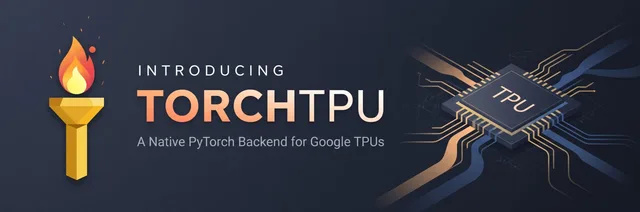
Google and Meta's PyTorch teams have collaborated to launch the open-source project TorchTPU, providing a native PyTorch backend for Google TPUs; migration only requires changing model.to("cuda") to model.to("tpu"). The project supports both eager and torch.compile modes, adds a new DeferAndFuse eager mode, covers about 450 Aten operators, and has been verified to run out of the box on 4,917 Hugging Face models, with a Tier 1 pass rate of 98% and Tier 2 numerical consistency relative to GPUs of 97%. According to the official announcement, it has already been used in the inference and training production workloads of some major Google Cloud customers, and is integrated with vLLM, SGLang, TorchTitan, Ray, and TorchRec.
Google and Meta's PyTorch teams have collaborated to launch the open-source project TorchTPU, providing a native PyTorch backend for Google TPUs; migration only requires changing model.to("cuda") to model.to("tpu"). The project supports both eager and torch.compile modes, adds a new DeferAndFuse eager mode, covers about 450 Aten operators, and has been verified to run out of the box on 4,917 Hugging Face models, with a Tier 1 pass rate of 98% and Tier 2 numerical consistency relative to GPUs of
Matched fieldsSummary、Body