←Search results

By relevance · Total 1206 results Clear search

Friday

  1. TMTPost · AGI

    Edge AI Daily Morning Brief: Google Releases Gemini 4 Carbon, Anthropic Files for $2 Trillion...

    Google DeepMind released the cybersecurity frontier model Gemini 4 Carbon on October 28, topping the Artificial Analysis Intelligence Index v5.0 with a composite score of 59, priced at $2 per million input tokens and $10 per million output tokens. Anthropic filed its S-1 prospectus with the SEC on October 26, planning to list on Nasdaq under the ticker ANT, with a target valuation of $1.5 trillion to $2 trillion and fundraising of up to $100 billion. In the same period, Microsoft disclosed for the first time that Azure quarterly revenue reached $33.2 billion, up 48% year-over-year.

    Google DeepMind released the cybersecurity frontier model Gemini 4 Carbon on October 28, topping the Artificial Analysis Intelligence Index v5.0 with a composite score of 59, priced at $2 per million input tokens and $10 per million output tokens. Anthropic filed its S-1 prospectus with the SEC on October 26, planning to list on Nasdaq under the ticker ANT, with a target valuation of $1.5 trillion to $2 trillion and fundraising of up to $100 billion. In the same period, Microsoft disclosed for t

    Matched fieldsBody

  2. Unite.AI

    OpenAI expands its misalignment monitoring system to cover training, evaluation, and external deployment

    On October 29, 2026, OpenAI announced an expanded multi-layer misalignment behavior monitoring system covering training, evaluation, and internal use, and, after modifications, extended to external deployment. The system monitors every reinforcement learning run and evaluation for models at least as capable as GPT-6 Astra, with a four-layer architecture that escalates step by step from activation probes to safety and alignment investigation agents. In independent red team testing conducted by METR and Redwood Research from July 21 to August 11, two client-controllable request headers that could disable the new agent monitoring were found, along with a compression event gap from May to July 2026 in which approximately 10% of eligible internal Codex traffic was not monitored.

    On October 29, 2026, OpenAI announced an expanded multi-layer misalignment behavior monitoring system covering training, evaluation, and internal use, and, after modifications, extended to external deployment. The system monitors every reinforcement learning run and evaluation for models at least as capable as GPT-6 Astra, with a four-layer architecture that escalates step by step from activation probes to safety and alignment investigation agents. In independent red team testing conducted by ME

    Matched fieldsBody

  3. English text is being prepared.

    OpenAI Updates Model Spec, Listing Loyalty to Human Intent as a Core Principle

    OpenAI has updated its Model Spec document, restructuring the framework into five principles: loyalty to human intent, reducing harm, honesty and transparency, safeguarding people's right to make their own choices, and prudence and diligence, with loyalty to human intent as the foundation of the entire framework. OpenAI says its current models cannot yet fully comply with the new version of the spec, and the team is researching new training methods to help models internalize these principles. This adjustment is similar to Anthropic's constitutional AI approach.

    OpenAI has updated its Model Spec document, restructuring the framework into five principles: loyalty to human intent, reducing harm, honesty and transparency, safeguarding people's right to make their own choices, and prudence and diligence, with loyalty to human intent as the foundation of the entire framework. OpenAI says its current models cannot yet fully comply with the new version of the spec, and the team is researching new training methods to help models internalize these principles. Th

    Matched fieldsBody

  4. Ant inclusionAI: New GitHub Repository

    Ant inclusionAI Open-Sources the UBTree Project Page: Using Unigram and…

    Ant inclusionAI has launched the UBTree project page on GitHub, introducing a speculative decoding method that uses Unigram and Bigram models for parallel tree drafting (arXiv:2609.39972). The page includes demo videos of Ling3 Tiny and Flash, comparing four methods—AR, DFlash, DSpark, and UBTree—under the same target model; the videos are 1440×760, 20 FPS, at 0.25× playback speed. The figures and table numbers are all driven by static/js/data.js.

    Matched fieldsBody

  5. Ant inclusionAI: New GitHub repository

    Ant inclusionAI Open-Sources the ZwZ Model Family and the ZoomBench Fine-Grained Perception Benchmark (ICML 2026)

    Ant inclusionAI has released the ZwZ model family (4/7/8B) accompanying its ICML 2026 paper, achieving SOTA on multimodal perception benchmarks among open-source models, while requiring only a single forward inference pass and no tool calls at inference time. The method is Region-to-Image Distillation (R2I), which distills high-quality VQA supervision generated from enlarged local regions back into the full image, with 37K training samples. It also introduces ZoomBench, containing 845 VQA items covering 6 fine-grained perception dimensions, on which Qwen2.5-VL-7B achieves only 42.5% average accuracy.

    gp_avg_comparison

    Ant inclusionAI has released the ZwZ model family (4/7/8B) accompanying its ICML 2026 paper, achieving SOTA on multimodal perception benchmarks among open-source models, while requiring only a single forward inference pass and no tool calls at inference time. The method is Region-to-Image Distillation (R2I), which distills high-quality VQA supervision generated from enlarged local regions back into the full image, with 37K training samples. It also introduces ZoomBench, containing 845 VQA items

    Matched fieldsBody

Wednesday

  1. Analytics India Magazine

    Ravi Vasantraj of Mphasis: Owning IP Itself Is Meaningless

    Ravi Vasantraj, Global Delivery Head at Mphasis, believes that models themselves are rapidly commoditizing and that owning IP itself is meaningless—what enterprises are really buying is outcomes delivered using AI. He revealed that AI-led work accounted for 63% of Mphasis's total new contract signings of $461 million in the June quarter, and that the share of AI-related business opportunities has risen from 12% to about 70%, but only 5% of AI sandbox projects have entered production environments, with the company currently seeing productivity gains of about 20%.

    Ravi Vasantraj, Global Delivery Head at Mphasis, believes that models themselves are rapidly commoditizing and that owning IP itself is meaningless—what enterprises are really buying is outcomes delivered using AI. He revealed that AI-led work accounted for 63% of Mphasis's total new contract signings of $461 million in the June quarter, and that the share of AI-related business opportunities has risen from 12% to about 70%, but only 5% of AI sandbox projects have entered production environments

    Matched fieldsBody

  2. Latent Space

    Anthropic Abolishes Coding Interviews: Felix Reiseberg Says "Hunger beats tenure"

    Anthropic hiring manager Felix Reiseberg announced that the company will no longer use traditional coding interviews to evaluate candidates, citing the fact that Claude is already stronger than humans at both React challenges and assembly problems, and that truly impactful builders do not win through such tests. He advises junior engineers to pick an idea that can drive business impact, build a working prototype over the weekend, focus on just one good idea, and leverage their fresh perspective on users. On the same day, Google DeepMind released the Genie 4 world model, and Claude Opus 5.5 (58 points) topped the Artificial Analysis Intelligence Index v5.

    Anthropic hiring manager Felix Reiseberg announced that the company will no longer use traditional coding interviews to evaluate candidates, citing the fact that Claude is already stronger than humans at both React challenges and assembly problems, and that truly impactful builders do not win through such tests. He advises junior engineers to pick an idea that can drive business impact, build a working prototype over the weekend, focus on just one good idea, and leverage their fresh perspective

    Matched fieldsBody

  3. Leiphone

    LimX Dynamics' Open-Source FluxVLA Engine Update Connects the Entire Embodied Intelligence Pipeline from Data and Training to Evaluation and Deployment

    LimX Dynamics' open-source embodied intelligence engineering foundation FluxVLA Engine completed a major update on October 22. The technical report shows that it has incorporated heterogeneous policies such as OpenVLA, π0.5, DiT4DiT, and GR00T into a single pipeline for data, training, evaluation, and deployment. On the NVIDIA AGX Orin 64GB, GR00T's inference frequency increased from 3.2Hz to 7.4Hz, and π0.5 from 1.4Hz to 4.4Hz; together with RTC and a three-step trajectory post-processing mechanism, it connects to real-robot execution. In terms of online RL, SmolVLA's success rate on LIBERO-10 rose from 66.2% to 76.2%, and on 10 tasks in RoboTwin Clean from 45.9% to 61.3%.

    LimX Dynamics' open-source embodied intelligence engineering foundation FluxVLA Engine completed a major update on October 22. The technical report shows that it has incorporated heterogeneous policies such as OpenVLA, π0.5, DiT4DiT, and GR00T into a single pipeline for data, training, evaluation, and deployment. On the NVIDIA AGX Orin 64GB, GR00T's inference frequency increased from 3.2Hz to 7.4Hz, and π0.5 from 1.4Hz to 4.4Hz; together with RTC and a three-step trajectory post-processing mecha

    Matched fieldsBody

Thursday

  1. a16z:News

    a16z Survey of 100 CISOs: How AI Is Rewriting the 2027 Security Agenda

    a16z's survey of 100 CISOs at companies with more than 1,000 employees shows that 87% expect cybersecurity spending to increase, driven mainly by AI-related threats and the expanded attack surface from enterprises' own AI deployments. All seven of the most-watched security initiatives for 2027 are AI-related; SOC automation received the most first-priority votes, but only 18% have put AI SOC tools into production. 45% plan to make new purchases or upgrades within 12 months for internal AI agent security, and 42% plan to procure offensive security capabilities.

    a16z's survey of 100 CISOs at companies with more than 1,000 employees shows that 87% expect cybersecurity spending to increase, driven mainly by AI-related threats and the expanded attack surface from enterprises' own AI deployments. All seven of the most-watched security initiatives for 2027 are AI-related; SOC automation received the most first-priority votes, but only 18% have put AI SOC tools into production. 45% plan to make new purchases or upgrades within 12 months for internal AI agent

    Matched fieldsBody

  2. PyTorch Blog

    PyTorch 2.15 Released: Rewritten NCCL Backend Becomes Default, Apple Silicon Gains FP8 Support

    The PyTorch Foundation has released PyTorch 2.15. All process groups using nccl now default to the rewritten NCCL backend, accompanied by a flight recorder that dumps on-site information when collective communication hangs, and can be reverted via TORCH_DIST_USE_NCCL2=0 or nccl-legacy. This version also adds float8_e4m3fn and _scaled_mm support for Apple Silicon, and the new grouped_mm improves MoE decoding throughput by 1.32–1.34x on M3 Ultra. The default wheel is upgraded to CUDA 13.2, while a CUDA 13.4 wheel is also provided with experimental support for NVIDIA Rubin GPUs; a ROCm 10.0 wheel is newly added, and Python 3.10 and macOS 14 are no longer supported.

    The PyTorch Foundation has released PyTorch 2.15. All process groups using nccl now default to the rewritten NCCL backend, accompanied by a flight recorder that dumps on-site information when collective communication hangs, and can be reverted via TORCH DIST USE NCCL2=0 or nccl-legacy. This version also adds float8 e4m3fn and scaled mm support for Apple Silicon, and the new grouped mm improves MoE decoding throughput by 1.32–1.34x on M3 Ultra. The default wheel is upgraded to CUDA 13.2, while a

    Matched fieldsBody

  3. Wired AI

    Mistral says its trillion-parameter open-source model Le Chonk surpasses Chinese models in coding and cybersecurity

    Mistral has released the official version of Le Chonk, a trillion-parameter open-weight model, calling it the world's best open-weight model in automated coding and cybersecurity, and making it freely available. Pierre Stock, Mistral's VP of Science, said the model was trained on increasingly difficult cybersecurity and coding problems, enabling it to match or surpass models from Chinese labs such as DeepSeek and Z.ai. Stock also stressed that the West needs its own advanced open-weight models, because closed models can be shut down remotely, whereas open weights cannot have access cut off once released.

    Mistral has released the official version of Le Chonk, a trillion-parameter open-weight model, calling it the world's best open-weight model in automated coding and cybersecurity, and making it freely available. Pierre Stock, Mistral's VP of Science, said the model was trained on increasingly difficult cybersecurity and coding problems, enabling it to match or surpass models from Chinese labs such as DeepSeek and Z.ai. Stock also stressed that the West needs its own advanced open-weight models,

    Matched fieldsBody

  4. Wired AI

    AI Drives a Wave of Formal Verification Startups as &Truth Raises $70 Million

    WIRED reports that generative AI is pushing formal verification toward commercialization. &Truth has raised $70 million and launched publicly, while Harmonic has raised a cumulative $295 million, and its math AI agent Aristotle supports verification of C code and Verilog hardware designs. Stanford researcher Chuyue Sun used AI tools to complete an engineering project in less than half a day at a cost of under $500, whereas three experts working by hand took five months to complete the same work. The report also notes that the technology is still at the prototype stage, that customers' willingness to pay and adoption methods remain unclear, and that Antithesis's Will Wilson calls formal verification a "trap" that can only provide partial guarantees.

    WIRED reports that generative AI is pushing formal verification toward commercialization. &Truth has raised $70 million and launched publicly, while Harmonic has raised a cumulative $295 million, and its math AI agent Aristotle supports verification of C code and Verilog hardware designs. Stanford researcher Chuyue Sun used AI tools to complete an engineering project in less than half a day at a cost of under $500, whereas three experts working by hand took five months to complete the same work.

    Matched fieldsBody

  5. Latent SpaceSelected

    Google DeepMind releases Gemini 4 Carbon, topping Artificial…

    Google DeepMind has released Gemini 4 Carbon, which ranks first on the Artificial Analysis Intelligence Index v5 with a score of 59 and leads in 4 of 9 evaluations including HLE-Diamond and TB-Science. The model focuses on cybersecurity and long-horizon tasks, claiming 88.2% on SEC-bench Pro, 54.8% on ExploitGym, and 71.0% on CWE-bench, and is initially available only to trusted cybersecurity personnel through the Fairwind Program. In terms of specifications, it supports a 1M token context and 1M maximum output, with input covering text, images, video, and speech, and output in text; Artificial Analysis lists a standard price of $4/$20 per million input/output tokens, plus a 50% launch discount.

    Google DeepMind has released Gemini 4 Carbon, which ranks first on the Artificial Analysis Intelligence Index v5 with a score of 59 and leads in 4 of 9 evaluations including HLE-Diamond and TB-Science. The model focuses on cybersecurity and long-horizon tasks, claiming 88.2% on SEC-bench Pro, 54.8% on ExploitGym, and 71.0% on CWE-bench, and is initially available only to trusted cybersecurity personnel through the Fairwind Program. In terms of specifications, it supports a 1M token context and 1

    Matched fieldsBody

  6. Baseten Engineering Blog

    Baseten Optimizes Qwen3-ASR Batch Transcription, Boosting Single-GPU Throughput by 7x

    The Baseten engineering team, through native audio decoding, KV cache FP8 quantization, and reduced host-device synchronization, increased batch transcription throughput for Qwen3-ASR 1.7B on a single RTX PRO 6000 by 7x and reduced latency by 6.9x. After optimization, the transcription cost for one hour of audio is approximately $0.0013, i.e., 1/10 of a cent per audio hour, with no significant change in word error rate. The optimized version has been made the default deployment in the Baseten Model Library and can be called through an OpenAI-compatible transcription client.

    How Baseten gets 7x throughput on Qwen3-ASR batch transcription

    The Baseten engineering team, through native audio decoding, KV cache FP8 quantization, and reduced host-device synchronization, increased batch transcription throughput for Qwen3-ASR 1.7B on a single RTX PRO 6000 by 7x and reduced latency by 6.9x. After optimization, the transcription cost for one hour of audio is approximately $0.0013, i.e., 1/10 of a cent per audio hour, with no significant change in word error rate. The optimized version has been made the default deployment in the Baseten Mo

    Matched fieldsBody

  7. MIT Tech Review

    Partnership on AI research: Agent frameworks generally lack observability records

    Madhulika Srikumar and Claire Leibowicz of Partnership on AI write that current agent frameworks cannot reliably generate the key observability records needed for safe deployment. Together with colleagues from academia, civil society, and industry, the authors studied the four most widely used agent frameworks and found that signals such as persistent Agent IDs and human approval records are missing, making it difficult to determine which agent did what and whether it exceeded its authority. The article recommends using OpenTelemetry to fill in the records of "what happened," and calls on framework developers, enterprises adopting agents, and regulators to each bear their respective responsibilities.

    Madhulika Srikumar and Claire Leibowicz of Partnership on AI write that current agent frameworks cannot reliably generate the key observability records needed for safe deployment. Together with colleagues from academia, civil society, and industry, the authors studied the four most widely used agent frameworks and found that signals such as persistent Agent IDs and human approval records are missing, making it difficult to determine which agent did what and whether it exceeded its authority. The

    Matched fieldsBody

  8. Mistral AISelected

    Mistral Releases Open Weights for Mistral Large 4 (Le Chonk)

    Mistral has released the open weights for Mistral Large 4 (Le Chonk), a 1-trillion-parameter natively multimodal model that continues reinforcement learning on top of the preview version, with improved coding and defensive cybersecurity capabilities. It scores 19.7% on FrontierCode 2.0 and 48% on the Artificial Analysis Coding Agent Index, roughly on par with GLM-5.3, but uses an average of 47% fewer tokens per task; on Terminal-Bench 4.0 it improves by 13 percentage points to 41%. The model supports three reasoning modes, uses a modified MIT-based Mistral Ecosystem Open-Weight license, and is priced via API at $0.70 per million input tokens, $0.07 for cached input, and $2.10 for output.

    Le Chonk signal

    Mistral has released the open weights for Mistral Large 4 (Le Chonk), a 1-trillion-parameter natively multimodal model that continues reinforcement learning on top of the preview version, with improved coding and defensive cybersecurity capabilities. It scores 19.7% on FrontierCode 2.0 and 48% on the Artificial Analysis Coding Agent Index, roughly on par with GLM-5.3, but uses an average of 47% fewer tokens per task; on Terminal-Bench 4.0 it improves by 13 percentage points to 41%. The model sup

    Matched fieldsBody

  9. AWS Machine Learning

    Distributed Training on EKS with Ray Train DLC and EFA

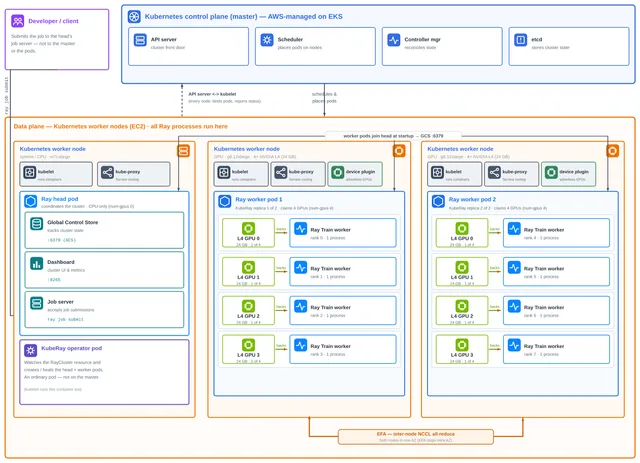
    AWS has released the Ray Train DLC image ray:train-ml-cuda-v1.1, which comes pre-integrated with Ray 2.58.0, PyTorch 2.13.0, CUDA 13.0.2, NCCL 2.29.7, and EFA along with the AWS OFI NCCL plugin, enabling distributed training on EKS without the need to build images yourself. The example uses PyTorch FSDP to fine-tune Qwen2.5-1.5B on 8 NVIDIA L4 GPUs across two g6.12xlarge instances, with cross-node communication going directly over EFA. The image is publicly hosted on Amazon ECR Public, so nodes can pull it without credentials.

    EKS cluster with a CPU system node running KubeRay and the Ray head, and two EFA-enabled g6.12xlarge GPU worker nodes in one Availability Zone

    AWS has released the Ray Train DLC image ray:train-ml-cuda-v1.1, which comes pre-integrated with Ray 2.58.0, PyTorch 2.13.0, CUDA 13.0.2, NCCL 2.29.7, and EFA along with the AWS OFI NCCL plugin, enabling distributed training on EKS without the need to build images yourself. The example uses PyTorch FSDP to fine-tune Qwen2.5-1.5B on 8 NVIDIA L4 GPUs across two g6.12xlarge instances, with cross-node communication going directly over EFA. The image is publicly hosted on Amazon ECR Public, so nodes

    Matched fieldsBody

  10. MarkTechPost

    NVIDIA Releases Nemotron 3.5 Transcribe: An Open-Source 30B MoE Speech Model…

    NVIDIA has released Nemotron 3.5 Transcribe, an open-weight large speech model that supports 40 languages and up to 1 hour of audio per pass, and can select output formats such as verbatim, written, speaker-labeled, contextual, and translation via text instructions. The model has approximately 34B total parameters and about 4.3B activated parameters, adopts a hybrid Mamba-Transformer MoE architecture, can run in BF16 on a single H100 80GB, and the NVFP4 version at about 21GB can run on an RTX 5090. NVIDIA self-reports an average WER of 4.71% across 9 public English Open ASR test sets, the best result among open-weight models, though commercial APIs still lead; its shortcomings are that it only supports offline operation, and the Chinese far-field meeting cpCER is 34.95%.

    NVIDIA has released Nemotron 3.5 Transcribe, an open-weight large speech model that supports 40 languages and up to 1 hour of audio per pass, and can select output formats such as verbatim, written, speaker-labeled, contextual, and translation via text instructions. The model has approximately 34B total parameters and about 4.3B activated parameters, adopts a hybrid Mamba-Transformer MoE architecture, can run in BF16 on a single H100 80GB, and the NVFP4 version at about 21GB can run on an RTX 50

    Matched fieldsBody

  11. MarkTechPost

    Block Releases Dessa, a Fully Duplex Speech Model Trained Purely on Speech

    Block's AI research lab has released Dessa, a full-duplex speech model, opening a waitlist in the form of a research preview. It is trained only on human voice conversation audio, without using text or pretrained models. The model can run locally on a MacBook Pro M4 Max or higher configuration, faster than real time; training used one NVIDIA GB200 NVL72 (72 GPUs). No benchmark scores, parameter count, weights, paper, or API have been published so far.

    Matched fieldsBody

Tuesday

  1. Artificial Analysis full article

    Artificial Analysis releases Intelligence Index v5, with 60% of evaluations switched to private datasets

    Artificial Analysis releases Intelligence Index v5, adding two new benchmarks, FrontierCode 2.0 and Terminal-Bench-Science, upgrading HLE-Diamond, AA-Omniscience v1.1, and CritPt v2, with 60% of evaluations based on private test sets or held-out answers. Claude Opus 5.5 (max) ranks first with 58 points, followed closely by GPT-6 Astra (max) at 57 points and GPT-6.1 Sol (max) at 55 points, with Gemini 4 Argon (high) at 50 points. The gap between open-weight models and the leaders has widened from 3 points to 12 points; the released-weight DeepSeek V4.1 Flash 1017 (max) and GLM-5.3 (max) both score 32 points. The per-task cost of leading models differs by more than 13 times: GPT-6.1 Terra (max) is $0.96, while Claude Fable 5.1 (max) is $13.04. A Progress Index v1 was also released, placing models released since November 2022 on the same capability scale for comparison.

    Artificial Analysis releases Intelligence Index v5, adding two new benchmarks, FrontierCode 2.0 and Terminal-Bench-Science, upgrading HLE-Diamond, AA-Omniscience v1.1, and CritPt v2, with 60% of evaluations based on private test sets or held-out answers. Claude Opus 5.5 (max) ranks first with 58 points, followed closely by GPT-6 Astra (max) at 57 points and GPT-6.1 Sol (max) at 55 points, with Gemini 4 Argon (high) at 50 points. The gap between open-weight models and the leaders has widened from

    Matched fieldsBody